Table of Contents
Understanding Elvenar’s Building Ecosystem
Elvenar’s building system forms the backbone of your entire gameplay experience. Every structure you place—from humble residences to magnificent Ancient Wonders—contributes to a complex economic and strategic web that determines your success. Unlike simple city builders where aesthetics dominate, Elvenar demands that every building serve a functional purpose, optimized for space efficiency and resource generation.
The game presents you with two distinct architectural paths: Elves with their organic, nature-inspired circular buildings, and Humans with their rectangular, medieval industrial structures. While both races share identical underlying mechanics, their building shapes fundamentally impact your city layout strategies. Elven buildings typically occupy smaller footprints but have awkward dimensions, while Human buildings offer more predictable rectangular shapes that can be easier to organize in grids.
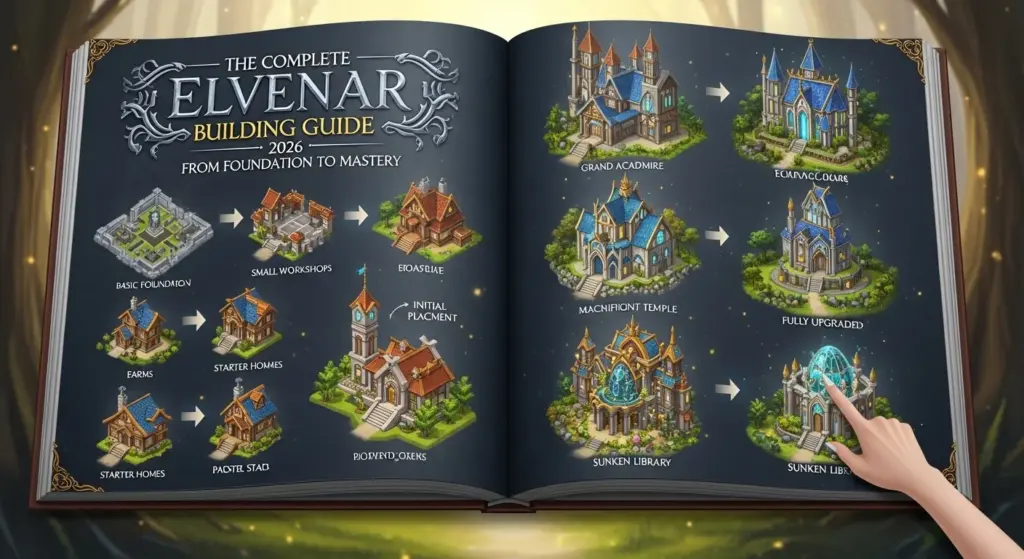
Core Building Categories: The Four Pillars
Residential Buildings: Your Population Engine
Residences represent the most fundamental building type in Elvenar. They provide three critical resources: population (which enables all other construction), coins (the primary currency for basic transactions), and culture (which boosts production efficiency). The key to residence management lies in balancing quantity with upgrade levels.
New players often make the mistake of building too many low-level residences rather than upgrading existing ones. A level 15 residence generates exponentially more population and coins than three level 5 residences, while occupying significantly less space when considering road requirements and culture needs. Prioritize upgrading all residences to maximum available level before expanding your residential district.
Strategic placement matters enormously. Residences should cluster together near your Main Hall to minimize road connections, and they benefit enormously from adjacent culture buildings. The “Enthusiastic” culture level (130% of required culture) provides substantial production bonuses, making culture investment adjacent to residences highly profitable.
Workshops: The Supply Lifeline
Workshops produce Supplies—the second primary resource alongside Coins. Supplies fuel building upgrades, unit training, research, and virtually every advanced game action. Like residences, workshops reward concentration over dispersion. A common early-game target is approximately 10 workshops, though this number decreases dramatically as you acquire Ancient Wonders and Magic Buildings.
Workshop production runs on variable timers: 5-minute emergency production, 1-hour active play sessions, 3-hour medium duration, and 9-hour overnight production. Match these timers to your real-life schedule. There’s no benefit to setting 9-hour productions if you log in every hour; conversely, 1-hour productions waste potential while you sleep.
Manufactories: Goods Production Hierarchy
Manufactories produce the nine goods types essential for trading, research, and tournament participation. These divide into three tiers: Tier 1 (Marble, Steel, Planks), Tier 2 (Scrolls, Crystal, Silk), and Tier 3 (Elixir, Magic Dust, Gems). Crucially, each player receives three “boosted” goods—one per tier—indicated by relics surrounding their city. These boosted goods produce at 400% efficiency, making specialization essential.
Building ratios depend heavily on your playstyle, but general guidelines suggest approximately 5 Tier 1, 3 Tier 2, and 3 Tier 3 manufactories for balanced play. However, if you join an active fellowship with robust trading, you can focus exclusively on your three boosted goods and trade for everything else, reducing manufactory count by half.
Manufactories expand significantly as they upgrade. A Human level 19 Marble manufactory occupies 5×3 squares, while an Elven level 19 Planks manufactory occupies 5×2. These dimensional differences impact your layout planning substantially.
Culture Buildings: The Invisible Multiplier
Culture buildings provide no direct resources but boost the production of everything else. Maintaining “Enthusiastic” culture (130% of required) increases Coin and Supply production by 20%, making culture investment incredibly profitable. However, culture buildings occupy precious space, creating a constant optimization puzzle.
The efficiency metric is culture per square. Early culture buildings like Temples of Holy Fire provide 96 culture per square (2400 culture from 5×5), while later options like Garden of Harmony provide only 70 per square. Regularly replace obsolete culture buildings with newer models—this “culture creep” frees substantial space over time.
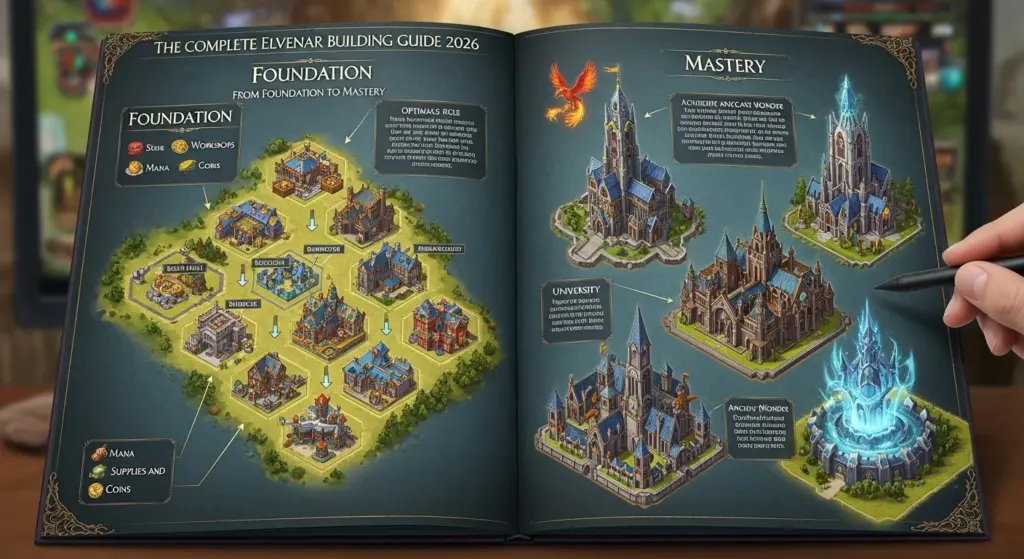
Space Optimization: The Ten Golden Rules
Veteran players have codified essential principles for maximizing limited space:
- Corner your Main Hall: Place it in a corner with no more than two connecting roads. Its awkward bulk dictates your entire layout if centered .
- Edge culture placement: Position culture buildings and your Builder’s Hut along outside edges—they don’t require road access .
- Upgrade roads immediately: Higher-tier roads provide culture bonuses, effectively creating “free” culture without space cost .
- Dual-purpose roads: Every road segment should touch at least two buildings. Single-building roads waste space .
- Avoid edge roads: Roads touching only one building at your city’s perimeter represent wasted potential .
- Exploit road ends: Place small culture ornaments at road terminations—these “wasted” spaces become productive .
- Maintain square shape: Oblong cities or irregular shapes create inefficient perimeter-to-area ratios .
- Short-side road contact: Orient rectangular buildings so their shorter dimension touches roads, minimizing required road tiles .
- Group by function: Cluster similar buildings for easier management and collection .
- Plan for growth: Buildings expand at levels 5-6 and beyond—leave expansion room .
Following these rules can free 15-20% more space for production buildings, directly accelerating your progression.
Ancient Wonders: Permanent Powerhouses
Ancient Wonders unlock in Chapter 4 and represent permanent, upgradeable bonuses that never become obsolete. Unlike regular buildings, their footprint remains constant as they level, making them incredibly space-efficient at high levels.
Essential Early Wonders:
- Golden Abyss: Provides population and coins. Despite appearing inefficient early (underperforming standard residences until Chapter 5), at maximum level it provides an 18% population discount across your entire city. This is universally recommended as your first wonder .
- Mountain Halls: Another 18% population discount plus goods production bonuses. Pairs perfectly with Golden Abyss to create economic dominance .
- Sanctuary (Elves) / Martial Monastery (Humans): The most powerful combat wonder, providing health bonuses to all units. Expensive to upgrade but essential for fighters .
- Needles of the Tempest: Accelerates barracks training and boosts Light Ranged units—critical for tournament performance .
Upgrade Strategy: Concentrate all Knowledge Points on one wonder until it reaches maximum level (31), then move to the next. A level 31 wonder provides exponentially more value than multiple low-level wonders. Never spread resources thin.
Magic Buildings: Premium Efficiency
Magic Residences and Magic Workshops represent the pinnacle of building efficiency, won primarily through Spire of Eternity participation. A Magic Workshop produces as many supplies as 9 standard workshops while requiring only 2 residences worth of population. This space efficiency transforms late-game city planning.
Top players often run cities with only 2-4 Magic Workshops rather than 10+ standard ones, freeing enormous space for other buildings. Similarly, Magic Residences allow drastic reduction in residential footprint. The Spire’s Laboratory (first boss) drops Magic Residences; the High Halls (second boss) drops Magic Workshops—making Spire participation essential for advanced city building.
Guest Race Settlements: Temporary Expansion
From Chapter 6 onward, guest races (Dwarves, Fairies, Orcs, etc.) occupy your city temporarily. These settlements require massive space—often 20-30% of your grid—and feature unique mechanics.
Settlement Strategy:
- Clear substantial space before unlocking the portal
- Place portals centrally to minimize road connections to settlement buildings
- Portal tracks connect settlement buildings to the portal (not to your main road system)
- Upgrade portal first, then production buildings, to maximize output
Production timers vary by building level—higher levels offer longer production windows (better for sleep schedules) and increased output. Balance upgrade timing with your chapter progression needs.
Evolving Buildings: Event Rewards
Events provide evolving buildings that improve through artifact collection. These permanent structures offer unique bonuses—some provide combat advantages, others economic boosts, and many provide hybrid benefits. The Fire Phoenix and Brown Bear stand as the most powerful fighting buildings, while the Polar Bear reduces tournament cooldowns.
Collection Strategy: Craft base plates from the Magic Academy when offered, but don’t place them until you have sufficient artifacts for meaningful evolution. A single fully-evolved building outperforms multiple level-1 buildings occupying the same space. Concentrated power on minimal footprint should guide your decisions.
Building Upgrades: Timing and Priorities
The upgrade sequence significantly impacts your progression speed:
- Residences and Workshops first: These economic foundations enable everything else
- Boosted manufactories next: Maximize your 400% production advantage
- Main Hall when storage-limited: Upgrade when you consistently hit capacity caps
- Barracks and Armories as needed: Match military infrastructure to your fighting frequency
- Ancient Wonders continuously: Never stop investing Knowledge Points
Avoid the trap of “saving” upgrades for later chapters. Buildings upgraded earlier provide compounding benefits over longer periods. A manufactory upgraded in Chapter 6 generates more total goods by Chapter 10 than one upgraded at Chapter 9, even if both reach the same level.
Common Building Mistakes
Overbuilding Armories: These population-heavy structures drain your workforce. Use Shrines/Bulwarks Ancient Wonders for training queue capacity instead.
Neglecting Culture: Low culture reduces all production by 20% or more—far more expensive than the culture buildings required to fix it.
Premature Expansion: Unlocking map expansions before optimizing existing space spreads your city thin and increases collection time.
Cross-Tier Manufacturing: Building non-boosted goods manufactories wastes space. Trade for these instead, unless your fellowship completely lacks traders.
Static Layouts: Failing to rearrange as building sizes change creates road inefficiencies. Rebuild your city layout every few chapters.
Conclusion: Building for the Long Term
Elvenar city building rewards patience and planning over quick fixes. Every building decision compounds over months and years of gameplay. The most successful players approach their cities as evolving puzzles—constantly optimizing, upgrading, and adapting to new chapters and mechanics.
Master the fundamentals: maximize space efficiency through smart layout, prioritize economic buildings, invest heavily in Ancient Wonders, and specialize in boosted goods. As you advance, incorporate Magic Buildings and evolving buildings to achieve incredible density and power. Your city is your legacy in Elvenar—build it wisely.
Advanced Building Optimization Strategies
As your city grows, building placement becomes more important than simply constructing new structures. Efficient city management requires balancing production, population, culture, and available space. Players who regularly evaluate their layouts often experience smoother progression and better resource generation. Instead of expanding without a plan, consider how each structure contributes to your long-term goals. A well-organized city can support faster research, stronger military development, and more effective resource management.
Understanding Building Efficiency
Every building occupies valuable space, making efficiency one of the most important concepts in city development. Before placing a new structure, compare its benefits to the space it requires. Some buildings provide excellent returns during the early stages of the game but become less effective as your city advances through higher ages. Periodically reviewing older structures allows players to replace outdated buildings with more efficient alternatives.
Efficiency is not only about production numbers. It also involves road connections, accessibility, and the relationship between different building types. Cities designed with efficiency in mind often require fewer rearrangements and support sustainable growth over time.
Balancing Residential and Production Areas
Many players struggle with maintaining the right balance between residential and production districts. Too many residences can create an abundance of population without enough resources to support growth. On the other hand, focusing exclusively on production can leave the city short of workers and limit future expansion opportunities.
Creating dedicated sections for residences and production structures helps maintain organization. Grouping similar buildings together also makes future upgrades easier. As your city evolves, regularly reassess whether your current balance supports your strategic objectives.
Maximizing Expansion Space
Expansion space is one of the most valuable assets available to players. Every unlocked area represents an opportunity to improve city performance. However, careless placement can quickly lead to inefficient layouts and wasted land.
Before using a newly unlocked expansion, consider how future buildings might fit into the available area. Leaving room for larger structures can prevent major redesigns later. Planning several expansions ahead helps create a flexible city capable of adapting to changing requirements.
Event Buildings and Their Strategic Value
Event buildings often provide unique bonuses that standard structures cannot match. These bonuses may include increased resource production, population growth, culture generation, or special rewards. Because event buildings are frequently more efficient than regular alternatives, they can significantly improve overall city performance.
Players should carefully evaluate event rewards and determine which structures offer the greatest long-term benefits. Prioritizing high-value event buildings can strengthen the city while reducing dependence on traditional buildings.
Managing Roads Effectively
Road systems are often overlooked despite their significant impact on city organization. Poorly planned roads consume valuable space and create obstacles when expanding or rearranging structures. Efficient road networks connect buildings while minimizing unnecessary tiles.
Straight road layouts generally provide better space utilization than complicated patterns. Maintaining a simple transportation network allows for easier upgrades and future modifications. Periodically reviewing road placement can reveal opportunities to reclaim additional building space.
Adapting to New Technologies
Research advancements frequently unlock new buildings and production opportunities. As technologies become available, city layouts should evolve accordingly. Structures that were highly effective during earlier stages may no longer represent the best use of available space.
Successful players remain flexible and willing to redesign portions of their cities when necessary. Adapting to technological progress ensures that the city continues operating at peak efficiency throughout every stage of development.
Cultural Building Integration
Culture plays an important role in maintaining city productivity. Without sufficient culture, many structures operate below their full potential. Integrating cultural buildings into the city layout requires careful planning to maximize benefits while minimizing space consumption.
Instead of placing cultural structures randomly, consider positioning them in areas where they complement surrounding buildings. Strategic integration can improve overall efficiency without sacrificing valuable production capacity.
Long-Term Upgrade Planning
Upgrades require significant investments of resources and time. Developing a long-term upgrade strategy helps prevent wasted resources and ensures steady progression. Rather than upgrading buildings at random, prioritize structures that provide the greatest immediate and future benefits.
Creating an upgrade roadmap allows players to allocate resources more effectively. This approach supports consistent growth while minimizing periods of stagnation. Long-term planning is particularly important during later stages when upgrades become increasingly expensive.
Seasonal Events and City Development
Seasonal events introduce opportunities to acquire exclusive buildings and rewards. These events can dramatically influence city development strategies. Participating actively in events often provides access to structures that outperform standard alternatives.
Preparing for upcoming events by saving resources and planning available space can maximize rewards. Players who incorporate event planning into their overall strategy frequently gain a competitive advantage over those who ignore these opportunities.
Resource Storage Considerations
Efficient cities require sufficient storage capacity to support production and expansion activities. Running out of storage space can limit growth and reduce overall efficiency. Balancing storage buildings with production facilities helps maintain a steady flow of resources.
Monitoring storage levels regularly allows players to anticipate future needs and make adjustments before shortages occur. Proper storage management contributes to smoother city development and reduces unnecessary bottlenecks.
Preparing for Future Growth
The most successful cities are designed with future expansion in mind. Instead of focusing exclusively on immediate needs, consider how the city may evolve over the coming months. Planning for future technologies, event rewards, and expansion opportunities creates a more adaptable and resilient layout.
Cities that embrace long-term thinking are better positioned to handle new challenges and opportunities. By maintaining flexibility and continuously optimizing building placement, players can support steady growth and achieve lasting success throughout every stage of the game.
Final Thoughts
Mastering city development requires more than simply constructing buildings. Success comes from careful planning, efficient space utilization, strategic upgrades, and continuous adaptation to new opportunities. Players who focus on optimization, organization, and long-term growth can create thriving cities capable of supporting every aspect of gameplay. By applying these advanced strategies, you can improve efficiency, maximize productivity, and prepare your city for future expansion and success.