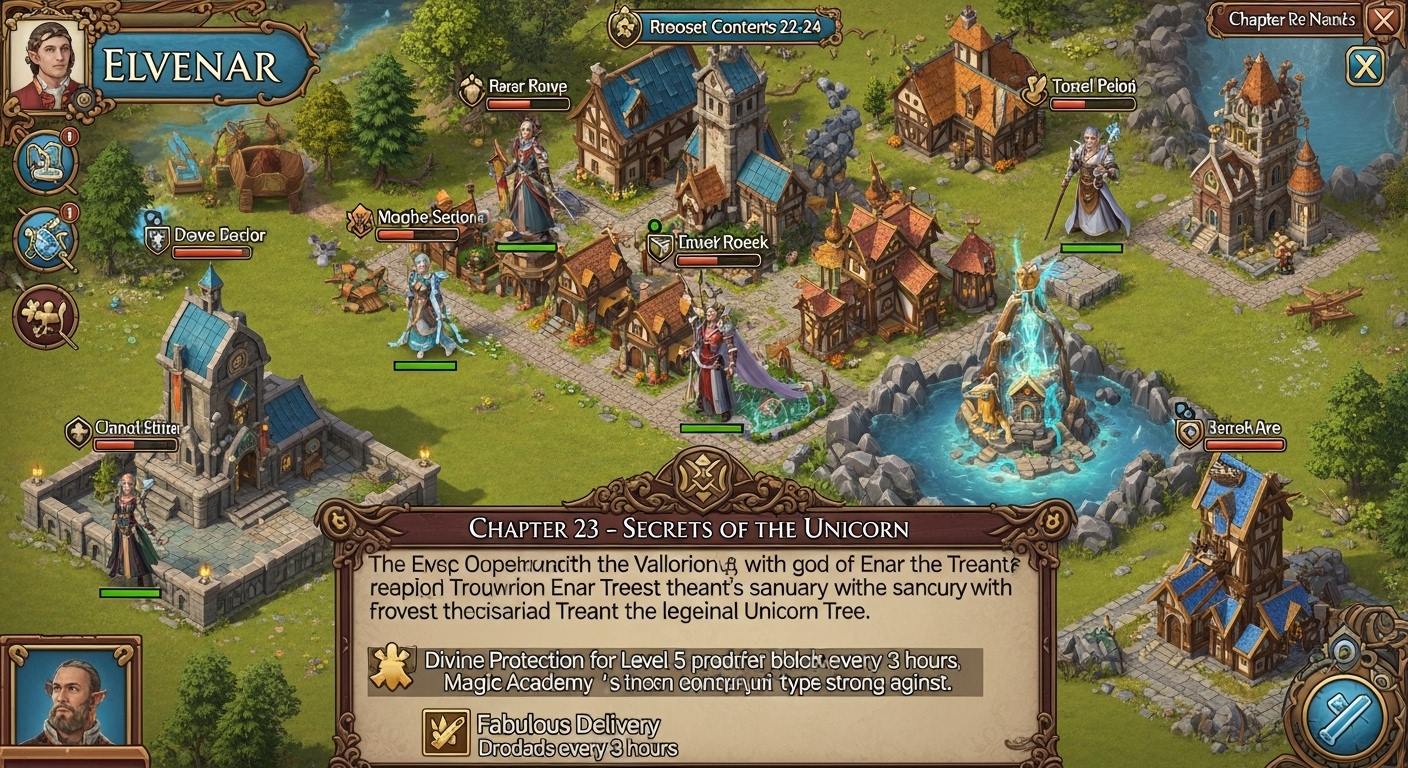
Introduction: The Foundation of Your Empire
In Elvenar, resources are the lifeblood of your civilization. Every building constructed, every technology researched, and every army trained depends on your ability to generate and manage resources efficiently. Whether you’re a new player establishing your first settlement or a veteran optimizing a sprawling metropolis, understanding the intricacies of Elvenar’s economy is essential for success. This comprehensive guide explores every resource type, production strategy, and optimization technique to transform your city into an economic powerhouse
.
Core Resources: Coins and Supplies
Coins: The Primary Currency
Coins serve as Elvenar’s primary currency, generated primarily through Residences via taxation. These structures provide both housing for your population and steady Coin income. Strategic placement near Cultural Buildings boosts their productivity significantly, creating synergy between city aesthetics and economic output
.
Advanced Coin Generation Strategies:
Beyond basic taxation, multiple avenues exist for Coin acquisition. Visiting other players’ cities and offering “neighborly help” generates bonus Coins without resource expenditure—simply click their buildings to motivate them
. Completing encounter negotiations on the world map provides substantial Coin rewards, while storyline quests offer generous payouts that accelerate early-game progression
.
The Main Hall determines your maximum Coin storage capacity. Regular upgrades prevent hitting caps that halt production, ensuring continuous economic growth. Experienced players recommend maintaining Coin reserves above 50% capacity to handle sudden expenses like technology research or building upgrades
.
Supplies: The Production Engine
Supplies represent your secondary critical resource, produced in Workshops and consumed for virtually every city action—building upgrades, troop training, and goods manufacturing. Unlike Coins, Supplies require active production management rather than passive generation
.
Production Cycle Optimization:
Workshops offer multiple production cycles: 5 minutes, 15 minutes, 1 hour, 3 hours, 9 hours, and 1 day. Shorter cycles always yield better efficiency than longer ones; two 3-hour orders outproduce one 9-hour order in the same timeframe
. Match your selection to your play schedule:
- Active players: 5-15 minute cycles for maximum yield
- Regular check-ins: 1-hour cycles balanced with life schedules
- Overnight/extended absence: 9-hour or 1-day cycles
For endgame efficiency, maintain minimum 8 Workshops set to 1-hour cycles. This configuration optimally completes recurring quests while maintaining steady Supply flow
. With a maxed Prosperity Towers Ancient Wonder and Power of Provision spells, 2 Magical Workshops can replace 9 normal ones, saving enormous space while maintaining production
.
Manufactured Goods: Tiered Production System
Tier 1: Basic Goods (Marble, Steel, Planks)
Your economic foundation rests on three Standard Goods: Marble, Steel, and Planks. Check your Main Hall to identify your production-boosted good—one of these three receives significant bonuses from collected relics
. This boost percentage, visible in your Main Hall, determines your specialization strategy.
The Boosted Goods Strategy:
Focus manufacturing exclusively on your boosted good and trade for others rather than building diverse factories. One boosted manufactory often outproduces three unboosted alternatives
. This specialization creates massive efficiency advantages, particularly when supported by an active Fellowship for trading.
Collect Relics by exploring provinces on the world map—each set of 6 matching relics increases your boost percentage for that good type
. Prioritize provinces containing relics matching your boosted good to maximize production efficiency.
Tier 2: Crafted Goods (Scrolls, Crystal, Silk)
As you advance to Chapter 2, you unlock Crafted Goods: Scrolls, Crystal, and Silk. These require upgraded manufactories and increased population but provide essential resources for mid-game progression. The same boosted goods principle applies—identify your boosted Crafted Good and specialize accordingly
.
Tier 3: Magical Goods (Elixir, Magic Dust, Gems)
Late-game chapters introduce Magical Goods: Elixir, Magic Dust, and Gems. These represent the pinnacle of manufacturing complexity, requiring significant space and population investment. Due to increasing production costs between tiers, building non-boosted Magical manufactories is far more inefficient than non-boosted Basic factories—making specialization absolutely critical
.
Knowledge Points: The Progression Currency
Knowledge Points (KP) fuel your research through the technology tree, regenerating at one per hour (maximum 10 stored). Never let your KP bar fill completely—wasted regeneration stalls advancement
.
Instant KP Generation:
The ultimate solution for rapid progression: scout nearby provinces and solve encounters. Each completed encounter awards 1 KP instantly plus valuable relics, bypassing the hourly limit entirely
. This technique transforms the world map from passive scenery into an active KP farm. Scout continuously as long as you have sufficient Coins and Supplies, turning exploration into accelerated research.
Balance your KP spending between short-term technologies (rapid chapter progression) and long-term Ancient Wonders (permanent city bonuses). Most successful players allocate daily KP between both priorities, adjusting based on current needs
.
Advanced Resources and Special Currencies
Relics: The Multiplier Resource
Relics enhance workshop efficiency significantly, providing production bonuses that accelerate your entire economy. Each set of 6 matching relics increases boost percentages for corresponding goods
. Beyond production benefits, relics are required for certain constructions and Ancient Wonders, making province exploration doubly valuable.
Ancient Wonder Knowledge Points
Dedicated KP for Ancient Wonders comes from Runes—special items obtained through various activities. These function separately from technology research KP, allowing parallel progression. Prioritize wonders that match your playstyle: Golden Abyss and Mountain Halls for general efficiency, Timewarp for tournament-focused players
.
Event Currency and Special Resources
Seasonal events introduce temporary currencies like Sky Essence or Stars used for event-specific progression and rewards. These resources expire when events conclude, so spend them completely before deadlines. Focus on acquiring daily reward buildings and evolving buildings that provide permanent benefits long after events end
.
Population and Culture: The Hidden Resources
Population Management
Population determines how many buildings you can construct and upgrade. Residences provide this critical resource, but efficient players maximize population density through upgrades rather than quantity. Upgraded residences house more citizens in the same footprint, freeing space for production buildings
.
Ancient Wonders like Golden Abyss and Mountain Halls provide massive population bonuses at high levels—combined they save over 700,000 population in late-game, equivalent to dozens of residence spaces
.
Culture Points
Culture affects your city’s happiness and productivity. Unlike other resources, culture buildings don’t require road access, allowing flexible placement. Position them centrally to maximize road efficiency at your city’s perimeter
. Maintain 140-170% happiness for optimal productivity—reaching 200% through neighborly help rather than excessive self-investment
.
Trading and Resource Acquisition
The 3-Star Trading Advantage
Make trades irresistible by offering 2 units less than the default amount. This creates a “3-star offer” appearing at the top of trade lists, accepted within minutes even in saturated markets
. The rapid turnover means faster resource acquisition than full-price trades sitting for days.
Since InnoGames changed cross-tier balance ratios from 1:4 to 1:1.5, cross-tier trading has become more viable
. However, ensure your Fellowship maintains diverse boosted goods producers—if everyone trades down, nobody supplies lower tiers.
The Wholesaler
Use the Wholesaler to convert surplus Coins or Supplies into needed goods, preventing resource waste from hitting storage caps
. While rates aren’t favorable for regular trading, this emergency option prevents production stoppages during critical moments.
Resource Optimization Strategies
Space Efficiency Mathematics
Every grid square in Elvenar is precious. Calculate production per square when comparing buildings:
- A 3×3 manufactory (9 squares) roughly equals two 2×2 manufactories (8 squares) in efficiency
- Culture buildings providing both population and culture often outperform separate residences and culture buildings
- Magical Workshops from the Spire of Eternity provide superior production per square than standard workshops
The “Just-in-Time” Production
Avoid overproduction that hits storage caps. Time your manufacturing to complete when you can immediately use resources for upgrades, research, or training. This “just-in-time” approach maximizes active production time and minimizes waste
.
Batch Production Efficiency
Click the circle icon when selecting production to apply the same item to all identical buildings simultaneously
. For Workshops, this works across all buildings. For Manufactories, batch identical types at the same upgrade level—upgrade in pairs for maximum efficiency.
Long-Term Resource Planning
Guest Race Preparation
Guest Races (Dwarves, Fairies, Orcs, etc.) require dedicated settlement space and unique resources. Plan spare expansions for these settlements—they grow substantially and can overwhelm unprepared cities
. Use Teleport Spells from the Spire to temporarily store buildings, freeing space for guest race structures.
Endgame Resource Transition
As you approach “endgame” (highest chapters), shift from rapid chapter progression to wonder maximization. Ancient Wonders provide permanent benefits that compound over time—investing heavily in Chapter 15+ yields greater long-term returns than rushing to Chapter 20 with minimal wonders
.
Common Resource Mistakes to Avoid
- Building non-boosted manufactories—always specialize in your boosted goods
- Letting KP cap at 10—scout provinces for instant generation instead
- Ignoring neighborly help—free Coins and culture bonuses from Fellowship interaction
- Overproducing supplies—they cap easily; spend before hitting limits
- Neglecting relic collection—boost percentages dramatically affect long-term production
Leave a Reply