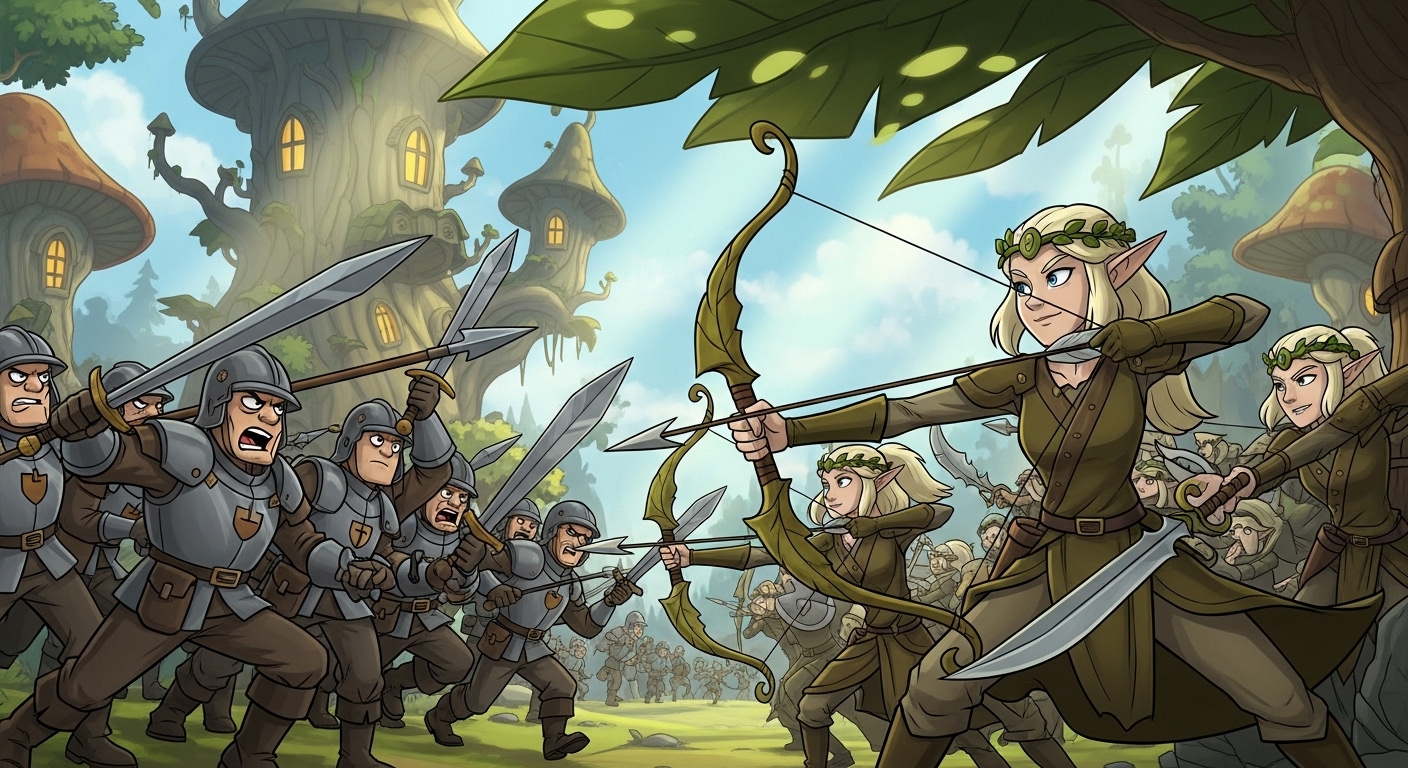
Introduction: Building Your Military Foundation
In Elvenar, military strength is essential for world map expansion, tournament participation, and Spire of Eternity challenges. Whether you prefer peaceful negotiation or aggressive conquest, understanding your army’s capabilities, training systems, and tactical deployment is crucial for success. This comprehensive guide covers every aspect of Elvenar’s military system—from basic unit types to advanced tournament strategies—helping you build a formidable force capable of dominating any battlefield
.
Understanding Your Military Buildings
The Barracks: Race-Specific Foundation
Your Barracks is the cornerstone of military production, unlocked early in Chapter 1. This building trains five unique units for each race: Elves receive Sword Dancers, Archers, Sorceresses, Treants, and Golems; Humans train Axe Barbarians, Crossbowmen, Priests, Paladins, and Mortars
. While both races have equal unit strength, their tactical styles differ—Human units typically hit harder but defend weaker, while Elven units are more balanced
.
Barracks Upgrades reduce training time and increase available slots. Every size increase adds another training slot, allowing parallel unit production. From Chapter XXI onward, Barracks also provide Prosperity, a special requirement for certain chapter buildings
. Prioritize Barracks upgrades early; faster training means faster army replenishment and more battles per day.
Training Grounds: Shared Elite Units
Available from Chapter 2, the Training Grounds trains five shared units for both races: Cerberus, Dryad, Banshee, Orc Warrior, and Orc Strategist
. These units fill tactical gaps not covered by race-specific troops. Cerberus excel at killing enemy Mages quickly; Banshees specialize as Heavy Range killers; Orc Warriors and Orc Strategists provide powerful mid-to-late game options
.
Upgrade your Training Grounds significantly—each upgrade dramatically increases training speed, making these elite units available faster for critical battles
.
Mercenary Camp: Specialized Reinforcements
The Mercenary Camp (unlocked later) provides additional specialized units including Blossom Mages, Rangers, Drone Riders, and Vallorian Veterans. These units often have unique abilities that excel in specific situations, such as Rangers’ mage-killing capabilities or Drone Riders’ exceptional speed for reconnaissance
.
Unit Classes and the Combat Pentagon
Elvenar features five unit classes arranged in a combat advantage system:
Light Melee (LM)
Fast, balanced frontline fighters with high initiative. Includes Sword Dancers (Elves), Axe Barbarians (Humans), Cerberus, and Drone Riders. Strong against Light Range, weak against Heavy Melee
.
Heavy Melee (HM)
Slow, tanky units with massive health but limited movement. Includes Treants (Elves), Paladins (Humans), and Orc Warriors. Strong against Light Melee, weak against Light Range and Mages
.
Light Range (LR)
High-damage, fragile shooters. Includes Archers (Elves), Crossbowmen (Humans), Rangers, and Dryads. Strong against Heavy Melee and Mages, weak against Light Melee and Heavy Range
.
Heavy Range (HR)
Armored ranged units with special protections. Includes Golems (Elves), Mortars (Humans), Banshees, and Orc Strategists. Strong against Light Range, weak against Heavy Melee
.
Mages
Support units with powerful special abilities. Includes Sorceresses (Elves), Priests (Humans), and Blossom Mages. Strong against Heavy Melee, weak against Light Melee
.
The Combat Pentagon: Light Melee → Light Range → Heavy Melee → Mages → Heavy Range → Light Melee (with variations). Understanding these relationships is fundamental to tactical deployment
.
Training and Army Management
Training Size vs. Speed
Two factors determine army production: Training Size (how many units per slot) and Training Speed (how fast slots complete). Training size increases with Armories, Shrines of Shrooms, and Dwarven Bulwarks—but larger stacks take longer to train. Training speed increases with building upgrades and wonders like Needles of the Tempest, Victory Springs, and Flying Academy
.
The Balance: If you check the game twice daily, aim for training queues lasting 12+ hours. If training completes in 2 hours but you sleep for 8, you lose 6 hours of potential production. Adjust your training size and speed so queues finish shortly after you typically log in
.
Armory Strategy
Armories increase training queue size but consume significant population and space. For active players checking twice daily, 2 Armories suffice; for less frequent players, 4 Armories prevent queue overflow
. Balance based on your schedule, not maximum theoretical capacity—excess armories waste resources better spent on production buildings.
Troop Production Rotation
Don’t train all unit types equally. Focus on your most-used troops based on current tournament types and world map enemies. For example, during Steel Tournaments, prioritize Archers and Rangers; during Marble Tournaments, emphasize Sorceresses and Blossom Mages
. Mercenary Camp units often provide the best value for specific encounters.
Tactical Deployment and Battle Strategies
The Default Deployment Strategy
When selecting troops, the order you place them matches the opposing lineup order
. As a default strategy:
- Place Archers/Rangers opposite Mages and Heavy Melee
- Place Banshees opposite Heavy Range
- Place Orc Strategists opposite Light Range
- Place Golems opposite Light Melee
This creates favorable matchups across the front line, but adapt based on battlefield terrain and enemy composition.
Terrain and Positioning
Before deploying, scout the battlefield with a single fast unit (like a Drone Rider or Cerberus) to view terrain obstacles
. Retreat without penalty to adjust your strategy. Use obstacles to create bottlenecks, protecting fragile ranged units while melee forces engage. Position Heavy Melee to block enemy advancement while your ranged units deal damage from safety
.
Manual vs. Auto-Fighting
Auto-fighting is convenient but often results in higher losses—AI doesn’t optimize positioning or target priority. Manual fighting allows strategic retreats, focus fire, and terrain exploitation. Even occasional manual fighting improves your understanding of unit behaviors, helping you select better troops for auto-fights
.
When to Manual Fight:
- Difficult tournament provinces (4+ stars)
- Spire of Eternity boss battles
- Encounters where auto-fight consistently fails
- When preserving specific troops matters
The “Niche Unit” Strategy
When standard lineups fail, deploy “ignored” units with highest stats: Drone Riders, Sinister Cerberus, Vallorian Veterans, and Gruff Orcs. These units excel in specific matchups where conventional strategies fail
:
- Drone Riders opposite Light Range (speed kills)
- Vallorian Veterans opposite Heavy Range (tank and spank)
- Gruff Orcs opposite Light Melee (overwhelming force)
You’ll lose troops securing victory, but sometimes a win with losses beats consistent defeat.
Tournament and Spire Strategies
Tournament Preparation
Before tournaments, craft every combat building available in the Magic Academy: Enlightened Light Range (ELR), Magnificent Mage Multiplier (MMM), and Unleashed Unit Upgrade (UUU). Even if not immediately used, stockpile these—there’s no storage limit, and they’re crucial for high-score attempts
.
Tournament-Specific Tactics
Each tournament type features specific enemy compositions requiring tailored strategies
:
Marble Tournament: Dominated by Heavy Melee, Heavy Range, and Light Range. Key units: Sorceresses, Priests, Blossom Mages. Use Light Range support but protect them from Mist Walkers.
Steel Tournament: Mage-heavy with Steinling and Thief support. Key units: Archers, Rangers. Use Light Melee to protect Archers from War Dogs. Prioritize killing enemy Mages early.
Planks Tournament: Mixed Heavy Melee, Light Melee, and Light Range. Key units: Golems, Mortars, Orc Strategists. Focus on eliminating Ancient Orcs first.
Crystal Tournament: Heavy Range, Light Melee, and Mage mix. Key units: Treants, Paladins, Orc Warriors. Eliminate Enchantresses and Hellhounds early.
The Timewarp Advantage
The Timewarp Ancient Wonder (or fed Polar Bear) reduces tournament cooldown between rounds. At maximum level, this allows completing 6 tournament rounds or even 2 full tournaments within 5-day booster durations, effectively doubling your score potential
. This is arguably the most powerful military investment for serious tournament players.
Ancient Wonders for Military Might
Essential Combat Wonders
- Simia Sapiens: The best military wonder in the game—provides free troops and training bonuses
- Needles of the Tempest: Speeds Barracks training and boosts Light Range damage
- Flying Academy: Speeds Mercenary Camp training and boosts Heavy Range
- Victory Springs: Speeds Training Grounds training and boosts Light Melee
- Timewarp: Reduces tournament cooldowns—game-changing for active players
Wonder Investment Strategy
Focus on maximizing 1-2 wonders before adding new ones. Random low-level wonders provide minimal benefit; concentrated investment creates powerful assets. For pure fighters, prioritize Simia Sapiens and Timewarp. For balanced play, add Needles and Flying Academy
.
Advanced Combat Techniques
Initiative and Turn Order
Units act based on initiative (displayed in unit stats) and placement. Light units generally act before heavy units. Understanding turn order lets you plan kill sequences—eliminating enemies before they act saves your troops from return fire
.
Targeting Priority
Target enemies based on who can strike you first, not just damage advantages. An enemy that moves before your key unit and can reach it should die first, even if another enemy has worse matchup against you .
Retreat and Reroll
Don’t hesitate to retreat from unwinnable battles. Troops return unharmed, allowing you to adjust strategy or wait for better conditions. Similarly, if world map enemies are unfavorable, scout different provinces rather than fighting disadvantageous matchups.
Leave a Reply