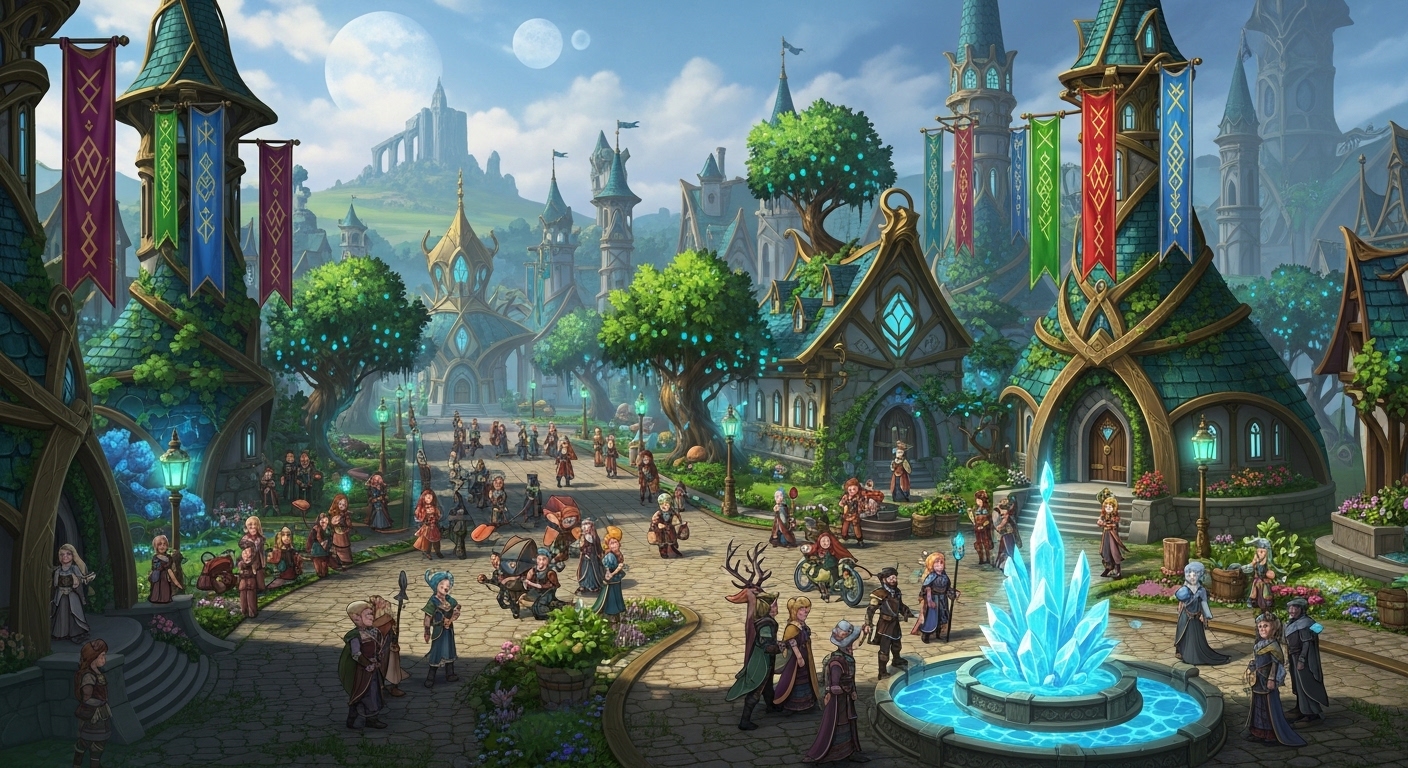
In the vibrant world of Elvenar, event currency serves as the magical key that unlocks seasonal treasures, evolving buildings, and exclusive rewards during the game’s frequent festivals. Unlike standard resources that persist indefinitely, event currency represents a time-limited opportunity that demands strategic collection, efficient spending, and careful planning. Understanding the dual-currency system and optimization techniques separates casual participants from elite reward collectors .
The Dual Currency Architecture
Elvenar’s event economy operates through two distinct currency types, each serving different functions within the festival ecosystem
:
Primary Event Currency (Golden Keys, Postal Keys, Chef Hats, Dwarven Chips, Sky Essence) represents the standard resource collected through active participation. You earn this currency by completing event quests, reaching quest milestones, opening reward chests, and collecting hourly drops from your city’s outskirts. This currency fuels the immediate reward mechanisms—opening chests, spheres, or postal boxes that contain randomized prizes
.
Secondary Event Currency (Stardust, Winter Gifts, Triumph Gems, Amuni Knowledge) functions as the progression resource. You acquire this currency by “trading” your primary currency through event mechanics—each opened chest or sphere generates secondary currency as a guaranteed byproduct. This secondary currency advances you along Grand Prize tracks, unlocks milestone rewards, and determines your League placement among fellow participants
.
Both currencies expire when events conclude, typically after 3-4 weeks of active celebration. Any unspent currency vanishes, making strategic timing essential for maximizing returns
.
Primary Currency Collection Methods
Maximizing event currency requires understanding and optimizing all collection channels:
Quest Completion provides the most substantial and reliable currency income. Events feature two quest categories: a main storyline that can be completed immediately upon unlocking, and daily episodic quests that release one per calendar day. Completing all available quests typically yields thousands of primary currency units—often representing 60-70% of total free-to-play acquisition
.
Quest milestones add bonus currency at specific completion thresholds, rewarding sustained participation beyond individual quest rewards. These milestones often include additional secondary currency, creating compound benefits for thorough quest completion
.
Daily Login Rewards grant guaranteed currency simply for accessing the game during the event period. The Autumn Zodiac 2024 event, for example, provided 50 Golden Keys initially plus 35 additional keys daily—over 1,000 keys from passive login alone across a three-week event
. These rewards require zero effort beyond opening the game, making them the most efficient currency source available.
City Outskirts Drops spawn hourly around your city’s edges, with specific timing mechanics that reward frequent check-ins. Maximum efficiency requires collecting these drops every 4 hours, as the system allows up to 6 simultaneous spawns before pausing new generation. Players logging in four times daily can capture approximately 24 drops, while those checking once daily collect merely 6-12
.
The drops appear at fixed server times regardless of when you last collected, meaning consistent scheduling optimizes acquisition. Missing a collection window doesn’t delay future spawns—it merely wastes that hour’s potential currency
.
Chest and Sphere Rewards sometimes return primary currency as randomized prizes, creating positive feedback loops where spending currency occasionally generates more currency. While unreliable, these returns can extend your total spending power by 10-15% across an event
.
Secondary Currency Mechanics
Secondary currency accumulation determines your access to the most coveted event rewards. The conversion rate from primary to secondary currency varies by event mechanics:
Sphere/Chest Opening guarantees secondary currency with each primary currency expenditure. Different options offer varying efficiency—some chests provide more secondary currency per primary key spent, while others prioritize different reward types. Strategic players analyze these ratios to optimize Grand Prize progression
.
Grand Prize Tracks typically require 20 secondary currency units per major reward, with the sequence looping after initial completion. Early Grand Prizes cost 20 tokens each, while later iterations (starting around prize #21) demand 30 tokens, creating accelerating costs for deep progression
.
League Competition ranks players by total secondary currency collected, with tiered rewards for top performers. The Autumn Zodiac 2024 featured five leagues: Hobby (all participants), Iron (top 50%), Bronze (top 20%), Silver (top 5%), and Gold (top 1%). League thresholds recalculate hourly based on server-wide participation, creating dynamic competition where sustained effort matters more than single-day spikes
.
Strategic Currency Spending
Efficient currency deployment requires balancing multiple reward priorities against limited resources:
Grand Prize Focus suits players seeking evolving building artifacts and major set pieces. This strategy prioritizes secondary currency efficiency—selecting chests/spheres with optimal token-per-key ratios regardless of other rewards. Calculators and community spreadsheets help identify mathematically optimal choices for pure Grand Prize progression
.
Daily Prize Targeting appeals to collectors wanting specific building variants or portrait frames. Since daily prizes rotate every 24 hours, this strategy requires saving currency for preferred options and potentially accepting suboptimal secondary currency returns to secure desired items
.
Balanced Approach distributes currency across Grand Prize advancement, daily prize attempts, and incidental rewards (instants, knowledge points, rune shards). Most free-to-play players naturally adopt this hybrid strategy due to currency constraints preventing exclusive focus on any single target
.
Chest Selection Mathematics varies dramatically by event type. The “rotating chest” events (like Autumn Zodiac) present 9 different sphere types with varying costs, secondary currency yields, and bonus reward probabilities. Analysis reveals that optimal strategies can differ by 20-30% in expected outcomes depending on target priorities
.
For example, maximizing Grand Prizes requires selecting high-efficiency spheres even when they offer less exciting incidental rewards, while daily prize hunters should prioritize spheres showing their target item regardless of efficiency metrics
.
Collection Optimization Techniques
Veteran event participants employ advanced strategies to maximize free currency acquisition:
The 4-Hour Cycle: Setting phone alarms or calendar reminders for 4-hour check-ins captures maximum outskirts drops without excessive disruption. This schedule aligns with natural spawn mechanics, ensuring you never reach the 6-drop cap that pauses generation
.
Quest Pre-Preparation: Reviewing community quest lists (available through iDavis, Italian fan sites, and Beta Fellowship documents) before events start allows pre-production of required goods, clearing of training queues, and strategic building placement. This preparation enables instant quest completion when daily quests unlock, preventing lost days due to production delays
.
Phoenix and Evolution Building Synergy: The Ashen Phoenix evolving building provides 2% bonus event currency per quest completed—seemingly modest but compounding significantly across 50+ event quests. Players with max-level Ashen Phoenix can earn 100% additional currency from quest completion, effectively doubling their primary income from this source
.
Fellowship Coordination: Active fellowships share event strategy tips, quest solutions, and currency optimization techniques. While currency itself cannot be traded, collective knowledge dramatically improves individual efficiency. Some fellowships maintain event-specific planning documents tracking optimal chest selections based on real-time prize rotations
.
Economic Considerations and Trade-offs
Event currency management involves complex resource allocation decisions:
Time vs. Currency: The 4-hour optimal collection cycle demands significant lifestyle integration. Players unable to maintain this schedule accept 25-50% currency reduction but gain quality-of-life improvements. The game accommodates various commitment levels, though competitive League placement typically requires near-optimal collection
.
Diamond Acceleration: Premium currency purchases can supplement event currency through direct buying or instant quest completion. However, the diminishing returns structure—where later Grand Prizes cost 50% more tokens—makes heavy diamond investment increasingly expensive for marginal rewards. Free-to-play strategies often achieve 80-90% of paid player outcomes through disciplined optimization
.
Opportunity Costs: Event participation demands time and attention diverted from normal city development. During intense events, players may neglect tournament participation, fellowship contributions, or chapter advancement. Successful players balance event currency collection against these competing priorities, recognizing that events recur while some opportunities (like specific tournament weeks) may be more valuable
.
Event-Specific Currency Variations
Different event types feature unique currency mechanics requiring adapted strategies:
Chest/Shuffle Events (Autumn Zodiac, Winter Magic) offer randomized reward pools with strategic selection. Players choose from 3 visible options, with rejected alternatives rotating out. This creates meaningful decisions where saving currency for optimal chests outperforms immediate spending
.
Merge Events (Gateway Into the Past, The Great Excavation) involve combining lower-tier items into higher-value creations. Currency efficiency depends on merge optimization and trade acceptance with event NPCs, adding puzzle-solving elements to pure collection
.
Progressive Events feature linear reward tracks where currency automatically advances fixed paths. These reduce strategic choice but ensure predictable returns for consistent participation
.
Common Currency Management Mistakes
New participants frequently undermine their event potential through preventable errors:
Hoarding Without Purpose: Saving currency for “better” options that never appear wastes potential daily prize opportunities. Unless targeting specific known rotations, spending currency efficiently typically outperforms indefinite hoarding.
Ignoring Outskirts Drops: Players focusing exclusively on quests miss 20-30% of potential currency from city drops. The minimal effort of perimeter checks yields substantial returns.
Impulsive Early Spending: Using all currency on day-one options prevents response to better later opportunities. Maintaining currency reserves until understanding full event mechanics enables informed optimization.
Neglecting Secondary Currency: Focusing exclusively on primary currency collection without considering Grand Prize progression efficiency leads to suboptimal reward acquisition. The best chest for primary currency generation may differ from the best chest for secondary currency advancement
.
Conclusion
Event currency represents Elvenar’s most dynamic resource system, transforming routine gameplay into festive optimization puzzles. The dual-currency architecture—primary for immediate rewards, secondary for progression—creates strategic depth where collection efficiency and spending wisdom both matter.
Success requires balancing quest completion, hourly check-ins, optimal chest selection, and long-term planning against the backdrop of limited-time availability. While premium acceleration offers shortcuts, disciplined free-to-play strategies achieve remarkable results through community knowledge, mathematical optimization, and consistent engagement.
Master event currency management, and each festival becomes not merely a celebration but a strategic opportunity to accelerate your kingdom’s development through exclusive buildings, powerful artifacts, and invaluable resources.