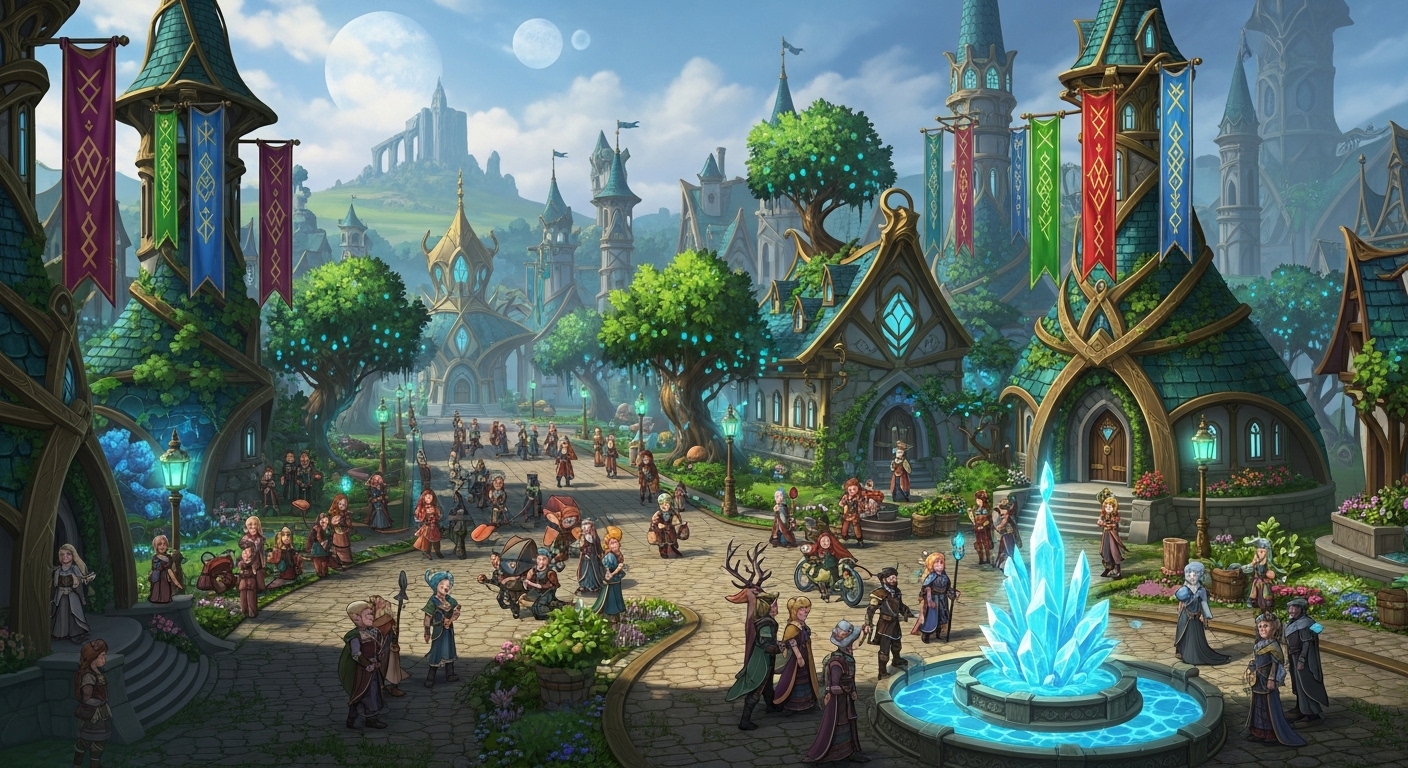
In the intricate economy of Elvenar, Manufactories serve as the industrial backbone of every thriving kingdom. These specialized buildings transform raw resources into the nine distinct goods types that fuel technological advancement, negotiation, and trade. Understanding the three-tier manufactory system—Basic, Refined, and Precious goods—along with the advanced Sentient and Ascended tiers that unlock in later chapters, is essential for efficient city development and sustainable resource management
.
The Three Basic Tiers: Foundation of Your Economy
Elvenar’s goods system is organized into three fundamental tiers, each containing three distinct resource types that follow specific production and trading relationships:
Tier 1 (Basic Goods) consists of Marble, Steel, and Planks. These foundational resources unlock earliest in your technological journey and remain relevant throughout your entire gameplay experience. Basic goods manufactories are the smallest, most space-efficient production facilities, making them ideal for early city layouts when expansion options remain limited
.
Tier 2 (Refined Goods) introduces Crystal, Scrolls, and Silk in the middle chapters of your progression. These goods require more complex production chains and larger manufactories, consuming more space and population while delivering higher-value outputs. The jump from Tier 1 to Tier 2 represents your city’s first significant industrial expansion
.
Tier 3 (Precious Goods) unlocks Elixir, Magic Dust, and Gems in later chapters. These premium resources demand the largest manufactories with substantial population requirements, but they become crucial for advanced technologies, high-level negotiations, and trading with other players. Precious goods manufactories represent significant city investments that must be carefully planned
.
The Boost System: Maximizing Production Efficiency
The cornerstone of manufactory strategy revolves around boosted goods. When you establish your city, the game randomly assigns one boosted good from each tier—one Basic, one Refined, and one Precious. These boosted goods receive production bonuses based on collected relics, potentially reaching 700% increased output at maximum relic collection
.
This boost system fundamentally shapes your manufactory strategy. A player with boosted Planks, Crystal, and Magic Dust should focus exclusively on those three manufactories, using trading to acquire non-boosted goods. Building non-boosted manufactories wastes precious city space and population while delivering fractions of the production efficiency
.
The mathematics are stark: a boosted Steel manufactory might produce 3,000 units in three hours, while the same-level unboosted Planks manufactory produces merely 300 units
. This 10:1 efficiency ratio makes specialization mandatory for competitive play.
Manufactory Upgrades and Chapter Progression
As you advance through Elvenar’s 22 chapters, manufactories unlock progressively higher upgrade levels. Each chapter typically introduces new upgrade technologies that improve production efficiency, though the relationship between chapter progression and manufactory efficiency is surprisingly complex
.
Early Chapter Efficiency (Chapters 1-5): Manufactories demonstrate consistent efficiency gains with each upgrade. A Level 6 manufactory in Chapter 2 significantly outperforms its Level 1 equivalent, justifying immediate upgrades upon technology unlock. During these formative chapters, building new manufactories and upgrading existing ones both represent sound investments
.
The Efficiency Plateau (Chapters 6-15): Community research reveals that manufactories experience efficiency fluctuations during middle chapters. While absolute production increases with each upgrade, the space, population, and culture requirements sometimes grow faster than output gains. Analysis suggests that manufactories occasionally reach “sweet spots” where delaying one chapter’s upgrade until supporting infrastructure (residences, culture buildings) improves can optimize overall city efficiency
.
Late Chapter Transformation (Chapters 16+): Advanced chapters introduce fundamental manufactory evolution. Chapter XII unlocks Sentient Goods—advanced versions of basic goods produced by manufactories upgraded to level 24 or higher. These Moonstone, Platinum, and Elven Tree Gum variants feature unique decay mechanics (10% daily conversion back to basic goods) and become essential for late-game technologies
.
Chapter XVIII introduces Ascended Manufactories, representing the pinnacle of goods production. These facilities produce Ascended Goods through entirely new mechanics, requiring dedicated research and substantial investment
.
Sentient Goods: The Tier 4 Evolution
Starting from Chapter XII – The Elementals, your manufactories undergo their most significant transformation. Once upgraded to level 24 and beyond, manufactories gain the ability to produce Sentient Goods through modified production options
.
The production shift works as follows: 1-day and 2-day production options for regular goods are replaced with Sentient Goods production, while 3-hour and 9-hour options for standard goods remain available. This creates strategic flexibility—players can maintain standard goods production for trading and quests while dedicending longer cycles to Sentient accumulation
.
Sentient Goods follow a fixed transformation pattern based on your original boosted good:
- Marble → Moonstone (boosted if your Basic boost is Planks)
- Steel → Platinum (boosted if your Basic boost is Marble)
- Planks → Elven Tree Gum (boosted if your Basic boost is Steel)
The decay mechanic adds management complexity: stored Sentient Goods lose 10% daily, converting 1:1 into their basic counterparts. This means 1,000 Moonstone becomes 900 Moonstone plus 100 Marble overnight. Unlike Mana or Seeds, Sentient Goods don’t vanish entirely, but efficient players develop consumption rhythms that minimize decay losses
.
Production Optimization Strategies
Efficient manufactory management requires balancing multiple variables:
Time Optimization: Manufactories offer four production durations—3 hours, 9 hours, 1 day, and 2 days (standard goods) or Sentient equivalents. The 3-hour option provides maximum efficiency for active players who can collect and restart frequently. Overnight or extended absences suit longer durations, though at reduced efficiency
.
Batch Production: The circle selection tool enables synchronized production across identical manufactories. However, manufactories only batch with others at the same upgrade level and star rating. This creates upgrade synchronization pressure—if you have six Planks manufactories at levels 4, 5, and 6, you must issue production commands separately for each pair, increasing micromanagement
.
Spell Enhancement: Magical Manufacturing spells boost manufactory output for 13 hours. Strategic timing maximizes returns—casting before collecting ready production applies the bonus retroactively, while casting before initiating new cycles ensures enhanced yields. Active players can achieve four 3-hour boosted cycles within a single spell duration
.
Space and Efficiency Mathematics
Veteran players debate manufactory efficiency using sophisticated calculations that account for total city impact. A manufactory’s true “cost” includes not just its footprint, but supporting roads, required population (from residences), and necessary culture buildings
.
Analysis reveals that higher-level manufactories generally improve efficiency when supported by modern infrastructure. A Level 31 manufactory requires fewer total tiles (including supporting buildings) than multiple lower-level equivalents producing the same output. However, this efficiency assumes access to high-efficiency population sources (Magic Residences) and culture buildings (event structures)
.
The breakpoint varies by chapter and available support buildings. Players relying on standard residences and basic culture structures may find that manufactories from 1-2 chapters prior deliver optimal efficiency, while those with premium buildings benefit from immediate maximum upgrades
.
Trading and Economic Integration
Manufactories don’t exist in isolation—they feed into Elvenar’s vibrant trading economy. The Trader building enables goods exchange with other players and the wholesaler, with upgrade levels unlocking new capabilities. Level 3 Trader unlocks Sentient Goods trading, essential for Chapter XII+ progression
.
Effective trading strategies leverage your boosted goods production to acquire non-boosted needs. A boosted Planks producer might trade surplus production for Marble and Steel, eliminating the need for inefficient unboosted manufactories. This specialization principle extends through all tiers—focus production on your three boosted goods, trade for everything else
.
Cross-tier trading follows established ratios (historically 1:4:16 for Tier 1:2:3), though these evolve with game updates. Understanding these ratios prevents unfavorable trades and maximizes the value of your boosted production
.
Common Manufactory Mistakes
New players frequently undermine their economic potential through preventable errors:
Building All Nine Manufactories: The impulse to produce every good type domestically wastes massive city space. With three boosted goods and active trading, six manufactories become unnecessary luxuries rather than necessities
.
Ignoring Upgrade Efficiency: Failing to research manufactory upgrades stalls production potential. Each chapter’s upgrade technology typically pays for itself through increased output, particularly when combined with improved supporting infrastructure.
Neglecting Sentient Transition: Reaching Chapter XII without preparing level 24+ manufactories creates production bottlenecks. The shift to Sentient Goods production requires proactive upgrading well before the chapter unlock
.
Overlooking Decay Management: Sentient Goods’ 10% daily decay punishes hoarding. Efficient players maintain lean inventories, consuming Sentient Goods in technologies or trading them before decay accumulates
.
Conclusion
Elvenar’s manufactory tier system provides a sophisticated economic progression that rewards strategic planning and specialization. From the humble Basic goods of early chapters through the transformative Sentient Goods of Elementals and the ultimate Ascended Goods of late-game chapters, your production infrastructure must evolve with your kingdom’s needs.
The boost system creates clear optimization paths—identify your three boosted goods, maximize their production, and trade for everything else. Upgrade timing requires balancing absolute production gains against supporting infrastructure costs, with efficiency calculations guiding optimal decisions.
Mastering manufactory tiers transforms resource scarcity into abundance, enabling rapid technological advancement, generous fellowship contributions, and tournament dominance. In Elvenar’s magical economy, efficient production isn’t just about having resources—it’s about having the right resources, at the right time, in the right quantities.