Tag: #elvenar #elvenargame #elvenaronline #elvenarplayers #elvenarfans #elvenarcommunity #elvenarstrategy #elvenarcity #elvenarkingdom #elvenarfantasy #elvenarworld #elvenarbuilding #elvenarfun

  • The Complete Elvenar Map Guide: Mastering World Exploration

    The Complete Elvenar Map Guide: Mastering World Exploration

    Understanding the World Map

    The World Map in Elvenar represents your gateway to expansion, resources, and progression. Unlike the static city grid where you build and upgrade, the World Map is a dynamic, ever-expanding territory filled with provinces waiting to be discovered, conquered, and exploited. Each province you scout and complete provides Knowledge Points, relics, essential resources, and most critically—city expansions that provide the space necessary for your growing empire

    .

    The map is organized in concentric rings around your starting city, with province difficulty and rewards increasing as you push outward. Your relationship with this map determines your economic strength, military capabilities, and ultimately your success in Elvenar. Mastering map exploration separates thriving cities from stagnant ones.

    The Scouting Mechanic: Time and Strategy

    Scouting Fundamentals

    Scouting is the process of sending your scout to investigate an adjacent province, revealing its contents, difficulty, and rewards. This process takes time—initially just minutes, but eventually stretching to days in later chapters. The scout time increases based on two factors: the distance from your city (ring number) and your current chapter

    .

    Critically, you can only scout one province at a time. This limitation creates strategic bottlenecks, particularly during events requiring multiple scouted provinces or when approaching chapter ends with province completion requirements. The community has long requested multiple scouting capability or reduced scout times, but developers have maintained this as a pacing mechanism

    .

    The Scout’s Tavern

    Available in later chapters, the Scout’s Tavern reduces scouting time by up to 65%. This building becomes essential for maintaining reasonable progression speed as scout times extend into multiple days. However, reaching the point where you can build this structure requires substantial prior scouting, creating a catch-22 that frustrates many players

    .

    Province Difficulty: The Color-Coded System

    Provinces display difficulty ratings through a color-coded system that directly impacts both fighting and negotiating costs:

    • Very Easy (Green): Minimal enemy squad size or negotiation costs
    • Easy (Light Green): Slightly elevated but manageable
    • Medium (Yellow): Noticeable difficulty increase
    • Hard (Orange): Significant resource investment required
    • Very Hard (Red): Extreme costs, often requiring specialized strategies

    Difficulty Determinants

    Province difficulty depends primarily on two factors: the number of provinces you’ve already scouted (your “scout count”) and your Squad Size Upgrades researched. The more provinces you’ve scouted, the harder new provinces become. Additionally, each Squad Size Upgrade you research increases enemy strength in all unscouted provinces

    .

    This creates a strategic tension: scouting more provinces provides expansions and rewards but makes future provinces harder. Meanwhile, Squad Size Upgrades help you complete existing provinces but increase difficulty for new ones.

    The Overscouting Debate: Community Strategies

    The Elvenar community maintains active debate about optimal scouting strategy, with two primary philosophies:

    Minimal Scouting Approach

    This conservative strategy advocates scouting only the provinces required for chapter advancement plus a small buffer for events (typically 4-6 extra provinces). Proponents argue this keeps provinces at “Very Easy” or “Easy” difficulty, minimizing resource expenditure per province and maintaining sustainable progression

    .

    The minimal approach requires disciplined patience. You must resist the temptation to scout for immediate expansion space, instead optimizing your existing city layout. This strategy works best for players who enjoy city planning efficiency and prefer manageable, predictable costs

    .

    Aggressive Scouting Approach

    The opposing philosophy encourages continuous scouting regardless of immediate needs. Advocates point to several advantages: more expansions for building space, increased trading partners, Knowledge Point generation from the Tome of Secrets Ancient Wonder (which provides supplies based on scouting activity), and preparation for future chapter requirements

    .

    Aggressive scouts note that later chapters require massive province counts—entering Chapter 15 requires 40 more provinces than Chapter 14. If you haven’t scouted ahead, you may wait longer for scouts than it takes to complete the chapter itself. Additionally, they argue that “Very Hard” provinces negotiate the same as “Easy” ones; the difficulty rating only affects fighting

    .

    The Consensus Balance

    Most experienced players recommend a middle path: scout ahead moderately while monitoring difficulty colors. Keep provinces at “Medium” difficulty or below through Chapter 10, then relax restrictions as your city strength grows. Maintain a buffer of 4-12 scouted-but-incomplete provinces for event quests, but avoid reaching “Very Hard” status unless prepared for the resource investment

    .

    Combat vs. Negotiation: Choosing Your Path

    Each province encounter offers two resolution methods: fighting or negotiating. Understanding when to use each approach maximizes efficiency and resource preservation.

    Fighting Advantages

    • No goods consumption—only troop losses
    • Scales with your military infrastructure
    • Tournament and Spire training translates directly to map progress
    • Ancient Wonders can significantly boost military effectiveness
    • Faster completion for active players

    Negotiation Advantages

    • No troop losses—preserves army for tournaments
    • Predictable costs visible before committing
    • Scales with your goods production, not military
    • Required for certain event quests
    • Often faster for casual players who check infrequently

    The Hybrid Approach

    Optimal play typically involves both methods. Fight provinces where you have type advantages and terrain benefits; negotiate where enemy composition would cause heavy losses or where goods are plentiful. Many players fight early provinces in a scouting push (when they’re Easy), then negotiate later ones as difficulty increases

    .

    Province Completion Strategy

    The 7-Encounter Technique

    A sophisticated strategy involves completing only 7 of 8 encounters in scouted provinces until necessary for chapter advancement. This keeps provinces “incomplete” for event quests that require completed provinces, while still allowing you to claim most rewards. When you finally need the province count for chapter progression, complete the final encounters en masse

    .

    Rune Shard Optimization

    Ancient Wonders require rune shards for construction, obtained primarily from province completion. By leaving provinces incomplete until you’ve unlocked new chapter wonders, you can direct rune shards toward wonders you actually want to build rather than random earlier options

    .

    Expansion Management

    Province expansions increase your city grid, but they also increase tournament and Spire difficulty if placed immediately. Advanced players often hold expansions unplaced until necessary, preventing difficulty spikes while maintaining the option for rapid expansion when needed

    .

    Advanced Scouting Tactics

    The Advanced Scouts Research

    Each chapter contains “Advanced Scouts” technology that reduces scouting costs, negotiation costs, and fighting difficulty for provinces within that chapter. The research description shows two numbers: provinces required and provinces recommended. Staying under the second number maintains easier difficulties

    .

    Strategic players scout only to the second number before researching Advanced Scouts, then use the cost reduction to push further. This timing maximizes the technology’s benefit

    .

    Squad Size Upgrade Timing

    Since Squad Size Upgrades increase enemy strength in unscouted provinces, optimal timing involves scouting all needed provinces before researching these upgrades. This “locks in” easier difficulties for your current chapter while still allowing military growth for completing them

    .

    Event Quest Preparation

    Many event quests require completing encounters or gaining relics from the World Map. Maintaining 4-12 scouted-but-incomplete provinces ensures you can fulfill these quests immediately without waiting for lengthy scout times. This preparation becomes essential for players pursuing event completion

    .

    Ring Strategy and Province Types

    The World Map organizes provinces into rings of increasing distance from your city. Each ring contains specific province types with distinct characteristics:

    Inner Rings (1-5): Lower costs, faster scouts, basic rewards. Essential for early expansion but quickly exhausted.

    Middle Rings (6-15): Moderate difficulty, substantial rewards, primary hunting ground for most of the game.

    Outer Rings (16+): Extended scout times, high costs, but necessary for late-game chapter requirements

    .

    Province types within rings include:

    • Standard Provinces: Basic encounters with balanced rewards
    • Ruins: Often contain Ancient Wonder runes
    • Cities: Higher difficulty but better rewards
    • Special Territories: Unique mechanics and requirements

    The Trading Network Benefit

    Scouting expands your visible trading network. Each scouted province reveals neighboring players and fellowships, expanding your potential trade partners. More trading partners means better trade rates and faster resource acquisition, particularly for goods you don’t produce efficiently

    .

    Players in isolated map regions suffer trade disadvantages, waiting longer for trades to complete or accepting worse exchange rates. Active scouting ensures robust market access.

    Common Map Mistakes

    Overscouting Without Preparation

    Reaching “Very Hard” provinces before developing adequate military or goods production creates progression bottlenecks. The resources required to complete these provinces may exceed your generation capacity, forcing extended waits

    .

    Ignoring Scout Times

    Failing to maintain continuous scouting wastes time. Your scout should always be active; idle scouts represent lost progress. Queue scouting before sleep or work to maximize efficiency

    .

    Completing Provinces Immediately

    Finishing all encounters in scouted provinces removes flexibility for event quests and rune shard targeting. The 7-encounter technique preserves options

    .

    Neglecting Expansion Placement

    Placing expansions immediately upon receipt increases tournament and Spire difficulty. Hold expansions until needed for specific building projects

    .

    Conclusion: Map Mastery as Strategy

    The World Map in Elvenar is not merely a progression gate—it’s a strategic resource to be managed with the same care as your city layout or economic production. Optimal play requires balancing immediate needs against future requirements, managing difficulty curves, and maintaining flexibility for changing circumstances.
  • The Complete Elvenar Building Guide: From Foundation to Mastery

    The Complete Elvenar Building Guide: From Foundation to Mastery

    Understanding Elvenar’s Building Ecosystem

    Elvenar’s building system forms the backbone of your entire gameplay experience. Every structure you place—from humble residences to magnificent Ancient Wonders—contributes to a complex economic and strategic web that determines your success. Unlike simple city builders where aesthetics dominate, Elvenar demands that every building serve a functional purpose, optimized for space efficiency and resource generation

    .

    The game presents you with two distinct architectural paths: Elves with their organic, nature-inspired circular buildings, and Humans with their rectangular, medieval industrial structures. While both races share identical underlying mechanics, their building shapes fundamentally impact your city layout strategies. Elven buildings typically occupy smaller footprints but have awkward dimensions, while Human buildings offer more predictable rectangular shapes that can be easier to organize in grids

    .

    Core Building Categories: The Four Pillars

    Residential Buildings: Your Population Engine

    Residences represent the most fundamental building type in Elvenar. They provide three critical resources: population (which enables all other construction), coins (the primary currency for basic transactions), and culture (which boosts production efficiency). The key to residence management lies in balancing quantity with upgrade levels.

    New players often make the mistake of building too many low-level residences rather than upgrading existing ones. A level 15 residence generates exponentially more population and coins than three level 5 residences, while occupying significantly less space when considering road requirements and culture needs. Prioritize upgrading all residences to maximum available level before expanding your residential district

    .

    Strategic placement matters enormously. Residences should cluster together near your Main Hall to minimize road connections, and they benefit enormously from adjacent culture buildings. The “Enthusiastic” culture level (130% of required culture) provides substantial production bonuses, making culture investment adjacent to residences highly profitable

    .

    Workshops: The Supply Lifeline

    Workshops produce Supplies—the second primary resource alongside Coins. Supplies fuel building upgrades, unit training, research, and virtually every advanced game action. Like residences, workshops reward concentration over dispersion. A common early-game target is approximately 10 workshops, though this number decreases dramatically as you acquire Ancient Wonders and Magic Buildings

    .

    Workshop production runs on variable timers: 5-minute emergency production, 1-hour active play sessions, 3-hour medium duration, and 9-hour overnight production. Match these timers to your real-life schedule. There’s no benefit to setting 9-hour productions if you log in every hour; conversely, 1-hour productions waste potential while you sleep

    .

    Manufactories: Goods Production Hierarchy

    Manufactories produce the nine goods types essential for trading, research, and tournament participation. These divide into three tiers: Tier 1 (Marble, Steel, Planks), Tier 2 (Scrolls, Crystal, Silk), and Tier 3 (Elixir, Magic Dust, Gems). Crucially, each player receives three “boosted” goods—one per tier—indicated by relics surrounding their city. These boosted goods produce at 400% efficiency, making specialization essential

    .

    Building ratios depend heavily on your playstyle, but general guidelines suggest approximately 5 Tier 1, 3 Tier 2, and 3 Tier 3 manufactories for balanced play. However, if you join an active fellowship with robust trading, you can focus exclusively on your three boosted goods and trade for everything else, reducing manufactory count by half

    .

    Manufactories expand significantly as they upgrade. A Human level 19 Marble manufactory occupies 5×3 squares, while an Elven level 19 Planks manufactory occupies 5×2. These dimensional differences impact your layout planning substantially

    .

    Culture Buildings: The Invisible Multiplier

    Culture buildings provide no direct resources but boost the production of everything else. Maintaining “Enthusiastic” culture (130% of required) increases Coin and Supply production by 20%, making culture investment incredibly profitable. However, culture buildings occupy precious space, creating a constant optimization puzzle

    .

    The efficiency metric is culture per square. Early culture buildings like Temples of Holy Fire provide 96 culture per square (2400 culture from 5×5), while later options like Garden of Harmony provide only 70 per square. Regularly replace obsolete culture buildings with newer models—this “culture creep” frees substantial space over time

    .

    Space Optimization: The Ten Golden Rules

    Veteran players have codified essential principles for maximizing limited space:

    1. Corner your Main Hall: Place it in a corner with no more than two connecting roads. Its awkward bulk dictates your entire layout if centered .
    2. Edge culture placement: Position culture buildings and your Builder’s Hut along outside edges—they don’t require road access .
    3. Upgrade roads immediately: Higher-tier roads provide culture bonuses, effectively creating “free” culture without space cost .
    4. Dual-purpose roads: Every road segment should touch at least two buildings. Single-building roads waste space .
    5. Avoid edge roads: Roads touching only one building at your city’s perimeter represent wasted potential .
    6. Exploit road ends: Place small culture ornaments at road terminations—these “wasted” spaces become productive .
    7. Maintain square shape: Oblong cities or irregular shapes create inefficient perimeter-to-area ratios .
    8. Short-side road contact: Orient rectangular buildings so their shorter dimension touches roads, minimizing required road tiles .
    9. Group by function: Cluster similar buildings for easier management and collection .
    10. Plan for growth: Buildings expand at levels 5-6 and beyond—leave expansion room .

    Following these rules can free 15-20% more space for production buildings, directly accelerating your progression.

    Ancient Wonders: Permanent Powerhouses

    Ancient Wonders unlock in Chapter 4 and represent permanent, upgradeable bonuses that never become obsolete. Unlike regular buildings, their footprint remains constant as they level, making them incredibly space-efficient at high levels

    .

    Essential Early Wonders:

    • Golden Abyss: Provides population and coins. Despite appearing inefficient early (underperforming standard residences until Chapter 5), at maximum level it provides an 18% population discount across your entire city. This is universally recommended as your first wonder .
    • Mountain Halls: Another 18% population discount plus goods production bonuses. Pairs perfectly with Golden Abyss to create economic dominance .
    • Sanctuary (Elves) / Martial Monastery (Humans): The most powerful combat wonder, providing health bonuses to all units. Expensive to upgrade but essential for fighters .
    • Needles of the Tempest: Accelerates barracks training and boosts Light Ranged units—critical for tournament performance .

    Upgrade Strategy: Concentrate all Knowledge Points on one wonder until it reaches maximum level (31), then move to the next. A level 31 wonder provides exponentially more value than multiple low-level wonders. Never spread resources thin

    .

    Magic Buildings: Premium Efficiency

    Magic Residences and Magic Workshops represent the pinnacle of building efficiency, won primarily through Spire of Eternity participation. A Magic Workshop produces as many supplies as 9 standard workshops while requiring only 2 residences worth of population. This space efficiency transforms late-game city planning

    .

    Top players often run cities with only 2-4 Magic Workshops rather than 10+ standard ones, freeing enormous space for other buildings. Similarly, Magic Residences allow drastic reduction in residential footprint. The Spire’s Laboratory (first boss) drops Magic Residences; the High Halls (second boss) drops Magic Workshops—making Spire participation essential for advanced city building

    .

    Guest Race Settlements: Temporary Expansion

    From Chapter 6 onward, guest races (Dwarves, Fairies, Orcs, etc.) occupy your city temporarily. These settlements require massive space—often 20-30% of your grid—and feature unique mechanics

    .

    Settlement Strategy:

    • Clear substantial space before unlocking the portal
    • Place portals centrally to minimize road connections to settlement buildings
    • Portal tracks connect settlement buildings to the portal (not to your main road system)
    • Upgrade portal first, then production buildings, to maximize output

    Production timers vary by building level—higher levels offer longer production windows (better for sleep schedules) and increased output. Balance upgrade timing with your chapter progression needs

    .

    Evolving Buildings: Event Rewards

    Events provide evolving buildings that improve through artifact collection. These permanent structures offer unique bonuses—some provide combat advantages, others economic boosts, and many provide hybrid benefits. The Fire Phoenix and Brown Bear stand as the most powerful fighting buildings, while the Polar Bear reduces tournament cooldowns

    .

    Collection Strategy: Craft base plates from the Magic Academy when offered, but don’t place them until you have sufficient artifacts for meaningful evolution. A single fully-evolved building outperforms multiple level-1 buildings occupying the same space. Concentrated power on minimal footprint should guide your decisions

    .

    Building Upgrades: Timing and Priorities

    The upgrade sequence significantly impacts your progression speed:

    1. Residences and Workshops first: These economic foundations enable everything else
    2. Boosted manufactories next: Maximize your 400% production advantage
    3. Main Hall when storage-limited: Upgrade when you consistently hit capacity caps
    4. Barracks and Armories as needed: Match military infrastructure to your fighting frequency
    5. Ancient Wonders continuously: Never stop investing Knowledge Points

    Avoid the trap of “saving” upgrades for later chapters. Buildings upgraded earlier provide compounding benefits over longer periods. A manufactory upgraded in Chapter 6 generates more total goods by Chapter 10 than one upgraded at Chapter 9, even if both reach the same level

    .

    Common Building Mistakes

    Overbuilding Armories: These population-heavy structures drain your workforce. Use Shrines/Bulwarks Ancient Wonders for training queue capacity instead

    .

    Neglecting Culture: Low culture reduces all production by 20% or more—far more expensive than the culture buildings required to fix it

    .

    Premature Expansion: Unlocking map expansions before optimizing existing space spreads your city thin and increases collection time

    .

    Cross-Tier Manufacturing: Building non-boosted goods manufactories wastes space. Trade for these instead, unless your fellowship completely lacks traders

    .

    Static Layouts: Failing to rearrange as building sizes change creates road inefficiencies. Rebuild your city layout every few chapters

    .

    Conclusion: Building for the Long Term

    Elvenar city building rewards patience and planning over quick fixes. Every building decision compounds over months and years of gameplay. The most successful players approach their cities as evolving puzzles—constantly optimizing, upgrading, and adapting to new chapters and mechanics.

    Master the fundamentals: maximize space efficiency through smart layout, prioritize economic buildings, invest heavily in Ancient Wonders, and specialize in boosted goods. As you advance, incorporate Magic Buildings and evolving buildings to achieve incredible density and power. Your city is your legacy in Elvenar—build it wisely.

  • Mastering Elvenar: Advanced Tricks and Pro Strategies for Dominating Your Fantasy Realm

    Mastering Elvenar: Advanced Tricks and Pro Strategies for Dominating Your Fantasy Realm

    Introduction: Beyond the Basics

    Elvenar is a game of patience, strategy, and efficient resource management. While beginners focus on simply keeping their city running, advanced players understand that success lies in optimizing every grid square, every production cycle, and every interaction. This comprehensive guide reveals the sophisticated tricks and professional strategies that separate thriving metropolises from struggling settlements, helping you maximize efficiency and accelerate your progression through the chapters

    .


    Resource Generation Secrets

    The Instant Knowledge Point Hack

    Waiting 10 hours for your Knowledge Point (KP) bar to refill is a beginner’s mistake. Professional players scout nearby provinces on the world map and solve encounters—each completed encounter awards 1 KP instantly plus valuable relics

    . This technique bypasses the hourly regeneration limit entirely, allowing rapid research progression when you’re eager to unlock new technologies. Scout continuously as long as you have sufficient Coins and Supplies, turning the world map into your personal KP farm rather than a passive waiting game

    .

    Coin Generation Beyond Taxation

    Running low on Coins? Don’t just wait for residence collections. Visit other players’ cities and “help” them with their current quests. This generates bonus Coins without spending resources, and Fellowship members can help each other for mutual Coin rewards

    . Additionally, completing encounter negotiations on the world map provides substantial Coin rewards, creating a virtuous cycle where exploration fuels both research and economy

    .

    The 3-Star Trading Advantage

    Make your trades irresistible by offering 2 units less than the default amount. This creates a “3-star offer” that appears at the top of other players’ trade lists and gets accepted within minutes, even when the market is saturated

    . While the discount seems minor, the rapid turnover means you acquire needed resources faster than competitors posting full-price trades that sit for days. This trick is especially powerful for cross-tier trading, where the stigma has reduced since InnoGames changed the balance ratio from 1:4 to 1:1.5

    .


    City Layout Optimization: The Science of Space

    The Corner Main Hall Strategy

    Place your Main Hall in a corner with no more than 2 roads leading from it. This bulky, awkwardly-sized building dictates your entire layout if centered—corners minimize road waste and free up prime space for productive buildings

    . Veteran players recommend the top corner, building streets downward and sideways from there. There will come a day when you desperately need to move it; better to establish this efficient foundation early when fewer buildings require relocation

    .

    Road Efficiency Mathematics

    Roads are space parasites—minimize them ruthlessly. Follow these golden rules:

    • Never place roads at city edges—they only touch one building, wasting space
    • Put narrow building edges toward roads: A 3×2 residence should have its 2-square side touching the road, not the 3-square side. This simple rotation can save 20+ road blocks—enough for an extra building
    • Roads should serve two buildings minimum—avoid dead-end roads entirely
    • Overwrite roads when upgrading: Drag new road types directly over old ones—no deletion required

    The Counter-Intuitive Culture Placement

    Place culture buildings in the CENTER of your city, not the edges. This allows maximum-length straight roads at the perimeter where they’re most efficient. Since culture buildings don’t need road access, central placement optimizes space usage perfectly while freeing edge space for road-dependent structures

    . Group all culture buildings together in rows, with your Builder’s Hut alongside them—neither requires roads, so keep paths far away

    .

    The Double Spiral Design

    For maximum efficiency enthusiasts, implement these advanced principles:

    • Zero crossroads—keep roads straight until hitting corners
    • Place biggest buildings at road ends (only need 1 road square)
    • Group same-sized buildings together for easy reorganization
    • Expand in perfect squares (5×5, 6×6, 7×7) to maintain optimal ratios

    When restructuring, use spare expansions as staging areas. Move buildings to temporary 5×5 spaces while reorganizing, then return them to optimized positions. Don’t fear demolition—rebuilding from scratch often yields better results than incremental adjustments

    .


    Production Mastery

    The Swipe-to-Collect Technique

    Click and hold on one ready building, then swipe across all other ready buildings to collect resources instantly. This cuts collection time by 90% compared to tapping individually

    . Combine this with fully zoomed-out view to spot all “harvest-ables” easily across your expanding kingdom

    .

    Batch Production Setup

    Click the circle icon when selecting production to apply the same item to all identical buildings simultaneously. For Workshops, this works across all buildings. For Manufactories, it only batches identical types at the same upgrade level—so upgrade in pairs for maximum efficiency

    . This trick transforms tedious individual clicking into streamlined mass production.

    The 9-Hour vs. 1-Day Calculation

    Shorter orders always beat longer ones in efficiency. Two 3-hour orders outproduce one 9-hour order in the same timeframe, and the difference increases with shorter cycles. For Workshops, 5-minute orders provide maximum yield if you can maintain active play

    .

    However, match production to your schedule: 9-hour orders for overnight, 1-day orders only if you’ll be offline 24+ hours. Setting 1-day orders when you check in twice daily actually loses resources compared to shorter cycles

    .

    Workshop Optimization for Endgame

    Endgame players need minimum 8 Workshops set to 1-hour cycles for quest efficiency. Remove excess manufactories (down to 2 per tier) to free massive population for upgrades

    . With a maxed Prosperity Towers Ancient Wonder and Power of Provision spells, 2 Magical Workshops can replace 9 normal ones, saving enormous space while maintaining production

    .


    Combat and World Map Tactics

    Selective Scouting Strategy

    Don’t “joy-scout” randomly. Prioritize provinces based on your needs:

    • Need trading power? Target provinces with relics matching your boosted goods
    • Need land expansions? Check Province Overview and target “easy” difficulty provinces

    Remember: each consecutive expansion requires completing one more province than the last. First expansion needs 1 province, second needs 2, third needs 3, and so on

    .

    Combat Damage Mechanics

    Units deal identical damage regardless of stack size—32 Berserkers hit as hard as 1 Berserker until they die. Always finish off enemy stacks completely rather than spreading damage, and prioritize eliminating threats over damaging multiple units

    . Use terrain obstacles to create bottlenecks, protecting fragile ranged units while melee forces engage

    .

    Army Composition Math

    Building more Armories isn’t always better. 2 Armories suffice for active players checking twice daily; 4 Armories for players checking less frequently. Balance based on your login schedule, not maximum capacity—excess armories waste population and space that could support production buildings

    .


    Ancient Wonder Strategies

    The “Max Before Adding” Rule

    Focus on maximizing 1-2 Ancient Wonders before adding new ones. This creates “hugely beneficial buildings with highly efficient benefits per square,” saving space for other content. Wonder costs increased significantly in recent updates, making this strategy essential

    .

    Priority Wonders for New Players

    1. Golden Abyss (population boost)
    2. Mountain Halls (population concentration)
    3. Timewarp (tournament cooldown reduction—game-changing for active players)

    These provide general benefits that remain useful throughout all game stages. At maximum level, Golden Abyss and Mountain Halls each provide 18% population discount, totaling over 700,000 population savings in late-game

    .

    Spell Fragment Farming

    During events, target large daily reward buildings (16+ squares) specifically for disenchanting. These provide massive Spell Fragment returns perfect for “Crab Hotels” (high-turnover crafting). Also stockpile Portal Profits from Trading Stations for emergency fragment needs

    . Artifacts disenchant for 2000 fragments each—if you have duplicates or decide against certain evolving buildings, these become valuable resources

    .


    Advanced Fellowship and Trading

    The Neighborly Help Optimization

    When visiting cities, check their town name—many players change it to indicate preferences like “Culture please!” or “Polish please!”

    . Motivate their strongest culture buildings for maximum mutual benefit. This reciprocal system generates extra rewards when they return the favor

    .

    Cross-Tier Trading Mastery

    Since InnoGames changed the balance ratio from 1:4 to 1:1.5, cross-tier trading stigma has reduced significantly

    . However, ensure your Fellowship has diverse boosted goods producers—if everyone trades down, nobody supplies the lower tiers. Specialize in your boosted goods, trade for everything else, and maintain production diversity within your group

    .


    Diamond and Premium Efficiency

    Smart Diamond Spending

    If purchasing Diamonds, prioritize:

    • Premium cultural buildings (permanent benefits)
    • City expansions (permanent space)
    • Builder’s Huts (permanent construction slots)

    Avoid spending on instant completions or temporary conveniences—these provide poor long-term value. Patience is cheaper than diamonds

    .


    Quick Reference: Essential Shortcuts

    Table

    ActionTrick
    Collect resourcesClick-hold and swipe across buildings 
    Upgrade roadsDrag new type directly over old 
    Batch productionClick circle icon to apply to all 
    Instant KPScout provinces, solve encounters 
    Fast tradesOffer 2 units less for 3-star priority 
    Space savingNarrow building edge to road 
    Culture placementCenter city, not edges 
    Road efficiencyZero crossroads, straight lines 

  • Elvenar: A Decade of Fantasy City-Building Excellence

    Elvenar: A Decade of Fantasy City-Building Excellence

    Introduction to a Living Fantasy World

    In the ever-evolving landscape of online strategy games, few titles have demonstrated the longevity and consistent innovation that Elvenar has achieved. Developed by InnoGames GmbH and released in April 2015, this free-to-play city-building MMO has captivated millions of players worldwide with its unique blend of resource management, strategic combat, and immersive fantasy storytelling

    . As the game approaches its tenth anniversary in 2025, it continues to expand with new content, proving that thoughtful game design and community engagement can sustain a title well beyond the typical lifecycle of browser-based games.

    Core Gameplay: Building Your Dream City

    At its heart, Elvenar is a city-building strategy game where players must construct and manage a thriving metropolis in a magical realm. The experience begins with a crucial choice: Elves or Humans. This decision fundamentally shapes the player’s journey, as each race offers distinct architectural styles, technological paths, and cultural aesthetics

    .

    Elves embody sophistication and harmony with nature. Their cities feature elegant structures intertwined with living plants, flowers, and organic designs that seem to grow from the landscape itself. Humans, conversely, represent industrial ambition and medieval engineering, with sturdy stone buildings and practical, robust architecture that emphasizes functionality over natural beauty

    . Despite these visual differences, both races share identical core mechanics, ensuring balanced gameplay regardless of choice.

    The foundation of city management rests on several interconnected systems. Residences house your population and generate Coins through taxation, which serve as the primary currency for construction and research. Workshops produce Supplies—essential materials for building upgrades, troop training, and various production activities. The Main Hall acts as your central storage facility, determining maximum capacity for both Coins and Supplies

    .

    What distinguishes Elvenar from simpler city builders is its road connection system. Every building must be connected to the Main Hall via roads, creating interesting spatial puzzles as cities expand. Players must balance efficiency with aesthetics, often redesigning their layouts multiple times as new technologies unlock larger or differently-shaped structures.

    The Research Tree and Technological Progression

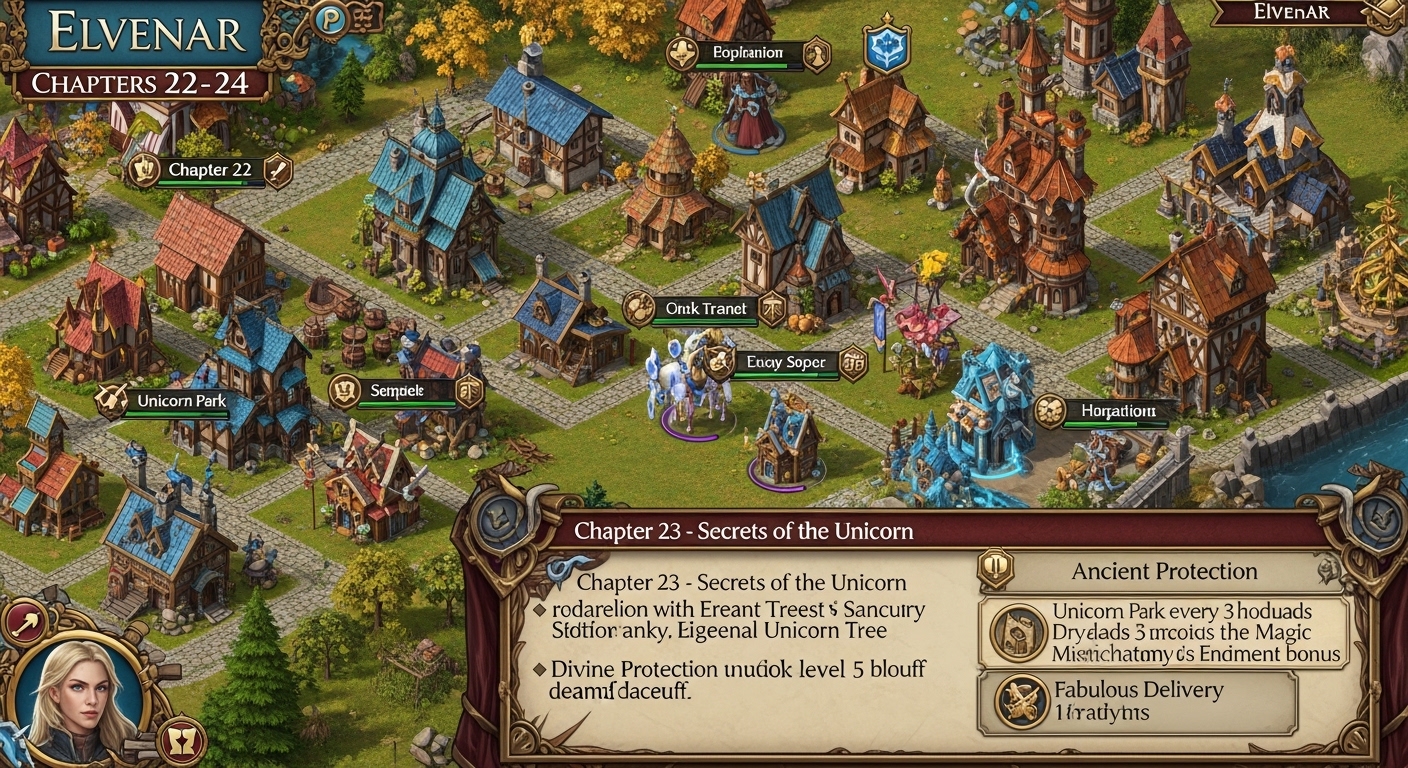
    Progression in Elvenar follows a chapter-based research system that has grown substantially over the years. As of 2025, the game features 24 chapters, with Chapter 23 “Secrets of the Unicorn” released in May 2025 and Chapter 24 following in November 2025

    . Each chapter introduces new buildings, resources, story quests, and Ancient Wonders—massive structures that provide powerful passive bonuses to your city.

    The narrative of Chapter 23 exemplifies Elvenar’s commitment to storytelling. Players face mounting evidence that Vallorion, a malevolent deity, has been resurrected and is causing natural disasters. To combat this threat, players must seek an audience with Enar, the god of the forest, by building a replica of the Treants’ sacred sanctuary and planting the legendary Unicorn Tree. This chapter introduces Heritage Huts for existing guest races and a powerful new combat ability called Divine Protection, which allows level 5 units to block debuffs from enemy types they’re strong against

    .

    Two new Ancient Wonders debuted in Chapter 23: the Unicorn Park (3×8), which produces Dryads every three hours and increases Magic Academy disenchantment bonuses, and the Fabulous Delivery Service (5×3), which boosts standard good production and reduces canned goods decay

    .

    Strategic Combat and World Map Exploration

    Beyond city management, Elvenar features a turn-based tactical combat system that pits players against various monsters and enemy forces. Battles occur on diverse battlegrounds with up to 20 different unit types available, creating tactically deep encounters that require careful consideration of unit strengths, weaknesses, and positioning

    .

    The world map serves as Elvenar’s multiplayer backbone. Here, players scout neighboring provinces, unlock powerful Relics through negotiation or combat, and interact with fellow rulers. Relics enhance workshop efficiency, providing significant production boosts that accelerate city development

    . This system encourages both peaceful cooperation and strategic conquest, allowing players to choose their preferred approach to expansion.

    Community and Social Features

    Elvenar emphasizes community through its Fellowship system (formerly Bands of Fellows), which allows up to 25 players to form persistent groups for trading, visiting, and coordinated chat

    . Fellowships provide crucial support networks where members exchange goods, share strategies, and participate in collective events.

    The development team maintains active communication with players through official forums, where they share development roadmaps, gather feedback, and announce upcoming features. In January 2025, the team revealed plans for two new chapters annually, a new community building (with both survey options being developed due to an unprecedented 50/50 vote split), and a revised update cycle moving from bi-weekly to tri-weekly releases to improve quality control

    .

    Events and Seasonal Content

    A vibrant calendar of seasonal events keeps the game fresh throughout the year. Recent events include the Living Chorus (March 2026), Cosmic Phoenix Rite (March 2026), Summit Trials (February 2026), and Winter Magic (November 2025)

    . These limited-time activities introduce exclusive buildings, special quests, and unique rewards that encourage regular engagement.

    The Seasons system represents another layer of progression, offering Blessings for Seasons that provide ongoing benefits to active players. Combined with the Magic Academy—where players disenchant items for valuable resources—and various crafting systems, Elvenar offers remarkable depth for those seeking long-term investment.

    Monetization and Player Experience

    As a free-to-play title, Elvenar utilizes a premium currency system centered on Diamonds. These can be purchased with real money or earned slowly through gameplay, and provide conveniences such as instant building completion, premium cultural buildings, and city expansions. Player opinions on monetization vary considerably: some praise the game as genuinely free-to-play with patience and strategy, while others argue that later chapters require significant investment to progress at reasonable speeds

    .

    Trustpilot reviews present a mixed but generally positive picture, with many long-term players (2+ years) emphasizing that success comes from strategic thinking rather than spending

    . However, some criticism exists regarding recent changes to Ancient Wonder upgrade requirements and account recovery issues. The development team has addressed some concerns through improvements to upgrade systems, with players noting that recent changes made it easier to upgrade previously stagnant Ancient Wonders

    .

    Technical Evolution and Platform Accessibility

    Elvenar began as a browser-based game but has expanded to include dedicated Android and iOS applications, with cross-platform progression ensuring players can manage their cities anywhere. The development team continues refining the technical foundation, with Version 1.225 released in September 2025 bringing various optimizations

    .

    Third-party tools like iDavis-Elvenar have emerged to support the community, offering city planners, building databases, event calculators, and quest lists. These resources demonstrate the dedication of Elvenar’s player base and the complexity that dedicated players navigate

    .

    The Future: Looking Ahead to 2026 and Beyond

    As Elvenar celebrates its tenth anniversary in 2025, the future appears bright. The commitment to two chapters per year ensures steady content flow, while the tri-weekly update cycle promises more polished feature releases

    . The development team has teased Spire improvements and continues refining existing systems based on community feedback

    .

    The game’s longevity speaks to its fundamental quality: a relaxing yet strategically engaging experience that respects player time while offering depth for those who seek it. Whether you’re drawn to the aesthetic pleasure of designing beautiful cities, the tactical challenge of turn-based combat, or the social aspects of Fellowship cooperation, Elvenar provides a fantasy sandbox that has matured gracefully over its decade of operation.

    Conclusion

    Elvenar stands as a testament to what persistent world games can achieve when developers prioritize consistent content updates and community dialogue. From its 2015 launch through its ambitious 2025 content roadmap, the game has evolved from a promising city-builder into a comprehensive fantasy MMO with remarkable breadth. As Chapter 24 unfolds and the tenth anniversary celebrations begin, both new players and veteran rulers have much to look forward to in this enchanting realm where magic and strategy intertwine.

    For those seeking a city-building experience that rewards patience, creativity, and strategic thinking, Elvenar remains one of the most compelling options in the free-to-play space—a fantasy kingdom that continues to grow more magnificent with each passing year.

  • Sentient Goods in Elvenar: The Complete Guide to Chapter XII and Beyond

    Sentient Goods in Elvenar: The Complete Guide to Chapter XII and Beyond

    Introduction: The Evolution of Resource Management

    In Elvenar, just when you think you have mastered the art of resource management, the game introduces new layers of complexity that transform your strategic approach. Sentient Goods represent the first major evolution beyond Standard Goods, arriving with Chapter XII – The Elementals. These advanced resources are not merely another currency to stockpile—they introduce unique production mechanics, a distinctive decay system, and entirely new trading dynamics that will fundamentally change how you manage your city from Chapter XII onward.

    This comprehensive guide will walk you through everything you need to know about Sentient Goods: how to unlock them, how to produce them efficiently, the unique “decay into something useful” mechanic that sets them apart, and the strategies that separate successful players from those who struggle. Whether you are approaching Chapter XII for the first time or already navigating the complexities of later chapters, this guide will ensure you master this essential resource system.

    What Are Sentient Goods?

    Sentient Goods are advanced versions of regular goods, representing a higher tier of resource that becomes essential for progression from Chapter XII forward. Unlike Standard Goods, which remain useful throughout the game, Sentient Goods are specifically required for:

    • Researching technologies in Chapters XII and beyond
    • Upgrading certain buildings to higher levels
    • Exploring and negotiating with distant provinces
    • Producing even more advanced resources in later chapters

    Like Standard Goods before them, Sentient Goods are grouped into three distinct categories that unlock progressively:

    • Basic Sentient Goods: Introduced in Chapter XII – The Elementals
    • Refined Sentient Goods: Introduced in Chapter XIII – The Amuni
    • Precious Sentient Goods: Become available in later chapters

    This tiered structure means that as you advance through the chapters, you will need to master increasingly complex production chains, with each tier building upon the resources of the previous one.

    Unlocking Sentient Goods

    Research Requirements

    Sentient Goods become available when you reach Chapter XII – The Elementals in the Research Tree. The first Sentient Good you can research is the Production Boost for Basic Sentient Goods, which unlocks the ability to produce these resources in your upgraded manufactories.

    For Refined Sentient Goods, you will need to progress to Chapter XIII – The Amuni and research the corresponding Production Boost technology.

    Manufactory Level Requirement

    Before you can produce any Sentient Goods, you must upgrade your Basic Manufactories to level 24 or higher. This investment ensures that only established cities with developed production infrastructure can access this advanced tier.

    Once your manufactories reach level 24, their production options change significantly:

    • 1-day and 2-day production options are replaced with Sentient Goods production
    • 3-hour and 9-hour production options remain unchanged for regular Standard Goods

    This means you cannot simply convert all your production to Sentient Goods. You must strategically balance your manufactory usage between producing Standard Goods for immediate needs and Sentient Goods for advanced progression.

    Determining Your Boosted Sentient Good

    Just as with Standard Goods, each player has a boosted Sentient Good that they produce more efficiently based on their relic collection. The formula for determining your boosted Sentient Good follows a +1 cycling pattern from your Standard Goods boost.

    Basic Sentient Goods (Chapter XII)

    Your boosted Basic Sentient Good is always your current Basic Boosted Good +1 in the standard goods order:

    Your Boosted Standard GoodYour Boosted Sentient Good
    MarbleMoonstone
    SteelPlatinum
    PlanksElven Tree Gum

    For example, if your boosted Standard Good is Marble, your boosted Sentient Good will be Moonstone. If your boosted Standard Good is Steel, you will be boosted for Platinum. If your boosted Standard Good is Planks, you will be boosted for Elven Tree Gum.

    Refined Sentient Goods (Chapter XIII)

    For Refined Sentient Goods, the same +1 cycling applies to your Refined Goods:

    Your Boosted Refined GoodYour Boosted Refined Sentient Good
    CrystalObsidian
    ScrollsArcane Ink
    SilkRoyal Velvet

    To determine your boosted Refined Sentient Good, open your Main Hall and navigate to the Relics tab. The game will clearly display which Sentient Good receives your production boost.

    Boost Mechanics

    Your production boost for Sentient Goods follows the same relic-based system as Standard Goods. The more relics you have collected for your boosted Sentient Good type, the higher your production multiplier. The required number of relics and the corresponding boost levels are displayed in the Relics Overview within your Main Hall.

    How to Produce Sentient Goods

    Production Requirements

    Producing Sentient Goods requires two key inputs:

    1. Divine Seeds: A resource introduced in Chapter XI (Halflings) that continues to be essential
    2. The corresponding Standard Good from the same manufactory type

    For example, to produce Moonstone in a Marble Manufactory, you need Divine Seeds and Marble. To produce Platinum in a Steel Manufactory, you need Divine Seeds and Steel. To produce Elven Tree Gum in a Planks Manufactory, you need Divine Seeds and Planks.

    Production Strategy

    A common mistake among players new to Sentient Goods is building too many manufactories dedicated to their production. Experienced players recommend starting with just one manufactory for your boosted Sentient Good.

    As one forum user explains: “Just build one to start, you won’t need a whole street full of them like with standard goods. You might want a second at some point but play it by ear”.

    This conservative approach allows you to:

    • Assess your Divine Seeds income before committing more space
    • Learn the production rhythms without overextending
    • Use trading to acquire non-boosted Sentient Goods rather than producing them inefficiently

    A Critical Warning

    When starting Sentient Goods production, pay close attention to which production option you select. A player who learned this lesson the hard way warns:

    “Hot tip: when you start a production, be sure to select the sentient production at the bottom and not the standard production at the top. Otherwise 3 hours later you’ll have a small handful of planks instead of bucket loads of gum. Learnt from experience. I still do that now when I’m a tad bleary eyed!!”

    This simple mistake can cost you hours of production time, so always double-check your selection before confirming.

    The Unique Decay Mechanic

    Perhaps the most distinctive feature of Sentient Goods—and the one that causes the most confusion—is their special decay system.

    How Decay Works

    Sentient Goods are affected by a daily decay of 10%, processed overnight. However, unlike Mana or Divine Seeds which simply vanish when they decay, Sentient Goods have a much more forgiving mechanic: they do not disappear but “transform back” into the original resource.

    The transformation works on a 1:1 basis. For example:

    • 1,000 Moonstone decaying → You lose 100 Moonstone and gain 100 Marble
    • 1,000 Platinum decaying → You lose 100 Platinum and gain 100 Steel
    • 1,000 Elven Tree Gum decaying → You lose 100 Tree Gum and gain 100 Planks

    This means your Sentient Goods are never truly “lost” to decay—they simply revert to their base Standard Good form. While this is less punishing than complete disappearance, it still represents inefficiency, as you invested Divine Seeds to create those Sentient Goods and now have only Standard Goods to show for it.

    Storage and Decay Management

    You can store unlimited amounts of Sentient Goods in your Main Hall. However, decay applies automatically to all stored Sentient Goods each night, regardless of how much you have.

    The compounding nature of decay means that the longer you take to use your Sentient Goods, the more you lose to the daily 10% reduction. A player provided a practical example:

    “Beginning with 0… Day 1 production 30,000. After decay 27,000. Day 2 production 30,000 + 27,000 = 57,000. After decay 51,300. Day 3 production 30,000 + 51,300 = 81,300. After decay 73,170. After 3 instances of Decay, I’ve lost 16,830 units—more than half of the day 1 production”.

    Reducing Decay Rates

    While decay is unavoidable, you can reduce its impact. The Simia Sapiens Ancient Wonder, which becomes available at the end of Chapter XIV, reduces Sentient Goods decay. At higher levels, this Wonder can significantly lower the decay rate, allowing you to stockpile Sentient Goods more effectively.

    As one player noted, “Considering just how much sentient goods you will need in every chapter from where you are? If your choice is the AW or one more sentient factory, then definitely [choose the Simia Sapiens], because decay is applied to all 9 [tiers]”.

    Production Timing Strategy

    Given the decay mechanic, many experienced players recommend a simple but effective strategy: only produce Sentient Goods when you need them.

    As one forum contributor explains: “First, there are occasions when I am halted in research, and when I am halted my need for Sentient goods is low, so unless I have an immediate use, I do not produce them. When sentient goods are lost to decay you are losing seeds, standard goods, coins, supplies, and the time involved to produce the Sentient goods”.

    When you do need to produce Sentient Goods for research or upgrades, the best approach is to produce them as quickly as possible to minimize the number of decay cycles they experience before being used.

    Trading Sentient Goods

    Trader Requirements

    To trade Sentient Goods with other players, you must upgrade your Trader:

    • For Basic Sentient Goods: Upgrade the Trader to level 3 (available in Chapter XII)
    • For Refined Sentient Goods: Upgrade the Trader to level 4 (available in Chapter XIII)

    How Sentient Trading Works

    Once your Trader is upgraded, Sentient Goods appear in the trading interface alongside Standard Goods. However, there are important differences:

    • Expanded trading range: You have access to a much wider area of trading partners on the World Map for Sentient Goods than for Standard Goods
    • Marked offers: Offers from players who are not within your standard trading group are specifically marked, with a tooltip informing you that you can only trade Sentient Goods with that player
    • Decay applies to offers: Sentient Goods offers decay every night by 10%, with decayed offered goods reappearing as Standard Goods in your storage

    The Wholesaler Option

    In addition to player-to-player trading, the Wholesaler offers non-boosted Sentient Goods in exchange for your boosted ones. While these trades are generally less favorable than player trades, they provide a reliable option when you cannot find a trading partner.

    Trading Strategy

    The most efficient approach to acquiring non-boosted Sentient Goods is to produce only your boosted type and trade for the others. As a game moderator confirmed: “Use your Boosted Tree Gum to trade for the others you need (Moonstone and Platinum)”.

    This strategy minimizes your manufactory footprint and Divine Seeds consumption while ensuring you have access to all Sentient Good types through the trading system.

    Maximizing Production Efficiency

    Using Enchantments

    Magical Manufacturing enchantments significantly boost your Sentient Goods production. When combined with other bonuses, the results can be dramatic.

    A player shared their experience with enchanted production using level 27 manufactories:

    • Unenchanted production: Total Sentient T3: 38,348 units at 1.98 units per Divine Seed
    • Enchanted production (with Elvenar Trade Center and Storm Phoenix): Total Sentient T3: 86,776 units at 5.16 units per Divine Seed

    That represents more than double the output from the same Divine Seeds investment—a massive efficiency gain.

    Key Buildings for Enhancement

    The Elvenar Trade Center Ancient Wonder increases the effect and duration of Magical Manufacturing enchantments. At level 15, it provided a 76.25% boost to enchantment effectiveness in the example above.

    The Storm Phoenix (a limited-time event building) doubles the effect value of Magical Manufacturing enchantments for 3.5 hours when fed with Pet Food.

    Time Management Strategy

    For maximum efficiency, players recommend using Time Spells to collect multiple productions while enchantments are active. As one player explained: “I use time spells to collect 1 – 9hr production and 2 – 3hr productions each factory within the active duration”.

    Strategic Recommendations

    For Players Entering Chapter XII

    1. Prepare your Divine Seeds production before reaching Chapter XII. You will need a steady supply.
    2. Upgrade one manufactory of your boosted type to level 24. Start with just one.
    3. Research Advanced Scouts first in Chapter XII, then prioritize the Basic Sentient Goods technology.
    4. Upgrade your Trader to level 3 as soon as possible to enable trading.
    5. Produce only your boosted Sentient Good and trade for the others.

    For Players in Later Chapters

    1. Consider building the Simia Sapiens Ancient Wonder to reduce decay rates across all nine Sentient Good types.
    2. Use Magical Manufacturing enchantments when you need large quantities of Sentient Goods for research or upgrades.
    3. Avoid idle production—only produce Sentient Goods when you have an immediate need to minimize decay losses.
    4. Keep your Trader upgraded to access Refined Sentient Goods trading when you reach Chapter XIII.

    Conclusion

    Sentient Goods represent a significant evolution in Elvenar’s resource management systems. While they introduce new complexities—particularly the decay mechanic—they also offer strategic depth that rewards careful planning and efficient execution.

    The key principles to remember are simple: produce only your boosted type, trade for the others, use enchantments when you need large quantities, and only produce Sentient Goods when you are ready to use them. With these strategies in place, you will master the Sentient Goods system and smoothly progress through Chapter XII and beyond.

  • Mastering the Elvenar Research Tree: A Complete Guide to Technological Progression

    Mastering the Elvenar Research Tree: A Complete Guide to Technological Progression

    Introduction: The Backbone of Your City

    In Elvenar, the Research Tree is far more than a simple upgrade menu—it is the very backbone of your city’s progression. Every building you construct, every troop you train, and every resource you unlock traces its origin to a specific technology. Understanding how this intricate system works separates successful, smoothly advancing cities from those that stall and struggle. This comprehensive guide will walk you through everything you need to know about the Elvenar Research Tree, from its basic mechanics to advanced strategies for efficient progression through even the most challenging chapters.

    What Is the Research Tree?

    The Research Tree is Elvenar’s primary progression system, representing your civilization’s technological and cultural advancement. As you progress through chapters—each introducing a new theme, guest race, or major storyline—you unlock new technologies that expand your city’s capabilities.

    Each technology node requires two things to unlock: Knowledge Points (the universal research currency) and often specific resources that vary by chapter. These resources might include standard goods like coins and supplies, or chapter-specific resources like Mana, Divine Seeds, Sentient Goods, or guest race productions.

    The tree itself is not a single linear path. Many chapters feature branching paths that allow you to choose your research priorities. Some branches focus on military improvements, others on economic upgrades, and still others on unlocking new buildings or production capabilities. Making the right choices about which technologies to research first can dramatically impact your progression speed.

    How Knowledge Points Work

    Knowledge Points (KPs) are the fuel that powers your research. You earn them through multiple methods:

    • Automatic generation: Your city produces one KP per hour, storing up to ten at a time in your KP bar
    • Ancient Wonders: Some Wonders generate additional KPs daily
    • Tournaments: Participating in weekly tournaments rewards KPs based on your performance
    • Events: Special event quests often reward KPs
    • Province encounters: Completing encounters on the world map yields KPs
    • Direct purchase: You can buy KPs using gold, though costs increase with each purchase

    The key to efficient research is never letting your KP bar sit full. Any KP generated while your bar is at capacity is wasted. Make a habit of checking your Research Tree regularly and investing KPs even if you cannot complete a technology immediately.

    The Structure of a Typical Chapter

    While every chapter in Elvenar introduces unique mechanics and themes, most follow a recognizable structure. Understanding this pattern helps you plan your research strategy effectively.

    The Portal Technology

    Nearly every chapter after the early game begins with a technology that unlocks the chapter’s central portal building. This portal serves as the heart of the chapter’s settlement mechanics. For example, in the Halflings chapter (Chapter XI), the Spring Grove portal stores all chapter-specific resources and enables the production chains that follow.

    Researching and building your portal should almost always be your first priority when entering a new chapter. Without it, you cannot access any of the chapter’s unique productions or progress further through the tech tree.

    Production Buildings and Chains

    After establishing your portal, the Research Tree typically unlocks various production buildings. These structures work together in chains, where one building’s output becomes another’s input. The Halflings chapter demonstrates this clearly: Grain Fields produce ingredients like Grain, Carrots, Pumpkins, and Apples, which then feed into Halfling Farms that produce Tingle Bread, Savvy Soup, and Jolly Jelly—the key goods required for unlocking technologies.

    More advanced chapters introduce increasingly complex production networks. In Chapter XX (The Power of Music), you must manage relationships between Instrument Makers and specific types of Manufactories—Violin Makers connect to Refined Manufactories, Flute Makers to Precious Manufactories, and Drum Makers to Basic Manufactories. These connections require careful city planning and cannot be ignored.

    Advanced Scouts Technology

    One of the most important recurring technologies in the Research Tree is Advanced Scouts. This technology, which appears near the beginning of most chapters (though notably absent in some later chapters like Chapter 17), permanently reduces the cost and difficulty of scouting new provinces, negotiating with encounters, and fighting battles.

    Because this reduction applies only to provinces scouted after researching the technology, it should be prioritized early in each chapter. Scouting provinces before unlocking the current chapter’s Advanced Scouts permanently locks in higher costs for those provinces—a mistake that can cost millions of resources over time.

    Settlement Expansions

    Most chapters include technologies that grant additional city expansions. These are invaluable because space is always at a premium in Elvenar. Some expansions are mandatory for chapter completion, while others are optional and can be researched at your leisure. Generally, you should prioritize mandatory expansions when they block progress toward other technologies, but optional expansions can wait until you need the space.

    Resource Management Across Chapters

    As you progress through the Research Tree, the types of resources you need evolve dramatically. Understanding this evolution helps you prepare for future chapters.

    Early Chapters (I-X)

    The earliest chapters require only basic resources: coins, supplies, and standard boosted goods (marble, steel, or planks, plus the相应 refined goods as you advance). Production is straightforward, and the Research Tree is relatively simple. Use these chapters to build a strong economic foundation.

    Mid Chapters (XI-XIV)

    Starting with the Halflings chapter (XI), you encounter new resource types like Mana and Divine Seeds. These “sentient” resources add complexity to your city management. The developers have rebalanced these chapters to smooth progression, adjusting requirements for coins, supplies, Mana, Seeds, and various goods.

    For example, in Chapter XII, Divine Seeds requirements increased by 50% in some technologies, while Mana requirements decreased in six technologies and increased in seven others. These adjustments aim to create a more consistent difficulty curve.

    Chapter XI itself saw significant changes: technologies that previously required Mana (which was difficult to obtain at this stage) now require coins and supplies instead. This makes early access to these technologies much more achievable.

    Late Chapters (XV+)

    From Chapter XV (The Elvenar) onward, you encounter Sentient Goods and increasingly complex settlement mechanics. In Chapter XV, production buildings must be strategically connected: academies must sit next to the portal, production buildings must connect to academies, and the Vault of Wisdom requires contact with all three production types.

    By Chapter XXIII (Secrets of the Unicorn), the game revisits elements from much earlier chapters. You return to Orc portals and settlement streets from Chapters VI through XI, with each race getting its own district, portal, and space allocation. This nostalgic design rewards long-term players while introducing new mechanics like Heritage Huts that produce resources needed for research.

    Branching Paths and Research Order

    One of the most common questions players ask is: “What should I research first?” The answer depends on your chapter and playstyle, but several general principles apply.

    Prioritize the Portal

    As mentioned, your chapter’s portal should be your first research target. Without it, you cannot produce chapter-specific resources, and without those resources, you cannot research most other technologies.

    Prioritize Advanced Scouts

    If Advanced Scouts is available in your chapter, research it immediately after your portal. The savings on scouting and encounter costs compound across every province you discover thereafter.

    Prioritize Production Upgrades

    After establishing your portal and Advanced Scouts, focus on technologies that improve your production buildings’ efficiency or unlock new production options. Faster production means faster resource accumulation, which means faster research overall.

    Balance Military and Economic Technologies

    Some chapters feature distinct branches for military improvements and economic upgrades. If you fight frequently, prioritize military technologies. If you prefer to negotiate, prioritize economic ones. Hybrid players should research both, but may want to focus on one branch first based on immediate needs.

    Leave Optional Expansions for Last

    Technologies that grant city expansions but are not required for further progress can safely wait until you need the space. Researching them earlier provides no immediate benefit if you have empty space already.

    The Role of Quests

    Your chapter questline is designed to guide you through the Research Tree efficiently. Following the questline closely ensures you research technologies in an order that supports your progression, building what you need when you need it.

    The developers have specifically rebalanced chapters 11 through 14 so that quests now ask for the recommended number of buildings and their levels, aligned with your world map progress and Research Tree position. If you find yourself stuck, check your quests—you may have diverged from the intended path.

    Common Mistakes to Avoid

    Researching Too Broadly

    Spreading Knowledge Points across multiple technologies delays the completion of any single one. Focus your KPs on one technology at a time unless you have a specific strategic reason to do otherwise.

    Ignoring Settlement Layout Requirements

    Many chapters impose specific adjacency requirements. In Chapter XV, academies must be next to the portal; production buildings must connect to academies; the Vault of Wisdom requires contact with all three production types. Ignoring these requirements can render your settlement buildings non-functional.

    Selling Settlement Buildings Too Early

    Each chapter’s settlement buildings are necessary for producing resources required by the Research Tree. Selling them before completing all technologies that require those resources forces you to rebuild them, wasting time and resources.

    Scouting Without Advanced Scouts

    As emphasized throughout this guide, scouting provinces before researching Advanced Scouts permanently locks in higher costs. Wait until you have the technology.

    Planning for Future Chapters

    Forward-thinking players can prepare for upcoming chapters by stockpiling resources their current chapter does not yet require. For example, knowing that Chapter XI introduces Mana requirements, you can begin producing Mana before you technically need it by building Mana-producing buildings from Ancient Wonders or events.

    Similarly, understanding that Sentient Goods become crucial in later chapters encourages you to develop your Sentient Goods production capacity early. The Trader upgrades that unlock higher-tier trading are valuable research targets when available.

    Conclusion

    The Elvenar Research Tree is a deep, rewarding system that rewards strategic thinking and careful planning. By understanding the structure of each chapter, prioritizing key technologies like the portal and Advanced Scouts, and managing your resources wisely, you can progress smoothly through even the most challenging chapters.

    Remember that every city is unique. Your playstyle, fellowship support, and Ancient Wonder choices all influence which research paths make the most sense for you. But the principles outlined here—focus on your portal, prioritize Advanced Scouts, follow your quests, and plan ahead—will serve you well regardless of your specific situation.

  • The Spire of Eternity in Elvenar: A Complete Guide to Contributions, Rewards, and Strategy

    The Spire of Eternity in Elvenar: A Complete Guide to Contributions, Rewards, and Strategy

    The Spire of Eternity stands as one of Elvenar’s most challenging and rewarding weekly features. Since its introduction, it has evolved significantly, offering players a complex multilayer experience that combines individual skill with fellowship cooperation. This comprehensive guide explores everything you need to know about making meaningful contributions to the Spire, maximizing your rewards, and understanding the recent changes that have transformed this mystical tower.

    What is the Spire of Eternity?

    The Spire of Eternity is a weekly mini-game that becomes accessible once players reach Chapter 3. Every Sunday at 16:00 CEST, a mysterious spire materializes on the left side of your city, remaining available until Friday at 22:00. Each week brings new opportunities and fresh rewards, with no progress carrying over from previous weeks .

    The Spire consists of three distinct levels, each progressively more difficult than the last. Each level contains four sections, with each section featuring four ghost guardians protecting reward chests, plus a powerful boss ghost that guards both a chest and the gateway to the next section or level . This structure creates a genuine sense of progression and achievement as players ascend through the tower.

    Core Mechanics: Fighting vs. Negotiation

    When confronting any ghost in the Spire, players face a fundamental choice: fight or negotiate. Each approach has its own mechanics, advantages, and challenges.

    Combat in the Spire

    Fighting in the Spire differs significantly from standard province battles. The critical difference lies in multi-wave encounters. Some fights feature two or even three consecutive rounds, requiring players to select their troops once and use that same army across all rounds without reinforcement or replacement . Losses from early rounds carry forward, making each subsequent wave increasingly difficult.

    Success in Spire combat demands careful preparation. Experienced players recommend deploying multiple five-day military buildings from the Magic Academy, including the Unleashed Unit Upgrade, Enlightened Light Range, and Magnificent Mage Multiplier. The Fire Phoenix, when fed, provides substantial combat bonuses that many consider essential for reaching the highest levels . Ancient Wonders such as the Martial Monastery, Needles of the Tempest, and Heroes’ Forge also contribute significantly to combat effectiveness.

    For players struggling with multi-wave fights, strategy guides suggest focusing on the final wave when selecting troops. Setting up to counter the last wave’s composition, even at the cost of heavier losses in earlier waves, often proves the most successful approach .

    The Negotiation Mini-Game

    Negotiation in the Spire presents a unique “mastermind-style” puzzle that differs from standard province negotiations. Each spirit desires one specific type of good, and players must deduce which good each spirit wants within three attempts or fewer .

    The puzzle begins with three goods and expands to up to eight different possibilities at the final boss. Players offer combinations of goods and receive feedback about which spirits are satisfied and which goods are unwanted. Successful negotiation requires logical deduction, carefully tracking clues across attempts.

    Experienced negotiators recommend using the first attempt to test five different goods, gathering maximum information about what the spirits do and do not want. Vertical and horizontal logic patterns then help narrow down the possibilities. If the solution remains unclear after two attempts, players may either spend diamonds for an additional round or exit to preserve goods for a fresh attempt .

    For players who prefer negotiation, the Astral Phoenix provides valuable benefits when fully evolved, reducing goods costs by ten percent .

    Fellowship Collaboration and Rewards

    The Spire incorporates a robust multiplayer component that transforms individual achievement into fellowship-wide benefits. This system encourages cooperation and strategic planning among fellowship members.

    Spirit Essence Points

    Individual progress in the Spire generates Spirit Essence points, which contribute to the fellowship’s overall standing. Players earn one point per regular encounter, two points per mini-boss at gates one through three, and three points per map boss. A complete run through all three levels yields a maximum of 63 points per player .

    Fellowship Rewards Structure

    The fellowship reward system features twelve milestones, unlocked at specific Spirit Essence thresholds: 10, 30, 60, 110, 180, 270, 380, 520, 690, 880, 1080, and 1330 points . Each unlocked milestone provides rewards to all fellowship members who have personally reached the corresponding individual progression point.

    This dual requirement means that players cannot simply rely on their fellowship to carry them. To receive second-level rewards, a player must have personally completed the second level of the Spire, regardless of how many points the fellowship collectively earns . This system ensures that individual effort remains meaningful while still rewarding fellowship cooperation.

    Strategic fellowships can optimize their rewards by coordinating efforts. Twenty-two players completing the entire Spire generates 1,386 points, unlocking all twelve rewards for every participant. Alternatively, smaller groups of dedicated players can still unlock substantial rewards for their entire fellowship .

    Recent Major Changes (2024)

    August 2024 brought significant changes to Spire rewards, sparking extensive community discussion. The development team implemented these changes based on beta testing feedback, aiming to balance excitement with valuable rewards while ensuring all player types could thrive.

    New Reward Structure

    The updated reward system reintroduced Magic Buildings through a new Tome of Magical Foundations, available in the second-stage boss reward pool. This tome allows players to choose between a Magical Residence, a Magical Workshop, or a Blueprint .

    Three new Tomes of Threefold Virtues were added, providing Spectral Stones, Vitality Surges, and Time Reduction Instants. The quality of these tomes improves as players progress further through the Spire .

    Teleport Building Spells were added as medium rewards with a fifteen percent chance, in addition to remaining as fellowship rewards for stage milestones. This change brought the weekly average of available Teleport Building Spells to 4.35 after three completed stages .

    Time Reduction Instants saw significant increases. The weekly average for three completed stages rose from 150.55 hours to 171.55 hours through the August changes .

    Community Response to Changes

    The reward changes generated mixed reactions, particularly regarding the reduction in diamond availability. Many veteran players cited diamonds as their primary motivation for reaching the Spire’s summit. One player expressed frustration that the reduced diamond income, combined with decreased Catalyst availability, would limit their ability to progress .

    Some players calculated that their time instant consumption now exceeded their gains, making weekly Spire completion potentially unsustainable for certain playstyles. A player reported using 79 hours worth of time instants while gaining only 57 hours, creating a net loss despite using them only for progression rather than troop retraining .

    However, developers emphasized that the overall reward value now exceeds previous offerings when considering all new items, including Eldian Sapphires, Pet Food, Blueprints, and the increased quantities of Spell Fragments and Royal Restorations .

    The Vestige of Eternity Ancient Wonder

    One of the most significant recent additions is the Vestige of Eternity, a specialized Ancient Wonder dedicated to the Spire. Unlike traditional Ancient Wonders, this structure does not appear in the research tree. Instead, it becomes available through Spire-specific technology and occupies no city grid space, as it is built outside the city boundaries .

    The Vestige of Eternity can be upgraded to level 35 across seven visual stages. It uses special Spirit Orbs instead of standard Rune Shards, obtained through Spire gameplay. Each five-level upgrade tier requires progressively more orbs, from nine orbs for levels 1-5 up to fifteen orbs for levels 31-35 .

    The Wonder provides two main effects. First, it grants one free Premium Expansion every five levels, totaling seven expansions at maximum level. Second, at the start of each Spire stage, players can choose from eleven rotating benefits that grow stronger with upgrades. These benefits include increased damage for all unit classes, shorter magical barrier timers, increased mystery chest chances, reduced negotiation costs, and various resource bonuses .

    Spire Battle Skill System

    A sophisticated difficulty scaling system called Spire Battle Skill has been introduced to personalize the challenge. Players begin with a value of 800 when first unlocking the Spire. This value is recalculated weekly based on performance, with higher values increasing both challenge and rewards .

    This system creates a dynamic experience where players are consistently challenged at an appropriate level while being rewarded proportionally to their skill development. Notably, the Spire Battle Skill affects challenge level and rewards but does not impact the drop rate for negotiation currency .

    Harold’s Shop and Radiant Stones

    Successful Spire encounters now reward Radiant Stones, a new currency usable in Harold’s Shop, available on each Spire stage. The shop offers exclusive items with limited stock that refreshes every six weeks .

    Players receive bonus Radiant Stones for winning multiple negotiation games in a row through a “Negotiation Combo Factor.” This bonus resets when a new Spire begins or if players lose or abandon a negotiation during the third round .

    Fellowship Progression Integration

    The Spire connects deeply with the broader Fellowship Progression system introduced in December 2021. Each Spire Crystal unlocked by the fellowship provides 4,000 Experience Points toward fellowship perks .

    These perks include Knowledge Point sharing, Tournament and Spire Archives that preserve partially earned points between weeks, and Advanced Help for extended neighborly assistance timeframes . This integration ensures that Spire activity contributes meaningfully to long-term fellowship development.

    Practical Strategies for Success

    For players seeking to maximize their Spire contributions, several proven strategies emerge from experienced community members.

    Newer players in earlier chapters should focus primarily on negotiation rather than combat. With limited troop数量和未开发的 ancient wonders, fighting becomes prohibitively expensive . As players progress and develop military infrastructure, fighting becomes increasingly viable.

    Mixing approaches often proves optimal. One common strategy involves negotiating the first level nearly completely, fighting the second level with proper support buildings active, and relying primarily on combat for the third level where negotiation costs become extremely high .

    Stockpiling five-day military buildings for occasional “push” weeks rather than attempting full clears every week provides better resource efficiency for developing cities. Even the top tournament players sometimes deploy seventeen or more five-day buildings simultaneously .

    Conclusion

    The Spire of Eternity represents one of Elvenar’s most engaging and rewarding features, offering layers of strategic depth for both individuals and fellowships. Recent changes have transformed the reward structure, emphasizing diverse valuable items over concentrated diamond income. The introduction of the Vestige of Eternity and Harold’s Shop adds new progression paths and meaningful choices.

    Whether you prefer the tactical challenge of multi-wave combat, the logical puzzle of negotiation, or the collaborative effort of fellowship coordination, the Spire offers something for every playstyle. By understanding its mechanics, staying informed about updates, and applying proven strategies, players can consistently contribute to their fellowship’s success while earning substantial personal rewards.

  • Maximizing Daily Engagement: The Elvenar Login System Explained

    Maximizing Daily Engagement: The Elvenar Login System Explained


    In the magical kingdom of Elvenar, daily login rewards serve as the foundation of consistent player engagement, providing guaranteed resources simply for accessing the game. Unlike complex systems requiring active participation, these rewards acknowledge that life interrupts even the most dedicated rulers. Understanding the various login reward mechanisms—from standard daily bonuses to event-specific windfalls and seasonal progression systems—ensures you never miss valuable opportunities to accelerate your city’s development

    .

    The Standard Login Reward Architecture

    At its core, Elvenar’s login system operates on a progressive reward structure that encourages consistent daily engagement. While specific implementations have evolved over the game’s history, the fundamental principle remains: checking in daily provides escalating benefits that reward loyalty

    .

    The system typically features consecutive day bonuses where each login builds upon previous engagement. Missing a day doesn’t erase your progress entirely but may reset certain streak-based benefits. This forgiving approach accommodates real-world schedules while maintaining incentive for regular play

    .

    Mobile-exclusive bonuses add another layer to daily engagement. Players accessing Elvenar through mobile applications receive a Free Daily Gift available through the in-game Store window—a feature unavailable to browser-based players

    . This mobile incentive reflects the game’s cross-platform strategy, encouraging app installation without penalizing desktop users.

    Event Login Rewards: Guaranteed Festival Currency

    The most substantial daily login rewards emerge during seasonal events, where simply opening the game generates significant event currency income. These rewards operate independently of quest completion, outskirts collection, or active participation, making them the most efficient currency source available

    .

    Autumn Zodiac 2024 exemplified this system: players received 50 Golden Keys immediately upon event start, followed by 35 Golden Keys daily simply for logging in

    . Across a typical three-week event, this passive income totaled over 1,000 Golden Keys—representing approximately 30-40% of total free-to-play currency acquisition. No quest completion, no strategic decisions, just guaranteed rewards for maintaining login habits.

    The Autumn Zodiac 2025 iteration maintained this structure with Shellux the Dragonsnail, again providing 35 Golden Keys daily alongside the initial starting bonus

    . This consistency allows players to budget event currency knowing that login rewards provide reliable baseline income regardless of quest difficulty or time availability.

    These daily event rewards stack with all other currency sources. A player logging in collects their guaranteed keys, then completes quests, collects outskirts drops, and opens chests—creating compound benefits from single sessions. The login reward serves as the foundation upon which active participation builds

    .

    Seasons System: Daily Quest Integration

    The Seasons feature represents Elvenar’s most significant evolution of daily engagement mechanics. Introduced with the “Season of Dreams” in late 2022, this system replaced repeatable quests with structured daily and weekly objectives spanning 75-day periods

    .

    Daily Quest Structure: Each day brings 4 new Daily Quests that must be completed within 24 hours. These quests integrate naturally with normal gameplay—producing goods, training units, collecting resources—rather than demanding extraordinary efforts. Completing all 4 quests earns 4 Daily Keys that unlock the Daily Chest containing randomized rewards

    .

    The Daily Chest mechanic creates urgency: uncompleted quests expire, and their associated keys vanish. However, the system includes protective measures—if you complete quests but forget to open the chest, rewards automatically add to your inventory when daily quests refresh

    . This prevents loss due to simple oversight, though manual collection remains preferred for immediate gratification.

    Weekly Quests complement daily objectives with more challenging tasks offering greater Season Petals rewards. These weekly objectives persist across multiple days, accommodating players who cannot engage daily while still rewarding consistent participation. The combination of daily and weekly quests creates flexible engagement tiers

    .

    Reward Progression and Waypoints

    The Seasons system structures rewards along a 50-waypoint progression track. Each completed quest advances your position, unlocking increasingly valuable prizes. Waypoints feature:

    Standard Rewards: Available to all participants simply by collecting sufficient Season Petals. These include instants, resources, knowledge points, and buildings from previous events

    .

    Premium Rewards: Locked behind the Season Pass purchase. These exclusive items include unique buildings, additional artifacts, and enhanced resource packages. The pass can be purchased at any point during the season, retroactively unlocking all previously passed premium waypoints

    .

    Choice Waypoints: Certain positions offer selection between multiple reward options, allowing customization based on individual city needs. Unselected rewards at season end are chosen automatically, ensuring no player loses unlocked benefits due to indecision

    .

    Season Blessings: After completing all 50 waypoints, every 130 additional Season Petals earns a Season Blessing—essentially a bonus chest with escalating rewards. These post-completion mechanics ensure continued engagement even for players who rapidly finish the main track

    .

    Strategic Login Timing

    While login rewards seem straightforward, optimization opportunities exist:

    Event Synchronization: Logging in at consistent times ensures you never miss daily event currency windows. Since event login rewards refresh on 24-hour cycles based on server time rather than personal last-login, establishing routine check-in times maximizes collection opportunities

    .

    Quest Stacking: Completing daily quests during single sessions prevents partial progress expiration. Since uncompleted daily quests vanish at refresh, partial completion wastes potential rewards. Planning play sessions to accommodate full quest completion optimizes Season progression

    .

    Mobile Utilization: Players with both browser and mobile access should claim mobile-exclusive daily gifts even when primarily playing desktop. These additional resources compound over time, creating significant advantages for cross-platform engagement

    .

    Weekly Quest Management: Since weekly quests persist across days, players with limited time can focus weekend sessions on challenging weekly objectives while handling quick daily quests during busy weekdays. This flexibility accommodates diverse schedules without punishing irregular engagement

    .

    Historical Evolution and Community Response

    Elvenar’s login reward systems have undergone significant transformation based on community feedback:

    Repeatable Quests to Seasons: The 2022 transition from infinite repeatable quests to structured Seasons represented the most dramatic change. Developers explained this shift as providing “more interesting quest tasks, with more meaningful rewards” while eliminating the grind of repetitive objectives

    . The community generally welcomed this evolution, though some veteran players missed the unlimited earning potential of repeatable systems.

    Daily Chest Mechanics: Early Seasons implementations required manual chest opening, leading to confusion when players completed quests but missed rewards. The auto-collection feature—adding unclaimed chest contents to inventory at refresh—addressed this pain point while maintaining the visual satisfaction of chest opening

    .

    Mobile Bonus Introduction: The mobile-exclusive daily gift emerged as smartphone engagement became increasingly central to gaming revenue. This platform-specific reward acknowledges mobile’s convenience while not penalizing desktop players who prefer larger screens or specific browser features

    .

    Common Login Reward Mistakes

    New and returning players frequently undermine their reward potential:

    Inconsistent Timing: Sporadic login patterns miss consecutive day bonuses and allow daily quest expiration. Even brief 5-minute sessions suffice to collect rewards and complete simple quests, making consistency more valuable than session length.

    Platform Neglect: Desktop-only players miss mobile daily gifts; mobile-only players sacrifice browser interface advantages. Optimal engagement leverages both platforms’ strengths—mobile for quick reward collection, desktop for complex city management.

    Event Ignorance: Some players don’t realize that event login rewards exist independently of quest participation. Simply opening the game during events generates currency, making zero-effort reward collection preferable to complete absence.

    Season Pass Hesitation: Delaying Season Pass purchase until late in the season wastes potential premium reward accumulation. Since passes retroactively unlock all passed waypoints, early purchase maximizes value from every completed quest

    .

    Comparative Value Analysis

    Understanding login reward value requires contextualizing against alternative acquisition methods:

    Event Currency: Login rewards typically provide 30-40% of total free event currency. A player earning 1,000 keys from login rewards and 2,000 from quests/outskirts achieves 3,000 total—login rewards represent the single largest income source despite requiring zero active play

    .

    Season Progression: Daily quests provide approximately 60% of Season Petals, with weekly quests contributing the remainder. Missing daily quests significantly slows waypoint advancement, potentially preventing completion of the 50-waypoint track before season end

    .

    Time Investment: Login rewards offer exceptional return on time invested. Five minutes collecting daily rewards and completing simple quests often yields resources requiring hours of alternative production. This efficiency makes daily engagement the highest-priority activity for time-constrained players.

    Conclusion

    Daily login rewards in Elvenar represent more than simple engagement mechanics—they embody the game’s philosophy of respecting player time while encouraging consistent participation. From guaranteed event currency to structured seasonal progression, these systems ensure that even brief daily sessions generate meaningful advancement.

    The evolution from basic consecutive bonuses to sophisticated Seasons integration demonstrates Elvenar’s commitment to rewarding loyalty without demanding addiction. Whether you’re a casual player collecting event login rewards during busy weeks or a dedicated ruler maximizing every Season waypoint, understanding and optimizing these daily systems transforms routine engagement into strategic advantage.

    In a game measured in months and years rather than hours, daily login rewards compound into significant differences. Master these systems, establish consistent habits, and watch your magical kingdom flourish through the steady accumulation of guaranteed blessings.

  • The Elvenar Crafting System: Mastering the Magic Academy

    The Elvenar Crafting System: Mastering the Magic Academy

    In the mystical world of Elvenar, the Crafting System stands as one of the most powerful yet frequently misunderstood mechanics available to city rulers. Centered within the Magic Academy, this system transforms accumulated resources into valuable buildings, powerful enchantments, and crucial combat boosts. Understanding crafting fundamentals separates efficient players from those who struggle with resource scarcity throughout their journey

    .

    The Magic Academy: Your Crafting Hub

    The Magic Academy serves as the cornerstone of Elvenar’s crafting ecosystem. This specialized building unlocks relatively early in your city’s development and provides three essential functions: researching ancient technologies, crafting valuable items, and disenchanting unwanted materials. The Academy operates on a cyclical schedule, refreshing its available crafting recipes every six hours, creating a rhythm that rewards consistent engagement

    .

    Upgrading your Magic Academy proves crucial for crafting efficiency. Each level increases the Spell Fragments gained from disenchanting items, with level 5 providing optimal returns regardless of your current chapter progress. A player in Chapter 3 with a level 5 Academy receives identical disenchantment values to someone in Chapter 21, making early Academy investment strategically sound

    .

    Crafting Resources: Spell Fragments and Combining Catalysts

    Two primary resources fuel the crafting engine: Spell Fragments (SF) and Combining Catalysts (CC). These materials work in tandem—virtually every crafting recipe requires specific quantities of both

    .

    Spell Fragments represent the more abundant resource, obtainable through multiple channels. The Spire of Eternity serves as the primary source, with weekly climbs generating thousands of fragments depending on your progress depth. Disenchanting unwanted buildings, instants, and enchantments from your inventory provides additional fragments, with values scaling based on item rarity and Magic Academy level. A single disenchantment can yield anywhere from hundreds to tens of thousands of fragments

    .

    Combining Catalysts prove more elusive. These rare materials primarily come from Spire rewards, crafting recipe outputs, and special building productions like the Moonstone Library set, which provides one catalyst daily once fully assembled. The scarcity of catalysts often becomes the bottleneck limiting crafting frequency, making their conservation and strategic deployment essential

    .

    The Crafting Recipe Ecosystem

    Elvenar’s crafting system features dozens of recipes across multiple categories, with availability rotating randomly every six hours. The recipe pool has expanded dramatically over time, now including hundreds of potential options that compete for limited crafting slots

    .

    Combat Boost Buildings rank among the most coveted recipes. These temporary structures provide percentage-based enhancements to specific unit types—Enlightened Light Range boosts Light Ranged units, Magnificent Mage Multiplier empowers Mages, and Unstoppable Orc Warriors strengthens Heavy Melee forces. These buildings typically last 5-7 days and can stack with other bonuses, creating devastating combat combinations when deployed strategically

    .

    Event Buildings and Artifacts allow players to acquire or upgrade special structures from past events. Crafting artifacts enables evolving building progression without waiting for event reruns, while complete buildings provide immediate utility. The Chess Set, Gingerbread House, and Mermaid Paradise represent examples of craftable building sets that provide ongoing resource generation

    .

    Enchantment Recipes create temporary city-wide buffs. Power of Provision accelerates supply production, Magical Manufacturing boosts goods output, and Ensorcelled Endowment enhances coin generation. These enchantments prove invaluable during heavy building phases or when preparing for demanding tournament pushes

    .

    Resource Conversion Recipes offer economic flexibility. Players can transform excess materials into scarce alternatives—converting surplus coins into supplies, basic goods into sentient goods, or spell fragments directly into combining catalysts. These recipes help balance asymmetric resource accumulation

    .

    Strategic Crafting Priorities

    Effective crafting requires establishing clear priorities based on your current city needs and future goals:

    Early Game (Chapters 1-6): Focus on Pet Food for evolving buildings and Portal Profits for guest race advancement. The Moonstone Library set should be your top crafting priority—despite requiring substantial initial investment (over 20,000 spell fragments), it generates 525 fragments and 1 combining catalyst daily once complete, paying for itself in approximately 40 days

    .

    Mid Game (Chapters 7-12): Transition toward Combat Boost Buildings as tournament participation becomes economically crucial. Enlightened Light Range and Unstoppable Orc Warriors particularly shine due to the “ranged dominance” meta in Elvenar combat. Maintain Moonstone Library production while stockpiling catalysts for high-value opportunities

    .

    Late Game (Chapters 13+): Prioritize Artifact Crafting for evolving building upgrades and Royal Restoration recipes for building rejuvenation. Combat boost buildings remain relevant, though their relative value decreases as permanent Ancient Wonder bonuses accumulate. Resource conversion recipes help manage the massive goods requirements of advanced chapters

    .

    The Recipe Rotation Challenge

    A persistent community concern involves recipe availability. With hundreds of recipes competing for limited slots, desired options may not appear for weeks. Players report waiting seven weeks or longer for specific combat boost recipes, creating frustration when tournament participation demands immediate enhancement

    .

    Several strategies mitigate this randomness:

    Frequent Checking: The six-hour rotation cycle means four potential opportunities daily. Consistent monitoring maximizes chances of catching desired recipes, though this demands significant time investment.

    Recipe Pool Manipulation: Crafting and retaining certain buildings (like the Chess Set) removes them from future rotation, theoretically increasing odds for preferred alternatives. However, with expanding recipe pools, this strategy’s effectiveness remains debatable

    .

    Diamond Acceleration: Spending premium currency to immediately refresh recipes provides direct access to desired options. This expensive approach suits wealthy players or critical tournament pushes but proves unsustainable for regular use.

    Timing Adjustment: Occasionally using diamonds to shift refresh timing ensures cycles occur during your active hours rather than sleep periods, preventing missed opportunities

    .

    Advanced Crafting Techniques

    Master crafters employ sophisticated strategies to optimize their Magic Academy usage:

    Disenchantment Optimization: Regular inventory audits identify disenchantment candidates. Portal Profits from evolving buildings like Fire Phoenix (5% every 48 hours = 210 fragments daily when disenchanted) and Trading Outpost provide steady fragment income. Event buildings that no longer serve your city layout convert into substantial resource injections—some players maintain over one million spell fragments through disciplined disenchantment

    .

    Recipe Profit Analysis: Certain recipes generate net positive returns. The Rainbow Flower Cage costs 300 spell fragments to craft but sells for one combining catalyst after placement—potentially profitable if catalyst value exceeds fragment cost. Similarly, the 6 Catalysts → 2,500 Fragments recipe enables resource conversion when catalysts accumulate excessively

    .

    Inventory Management: Maintaining diverse building stocks allows instant quest completion and strategic flexibility. Pocket combat boost buildings, resource instants, and miscellaneous structures prepare you for unexpected daily quest demands or sudden tournament pushes

    .

    Spire Integration: Weekly Spire participation provides the foundation for sustainable crafting. Gold Spire completion generates thousands of fragments and multiple catalysts, enabling consistent crafting without resource anxiety. Players struggling with fragment scarcity should prioritize Spire advancement over other weekly activities

    .

    Economic Considerations

    Crafting represents a significant economic sink requiring careful resource allocation. The Moonstone Library set exemplifies this—while ultimately profitable, its 20,000+ fragment construction cost demands months of saving for new players. This creates tension between immediate needs (combat boosts, enchantments) and long-term investments (passive generation buildings)

    .

    Opportunity Cost Awareness: Every fragment spent on combat boosts cannot fund Moonstone Library progress. Every catalyst used for minor enchantments delays artifact crafting. Successful players establish clear hierarchies—emergency combat boosts take precedence during tournament weeks, while passive generation dominates peaceful periods.

    Scaling Efficiency: As your city grows, fragment generation accelerates through multiple Spire clears, evolving building disenchantment, and Moonstone Library maturation. Early crafting scarcity transforms into late-game abundance, enabling frequent high-value crafting without resource anxiety. Patience during lean early periods yields exponential later returns

    .

    Common Crafting Mistakes

    New players frequently sabotage their crafting potential through preventable errors:

    Neglecting Magic Academy Upgrades: Failing to prioritize Academy level 5 dramatically reduces fragment generation from all sources. The upgrade cost pays for itself through improved disenchantment values within weeks.

    Impulsive Crafting: Using catalysts on marginal recipes (low-tier enchantments, temporary resource boosts) creates scarcity when high-value options finally appear. Disciplined catalyst conservation enables immediate response to exceptional opportunities.

    Ignoring Disenchantment: Hoarding obsolete buildings and unused instants wastes potential fragments. Regular inventory purges maintain liquidity for crafting demands.

    Recipe Pool Pollution: Crafting suboptimal buildings “just because they’re available” clutters inventory and potentially blocks better future options. Selective crafting maintains lean, purposeful stocks

    .

    The Future of Crafting

    Elvenar’s crafting system continues evolving. Recent updates introduced artifact crafting for evolving building advancement and expanded building sets with complex recipes. Community feedback suggests desire for deterministic recipe selection rather than random rotation, though developers maintain that randomness preserves game balance and engagement

    .

    The fundamental crafting loop—accumulate resources through Spire and disenchantment, convert through Magic Academy, enhance city capabilities—remains Elvenar’s most reliable progression path. Mastering this system ensures consistent advancement regardless of spending level, making the Magic Academy truly magical for dedicated players.

  • Elvenar Tournament Competitions: The Weekly Test of Strategy and Endurance

    Elvenar Tournament Competitions: The Weekly Test of Strategy and Endurance

    Every week from Tuesday through Saturday, thousands of Elvenar players across the world engage in the game’s most demanding competitive challenge: the Tournament. This recurring event transforms the peaceful city-building experience into a strategic battlefield where individual skill, resource management, and fellowship coordination determine success. With its sophisticated scoring system, escalating difficulty curves, and substantial rewards, the Tournament represents both the greatest challenge and the most lucrative opportunity for dedicated Elvenar commanders

    .

    Tournament Fundamentals: Structure and Timing

    The Tournament operates on a strict weekly cycle, opening every Tuesday and closing Saturday evening. Each week features one of nine distinct tournament types, each corresponding to a specific relic type: Marble, Steel, Planks, Crystal, Scrolls, Silk, Elixir, Magic Dust, and Gems. This rotation ensures variety while allowing players to prepare appropriate strategies for upcoming challenges

    .

    Participation requires scouted and fully cleared World Map provinces of the corresponding type. If a player has discovered 20 Marble provinces on the world map, they can access 20 tournament provinces during Marble week. This mechanic directly links exploration progress to competitive capacity, incentivizing aggressive world map expansion

    .

    Each tournament province contains up to six sequential rounds (also called encounters or stars), with completion of earlier rounds unlocking subsequent challenges. The first round offers manageable opposition, but difficulty escalates dramatically with each successive round. By round six, even experienced players with advanced cities face opponents with superior numbers, enhanced statistics, and challenging terrain configurations

    .

    The Scoring System: Mathematics of Optimization

    Tournament scoring follows a precise mathematical formula that rewards depth over breadth. Base points per encounter increase with each round: Round 1 provides 30 points, Round 2 yields 36, Round 3 offers 42, Round 4 gives 48, Round 5 awards 54, and Round 6 delivers 60 points. A fully completed six-star province thus generates 270 total points (30+36+42+48+54+60)

    .

    This progressive structure creates crucial strategic implications. Consider a player seeking 1,600 weekly points—the approximate “fair share” for a 25-member fellowship aiming for 10 chest rewards. They could achieve this through 54 provinces at 1 star (54 × 30 = 1,620) or 6 provinces at 6 stars (6 × 270 = 1,620). However, these equivalent point totals mask dramatically different resource costs

    .

    The first 5-9 provinces remain consistently easy regardless of city advancement, with players always outnumbering opponents. Province 8 marks the first significant difficulty spike, with Province 10 introducing severe numerical disadvantages where enemies outnumber your forces. By Province 20, the ratio reaches 1.5:1 against the player, with costs escalating non-linearly thereafter

    .

    Strategic conclusion: Completing fewer provinces to higher star levels proves substantially more resource-efficient than clearing many provinces at low rounds. Six provinces to 6 stars requires 36 encounters, while 54 provinces to 1 star demands 54 encounters—yet both yield similar points. The former concentrates effort in the “green zone” of easy provinces; the latter wastes resources on increasingly difficult encounters providing diminishing returns

    .

    The Cooldown Mechanic: Time as Resource

    Between completing one round and accessing the next, players face a 16-hour mandatory cooldown period. This timer represents a fundamental constraint that separates casual participants from competitive contenders. Without intervention, completing all six rounds in a single province requires nearly four days—problematic for a five-day event

    .

    Several mechanisms reduce this delay:

    Polar Bear Ancient Wonder: Each level reduces cooldown time by percentages. A level 10 Polar Bear provides substantial reduction, while higher levels approach theoretical minimums. One beta player reported achieving 1 hour 17 minute cooldowns using a level 19 TimeWarp combined with level 10 Polar Bear

    .

    TimeWarp Ancient Wonder: This structure reduces waiting time at all locations simultaneously, unlike single-use time boosters. Level 26+ TimeWarp combined with level 10 Polar Bear enables near-continuous tournament participation, allowing completion of two full tournaments and two Spire runs using a single set of five-day combat boosts

    .

    Time Boosters: Consumable items can accelerate individual province timers, though these prove less efficient than Wonder-based solutions for dedicated tournament players.

    The cooldown system thus creates a strategic hierarchy: Casual players accept natural timers and limited participation; committed players invest in Polar Bear and TimeWarp construction; elite competitors optimize both Wonders to maximum levels, achieving participation rates impossible through standard gameplay

    .

    Combat vs. Catering: Dual Paths to Victory

    Tournament encounters offer two resolution methods: fighting using trained military units or catering (negotiating) using manufactured goods. Each approach carries distinct advantages and resource implications.

    Fighting demands substantial troop production infrastructure and combat expertise. Successful fighters analyze enemy compositions, exploit class advantages (Heavy Ranged defeating Light Melee and Light Ranged; Mages dominating Heavy units), and leverage terrain positioning. The Fire Phoenix pet provides +50% combat bonus when fed, while Twilight Phoenix offers unit resurrection capabilities. Combat boost buildings (Unleashed Unit Upgrade, Enlightened Light Range, Magnificent Mage Multiplier) provide additional advantages when strategically deployed

    .

    Catering requires robust goods production and trading networks. Negotiation costs escalate with province progression and round completion, eventually demanding substantial quantities of all nine goods types. While catering avoids troop losses, it can deplete economic reserves rapidly during deep tournament runs.

    Hybrid approaches prove most sustainable for extended participation. Many elite players fight early rounds (where numerical advantages ensure victory) while catering difficult late-province encounters where troop losses would prove prohibitive. The TinLung pet rewards catering-focused players with Combining Catalysts—valuable crafting materials—making pure catering viable for players prioritizing specific resources

    .

    Fellowship Tournament System: Collective Achievement

    While individual tournament performance generates personal rewards, Fellowship coordination unlocks superior benefits. Fellowship tournament scores aggregate member contributions, with collective achievements determining weekly rewards

    .

    The chest system structures fellowship rewards. Each unlocked chest requires specific point thresholds and provides guaranteed rewards including Knowledge Points, Relics, and valuable items. Reaching 10 chests guarantees a Blueprint—essential for constructing and upgrading premium buildings. Advanced fellowships regularly achieve 12, 14, or even 19+ chests, with each additional chest providing escalating rewards

    .

    Fellowship Perks enhance tournament performance through the Progression system:

    • Tournament Archive: Stores unspent points from failed chest attempts, applying them to future weeks. This safety net prevents wasted effort when falling slightly short of thresholds
    • Advanced Help: Extends received help duration, indirectly supporting tournament preparation through improved city efficiency
    • Knowledge Points Sharing: Accelerates Ancient Wonder development, indirectly improving tournament capabilities through stronger military or economic infrastructure

    Each unlocked tournament chest generates 4,000 Fellowship Experience Points, accelerating Perk advancement and creating virtuous cycles of improving performance

    .

    Elite Competition: Records and Optimization

    The tournament’s competitive depth attracts dedicated players pursuing extraordinary achievements. Individual records exceed 37,000 points in single weeks, requiring completion of 100+ provinces across all six rounds. One player documented scoring 27,000 points using Azure Phoenix optimization, demonstrating how specific pet combinations enable exceptional performance

    .

    Fellowship competition reaches similar extremes. A veteran fellowship reported achieving 370,000+ weekly points during Steel tournaments—world records requiring coordinated participation from 25 members averaging 15,000 points each. Such achievements demand not merely individual skill but fellowship culture emphasizing tournament participation, resource sharing, and strategic coordination

    .

    Strategic Recommendations by Development Stage

    Early Game (Chapters 1-5): Focus on unlocking Training Grounds and establishing basic troop production. Prioritize completing 6-10 provinces to 6 stars rather than spreading efforts thinly. Build Polar Bear early to reduce cooldown frustration

    .

    Mid Game (Chapters 6-12): Construct TimeWarp to enable serious tournament participation. Develop hybrid fight/cater capabilities. Join active fellowships with 10+ chest weekly targets. Optimize city layout for military production

    .

    Late Game (Chapter 13+): Maximize Polar Bear and TimeWarp levels. Maintain all three military buildings (Barracks, Training Grounds, Mercenary Camp) running 24/7. Develop specialized strategies for each tournament type based on enemy compositions. Pursue fellowship leadership roles to coordinate collective achievement

    .

    Conclusion: The Tournament as Elvenar’s Competitive Heart

    The weekly Tournament transforms Elvenar from solitary city-building into dynamic competitive strategy. Its sophisticated scoring mathematics reward optimization; its cooldown mechanics separate dedication levels; its dual combat/catering systems accommodate diverse playstyles. Most significantly, its fellowship integration creates community bonds through shared achievement, where collective success exceeds individual capability.

    For new players, the Tournament provides progression milestones and resource acquisition. For veterans, it offers endless optimization challenges and competitive recognition. Whether pursuing modest weekly participation or world-record achievements, the Tournament remains Elvenar’s most engaging recurring challenge—a weekly testament to strategic planning, resource management, and community cooperation in this magical realm .