Tag: #citybuilder #empirebuilding #kingdombuilder #fantasycity

  • Elvenar Best Army Setup: The Ultimate Guide to Winning Battles

    Elvenar Best Army Setup: The Ultimate Guide to Winning Battles

    In Elvenar, having a strong and well-balanced army is essential for conquering provinces, completing tournaments, and progressing efficiently through the game. Many players struggle with battles not because they lack units, but because they don’t use the right army setup.

    This guide will help you understand the best army compositions, strategies, and unit combinations so you can dominate battles whether you play as Elves or Humans.


    Understanding Combat in Elvenar

    Before choosing the best army setup, you need to understand how combat works in Elvenar.

    • Battles are turn-based
    • Each unit has strengths and weaknesses
    • Terrain and positioning matter
    • Ranged and melee units behave differently

    Winning battles isn’t just about power—it’s about strategy and balance.


    Types of Units in Elvenar

    Both Elves and Humans have different units, but they generally fall into these categories:

    1. Light Melee Units

    • Fast and agile
    • Good for attacking ranged enemies
    • Weak against heavy units

    2. Heavy Melee Units

    • High defense and health
    • Slow movement
    • Best used as tanks

    3. Ranged Units

    • Attack from distance
    • Deal high damage
    • Vulnerable if enemies get close

    4. Magical Units (Elves) / Special Units (Humans)

    • Unique abilities
    • Can deal splash or special damage
    • Require strategic use

    Best Army Setup for Beginners

    If you’re new to Elvenar, start with a balanced army.

    Recommended Setup:

    • 2 Heavy Melee Units
    • 3 Ranged Units
    • 3 Light Melee Units

    Why this works:

    • Heavy units absorb damage
    • Ranged units deal damage safely
    • Light units eliminate enemy ranged units

    This setup is easy to manage and works well in early battles.


    Best Army Setup for Elves

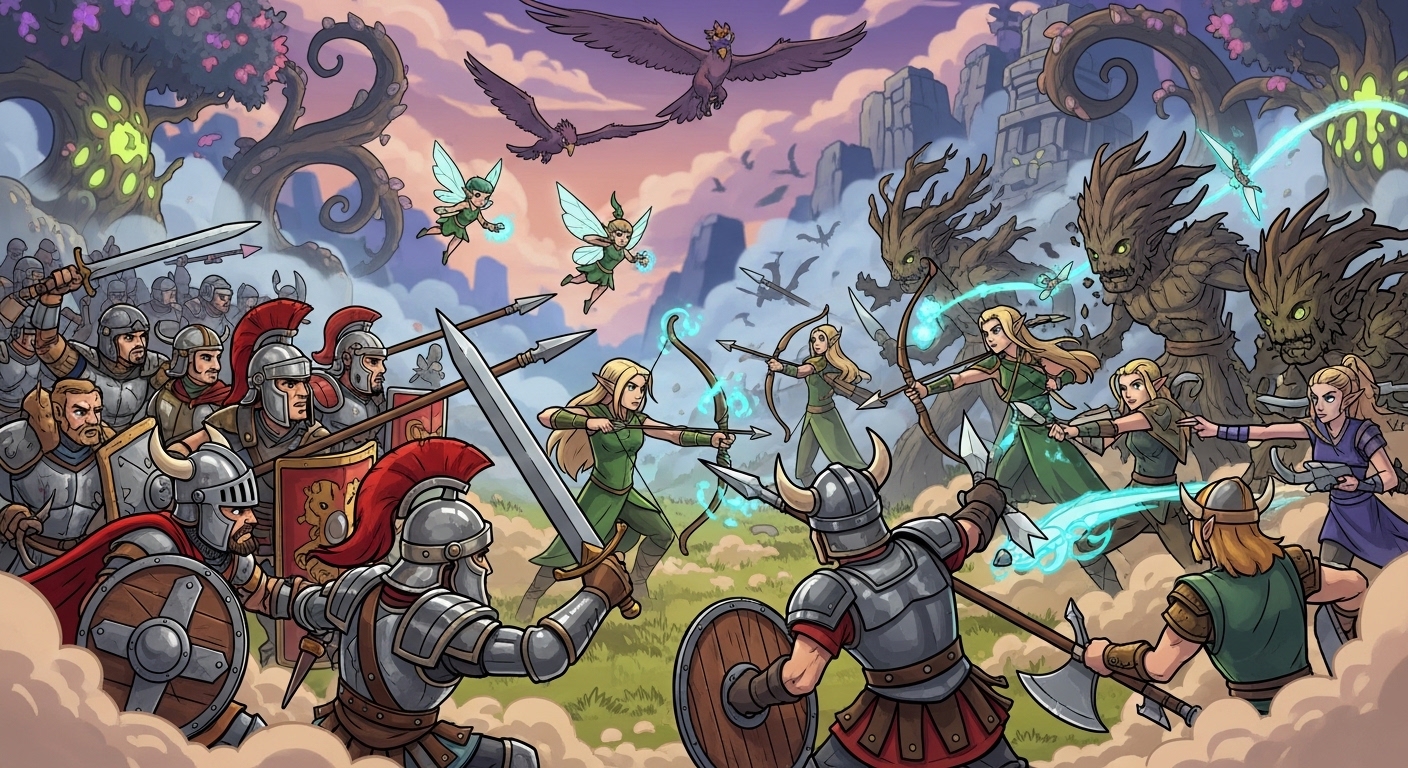
    Elven units are known for their speed and magic abilities.

    Strong Elven Composition:

    • Treants (Heavy Tanks)
    • Archers (Ranged Damage)
    • Sorceresses (Magic Units)

    Example Setup:

    • 2 Treants
    • 3 Archers
    • 3 Sorceresses

    Strategy:

    • Use Treants to block enemies
    • Keep Archers behind for damage
    • Use Sorceresses for splash attacks

    Elves rely on precision and positioning, so always protect your ranged and magic units.


    Best Army Setup for Humans

    Human units are more defensive and durable.

    Strong Human Composition:

    • Swordsmen (Heavy Units)
    • Crossbowmen (Ranged Units)
    • Knights (Fast Attackers)

    Example Setup:

    • 3 Swordsmen
    • 3 Crossbowmen
    • 2 Knights

    Strategy:

    • Use Swordsmen as front line
    • Crossbowmen deal damage from behind
    • Knights quickly eliminate threats

    Humans excel in defensive battles and sustained fights.


    Advanced Army Setups

    As you progress, you’ll need specialized setups depending on the enemy.

    1. Anti-Ranged Setup

    Use this when enemies have many ranged units:

    • 4 Light Melee Units
    • 2 Heavy Units
    • 2 Ranged Units

    Light units rush and destroy enemy archers quickly.


    2. Defensive Setup

    Best for tough battles:

    • 4 Heavy Units
    • 2 Ranged Units
    • 2 Support Units

    This setup focuses on survival and gradual damage.


    3. Aggressive Setup

    For quick wins:

    • 5 Ranged Units
    • 3 Light Units

    High damage but risky—requires good positioning.


    Importance of Terrain

    Terrain plays a huge role in battle outcomes.

    Key Tips:

    • Place ranged units on high ground
    • Use obstacles to block enemies
    • Protect weak units behind tanks

    Good positioning can turn a weak army into a winning one.


    Manual vs Auto Battles

    Auto Battle:

    • Quick and convenient
    • Works for easy fights

    Manual Battle:

    • Better control
    • Higher win chances in tough fights

    Recommendation:

    Use manual battles for:

    • Boss fights
    • Difficult provinces
    • Tournament battles

    Unit Positioning Strategy

    Positioning is just as important as unit selection.

    Basic Formation:

    • Heavy units in front
    • Ranged units at the back
    • Fast units on the sides

    Tips:

    • Don’t expose ranged units early
    • Focus attacks on one enemy at a time
    • Use terrain for advantage

    Common Mistakes in Army Setup

    Avoid these common errors:

    • Using only one type of unit
    • Ignoring enemy composition
    • Poor positioning
    • Overusing auto battle
    • Not upgrading units

    Fixing these mistakes can instantly improve your win rate.


    Upgrading Your Army

    Strong units make a big difference.

    How to improve your army:

    • Upgrade military buildings
    • Unlock new unit types
    • Research combat technologies

    Higher-level units have better stats and abilities.


    Tournament Army Strategy

    Tournaments require efficient army use.

    Tips:

    • Use balanced setups
    • Avoid heavy losses
    • Adapt to each enemy
    • Save strong units for later rounds

    Winning tournaments gives great rewards, so plan carefully.


    Best Army Setup for Map Exploration

    When exploring provinces:

    • Use balanced armies
    • Adjust based on enemy type
    • Preserve units for multiple battles

    Don’t go all-out in one fight—think long-term.


    Combining Army with Strategy

    The best army setup depends on your strategy.

    Key Principles:

    • Adapt to enemies
    • Use terrain wisely
    • Protect valuable units
    • Focus on efficiency

    No single setup works everywhere—you must adjust.


    Pro Tips for Dominating Battles

    • Always scout enemy units
    • Use manual battles in tough situations
    • Keep your army balanced
    • Upgrade regularly
    • Learn enemy weaknesses

    These small improvements can make a huge difference.


    Conclusion

    The best army setup in Elvenar is not about using the strongest units—it’s about using the right combination of units for each battle. A balanced army with proper positioning and strategy will always outperform a random setup.

  • The Complete Elvenar Army Training Guide: From Recruit to Warlord

    The Complete Elvenar Army Training Guide: From Recruit to Warlord

    Military dominance in Elvenar requires more than simply building a barracks and clicking “train.” Mastering army training involves understanding complex interactions between building upgrades, Ancient Wonders, training mechanics, and strategic planning. Whether you’re struggling to maintain troop levels for tournament participation, failing to clear Spire of Eternity encounters, or watching your armies crumble against seemingly equal opponents, this comprehensive guide reveals every technique for transforming your military from a ragtag militia into an unstoppable force.
    Understanding Training Fundamentals
    Elvenar’s military training system operates through three distinct production facilities: the Barracks (producing basic units), Training Grounds (specialized troops), and Mercenary Camp (advanced units) . Each facility features unique mechanics that determine training speed, capacity, and unit types available.
    The core training mechanic involves slots—individual production queues where units develop over time. Your Barracks starts with limited slots but gains additional ones through upgrades, eventually reaching five slots that enable continuous 24/7 production . Training consumes supplies and time, with larger training sizes requiring proportionally more resources and longer durations .
    Training Size determines how many units fit in each slot, while Training Speed controls how quickly those units develop . These distinct metrics create strategic tension: larger training sizes extend queue durations (beneficial for overnight production), while faster speeds enable rapid replenishment during active play sessions . Balancing these factors determines your sustainable military output.
    Strategy 1: The Training Queue Optimization
    Your training queue represents the foundation of military sustainability. The goal is maintaining continuous production that never stalls, regardless of your play schedule .
    The 8-12 Hour Benchmark: Experienced players target 8-12 hours of total training queue time across all five slots . This covers overnight absence while preventing excessive idle time during the day. With shorter queues, you lose production hours while sleeping; with excessively long queues, you waste capacity that could train additional unit types .
    Slot Management Techniques: Upgrade your Barracks to unlock all five slots as early as possible . Each slot operates independently, allowing diverse unit production simultaneously. Queue different unit types across slots to maintain balanced armies, or focus all slots on high-demand units during intensive tournament weeks .
    The Slider Adjustment: Training interfaces feature adjustable sliders controlling unit quantities per slot . During active play, reduce slider settings for frequent collection; before extended absence, maximize sliders for overnight production. This flexibility optimizes output without requiring constant building upgrades .
    Strategy 2: Armory Expansion and Management
    Armories fundamentally transform training capacity by increasing the Training Size—the number of units per slot . More armories mean larger batches, longer queues, and reduced collection frequency requirements .
    Quantity vs. Quality Debate: While more armories extend training time, they also consume significant space and population . Endgame competitive cities typically maintain 5-6 armories at level 15-31, balancing capacity against city efficiency . Excessive armory counts (6+ low-level armories) can actually hinder performance by extending queues beyond practical collection windows .
    Leveling Strategy: Armories change size during upgrades, requiring city reorganization . Some players cap armories at level 15 (4×4 size) for space efficiency, while others push to level 31 for maximum training size multipliers . Your chapter progression and available space determine optimal leveling paths.
    Temporary Armory Tactics: Deploy temporary armories (gained through events or crafting) strategically during intensive training periods . These structures boost Shrine of Shrooms calculations without permanent space commitment, allowing flexible capacity adjustments for tournament pushes or Spire attempts.
    Strategy 3: Ancient Wonder Prioritization
    Ancient Wonders revolutionize training mechanics, offering exponential returns that transcend standard building upgrades. Strategic wonder selection separates efficient militaries from resource-draining failures.
    Dwarven Bulwark: This Chapter 6 wonder extends training queue time based on your world map squad size . At early levels, it may add only minutes; at advanced levels (20+), it contributes hours of additional training capacity . Bulwark particularly benefits players who’ve completed squad size upgrades on the world map, as its calculations scale with those advancements .
    Shrine of Shrooms: Operating on total armory levels rather than squad size, this wonder excels for players with numerous armories . With 5-6 max-level armories, Shrooms often outperforms Bulwark; with fewer armories, Bulwark provides superior returns . Many competitive players maintain both, using Shrooms for primary capacity and Bulwark for supplementary extension .
    Speed Enhancement Wonders: Needles of the Tempest (Barracks speed), Victory Springs (Training Grounds speed), and Flying Academy (Mercenary Camp speed) reduce training durations while simultaneously boosting unit combat effectiveness . These dual-benefit wonders prioritize training efficiency over raw capacity, appealing to active players who collect frequently .
    Simia Sapiens: Considered by many as the game’s premier military wonder, Simia provides free troops periodically and enhances overall unit production . While expensive to level, its compound benefits justify investment for serious tournament competitors.
    Strategy 4: Building Upgrade Sequencing
    Strategic upgrade timing maximizes training efficiency without wasting resources on premature advancements.
    Barracks Priority: Upgrade your Barracks to maximum level for your chapter before heavily investing in armories . Higher-level barracks unlock additional slots and reduce individual unit training time, creating foundation capacity that armories then amplify .
    Training Grounds and Mercenary Camp: These secondary facilities unlock in later chapters (Chapter 8 and beyond), offering specialized units that outperform basic Barracks troops in specific encounters . Prioritize unlocking these facilities, then upgrade them parallel to your Barracks for balanced military development.
    The 20-Hour Target: Experienced players aim for 20+ hours of combined training queue time across all facilities . This ambitious target ensures continuous production even with irregular play schedules, supporting intensive tournament participation without troop shortages.
    Strategy 5: Unit Selection and Specialization
    Not all units train equally, and understanding these differences optimizes your production focus.
    Unit Weight Mechanics: Different unit types occupy varying training slot capacities . Light units (weight 1) train in large batches, while heavy units (weight 6) consume entire slots for single squads . This affects queue duration calculations—training six light melee units fills a slot faster than one heavy melee unit, despite equal slot utilization.
    Barracks vs. Specialized Facilities: Barracks produce “generalist” troops effective in standard situations, while Training Grounds and Mercenary Camp units specialize against specific enemy types . Rangers (Training Grounds) excel against mages with their strike-back ability, while Cerberus (Mercenary Camp) dominate mage encounters through initiative advantages .
    Ranged Unit Dominance: Tournament and Spire metas favor ranged units—Mages, Light Range, and Heavy Range—due to their initiative advantages and damage output . Prioritize training facilities producing these unit types, using Barracks primarily for support or specialized counters.
    Strategy 6: Supply Management for Sustained Training
    Training consumes massive supply quantities that standard production cannot sustain without optimization.
    Workshop Quantity: Endgame military cities require 8+ fully upgraded workshops to support continuous training . This exceeds standard economic recommendations, reflecting the supply demands of intensive troop production.
    Magic Workshop Integration: Spire of Eternity rewards include Magic Workshops with superior production efficiency . These structures should replace standard workshops in military-focused cities, freeing space for additional armories while maintaining supply output.
    Power of Provision Optimization: Deploy Power of Provision spells on workshops during intensive training periods . These enchantments dramatically boost supply production, enabling sustained high-volume training that would otherwise deplete reserves.
    Prosperity Towers: This Ancient Wonder generates supplies passively while extending enchantment durations . High-level Prosperity Towers (15+) maintain continuous Power of Provision effects, automating supply enhancement without manual spell casting.
    Strategy 7: Advanced Training Techniques
    Beyond basic mechanics, sophisticated strategies maximize military efficiency.
    Brown Bear Feeding: The Brown Bear pet building, when fed, provides troop production bonuses that compound with other enhancements . Strategic feeding before tournament pushes or Spire attempts generates massive troop reserves without proportional time investment.
    Time Instant Utilization: Stockpiled time instants (from events, Spire, or crafting) enable instant training completion during critical moments . Reserve these for tournament final rounds or Spire boss encounters where troop shortages would otherwise limit progress.
    Mercenary Camp Specialization: Mercenary Camp troops often outperform Barracks equivalents in specific matchups . Prioritize unlocking and upgrading this facility, focusing production on Drone Riders (anti-Light Range) and other specialized counters rather than generalist Barracks units.
    Strategy 8: Balancing Military with City Health
    Over-prioritizing military infrastructure creates imbalances that hinder overall progression.
    The Expansion Cost: Every expansion (province or premium) increases tournament and Spire encounter difficulty through the CAL (City Advancement Level) formula . Aggressive military players should minimize unnecessary expansions, focusing on “lean and mean” city designs that maximize training efficiency without escalating encounter costs .
    Wonder Level Management: While military wonders enhance training, excessive Ancient Wonder levels increase enemy squad sizes in tournaments and Spire . Balance wonder investment against encounter difficulty—sometimes lower-level wonders provide better cost-benefit ratios than maxed alternatives .
    Population and Culture Support: Armories and training facilities demand substantial population and culture . Ensure your city maintains adequate housing and happiness infrastructure to support military expansion without triggering production penalties.
    Conclusion: Your Path to Military Mastery
    Mastering Elvenar army training requires balancing multiple interconnected systems:
    Optimize training queues for 8-12 hour durations covering your longest absence periods
    Build 5-6 armories at moderate-to-high levels, avoiding excessive counts that extend queues impractically
    Invest in Dwarven Bulwark and Shrine of Shrooms for extended training capacity
    Prioritize speed wonders (Needles, Victory Springs, Flying Academy) for active play styles
    Maintain 8+ workshops with Magic Workshop upgrades for supply sustainability
    Focus on ranged units from Training Grounds and Mercenary Camp for tournament meta
    Utilize Brown Bear feeding and time instants for intensive push periods
    Balance military expansion against CAL increases from excessive provinces or wonders
    Remember that effective military training in Elvenar is not about maximizing single metrics—it’s about creating synergistic systems where armory capacity, wonder bonuses, supply production, and strategic unit selection combine into sustainable force generation. The players dominating your server’s tournament leaderboards have optimized these interactions, creating military machines that replenish faster than opponents can deplete them.

  • The Complete Elvenar Army Training Guide: Building Your Military Might

    The Complete Elvenar Army Training Guide: Building Your Military Might

    Introduction

    Military strength in Elvenar isn’t just about having troops—it’s about understanding the intricate systems that govern unit production, training efficiency, and squad composition. Whether you’re preparing for your first tournament, struggling with Spire of Eternity encounters, or simply seeking to reduce negotiation costs in province expansion, mastering army training fundamentals will transform your gameplay experience. This guide covers everything from basic barracks mechanics to advanced Ancient Wonder strategies that separate casual militaries from elite fighting forces capable of conquering the toughest challenges Elvenar offers.

    Understanding Military Infrastructure

    The Three Military Buildings

    Elvenar features three distinct buildings for unit production, each unlocking at different progression points

    :

    Barracks: Available from the start, producing five unique units per race (Light Melee, Light Ranged, Mage, Heavy Melee, Heavy Ranged). These are your “generalist” troops—versatile but not specialized against specific enemy types

    .

    Training Grounds: Unlocked in Chapter 2, offering ten shared units between races. These troops specialize against specific enemy types and become essential for advanced combat

    .

    Mercenary Camp: Available from the Fairies chapter (Chapter 9), providing another ten shared units with different specializations than Training Grounds troops

    .

    All three buildings share a unified production queue, meaning you must balance training across building types rather than running them independently

    .

    Barracks Mechanics and Upgrades

    The Barracks serves as your primary training facility, with mechanics that significantly impact your military efficiency. Each upgrade reduces training time and can increase available training slots up to a maximum of five slots

    .

    Training Slots: The base training size per slot is 6 weight units. Different unit types have different weights—an Axe Barbarian weighs 1, while a Paladin weighs 6

    . This means one slot trains six Axe Barbarians or just one Paladin, creating strategic decisions about unit composition versus training speed.

    Collection Requirement: Unlike automatic production, you must manually collect trained units by clicking the army icon above the Barracks

    . This icon appears when the first slot completes, indicating availability for new training while subsequent slots continue. Failure to collect blocks further production, making regular check-ins essential for maximum efficiency.

    Training Size vs. Training Speed: The Core Strategic Decision

    The fundamental tension in army training involves choosing between two improvement paths: increasing training size (more troops per slot) or increasing training speed (faster completion)

    .

    Training Size Increasers

    Armories: These buildings increase the base training size of slots across all military buildings. More armories mean larger squads per training cycle

    .

    Ancient Wonders:

    • Shrine of Shrewdy Shrooms: Increases training size based on total armory levels in your city. More effective with 5-6+ maxed armories .
    • Dwarven Bulwark: Increases training size based on world map squad size. More powerful for players with extensive province completion and squad size upgrades .

    Training Speed Increasers

    Barracks Upgrades: Each level reduces base training time

    .

    Ancient Wonders:

    • Needles of the Tempest: Speeds up Barracks training specifically .
    • Victory Springs: Accelerates Training Grounds production .
    • Flying Academy: Enhances Mercenary Camp training speed .

    Finding Your Balance

    The optimal configuration depends entirely on your play schedule. A player checking every two hours benefits more from speed enhancements that allow frequent queue reloading. A daily player needs extended training times—10-12 hours across five slots—to maintain overnight production

    .

    Critical benchmark: If your total training time across five slots falls below your longest absence period (typically overnight sleep), you’re losing production capacity. Aim for training queues that match or exceed your offline periods

    .

    Unit Types and Training Priorities

    Base Race Units (Barracks)

    Each race begins with five unit types following standard military roles

    :

    Light Melee: Basic close combat with good HP and damage. Humans favor offense (Axe Barbarians), while Elves balance offense and defense (Sword Dancers)

    .

    Light Ranged: High damage, low HP ranged attackers. Essential for eliminating threats before they reach your lines.

    Mage: Support units with special abilities—weak individually but capable of modifying enemy attributes (reducing attack or defense for subsequent rounds)

    .

    Heavy Melee: Extreme HP, low damage tanks designed to absorb punishment.

    Heavy Ranged: Specialized ranged with protective capabilities against Light Ranged counterattacks .

    Shared Units (Training Grounds and Mercenary Camp)

    These buildings provide specialized units that excel against specific enemy types

    :

    • Cerberus/Dogs: Specialized against Mages
    • Rangers: Superior Light Ranged with extra movement and Strike Back ability
    • Orc Warriors: Devastating against Light Melee
    • Vallorian Guards: Heavy Melee specialists against Heavy Ranged
    • Mortars/Frogs: Heavy Ranged with extreme range advantages

    The key distinction: Barracks troops serve as generalists, while Training Grounds and Mercenary Camp troops provide specialized counters. Experienced fighters maintain diverse armies rather than focusing exclusively on one building’s output

    .

    Advanced Training Strategies

    The Brown Bear Strategy

    The Brown Bear evolving building represents one of the most powerful training accelerators available. When fed pet food, it provides massive training speed bonuses that can dramatically increase your troop replacement rate

    . Players serious about military dominance prioritize feeding their Brown Bear before intensive tournament or Spire sessions.

    Power of Provision Integration

    While primarily a supply-boosting spell, Power of Provision indirectly supports military training by reducing supply constraints. Since training consumes substantial supplies, maintaining abundant supply reserves through enchanted workshops enables continuous military production without resource bottlenecks

    .

    Quest Cycling for Supplemental Troops

    Repeatable quests occasionally offer military unit rewards. While not a primary training method, cycling through declinable quests to target troop rewards can provide emergency reserves or specialized units outside your normal production focus

    .

    Squad Size and Scaling Considerations

    As you progress through chapters and research Squad Size Upgrades, your battlefield presence increases—but so does enemy strength

    . This scaling creates the paradoxical situation where advancing actually makes combat more challenging in relative terms.

    Training Implications: Larger squad sizes require more troops to fill slots completely. A player with 12-unit base squads needs twice as many troops per slot as someone with 6-unit squads. This scaling necessitates corresponding increases in training infrastructure—more armories, higher-level military buildings, and wonder investments—to maintain combat effectiveness

    .

    Efficiency Warning: Some experienced players note that smaller, less-developed cities sometimes perform better in Spire and tournaments because the scaling works in their favor. The “lean and mean” approach—minimizing unnecessary expansions and wonders—can paradoxically create more efficient military operations

    .

    Training Cost Management

    Supply Requirements

    Training troops consumes substantial supplies, creating competition with other city functions. Advanced players balance military production against goods manufacturing and building upgrades by

    :

    • Maintaining dedicated supply production (workshops, Prosperity Towers)
    • Using Power of Provision spells during intensive training periods
    • Stockpiling supply instants from events and crafting for emergency troop replacement

    The “Army Camp” Interface

    The Army Camp displays your available squads across all unit types. Understanding this interface helps prevent training mistakes—producing units you don’t need while lacking critical types for upcoming encounters

    .

    Common Training Mistakes

    1. Single-Building Focus: Training exclusively from Barracks while ignoring Training Grounds and Mercenary Camp specializations limits combat effectiveness against diverse enemies .
    2. Insufficient Queue Length: Allowing training times to drop below offline periods wastes overnight production capacity .
    3. Neglecting Collection: Failing to collect completed training blocks further production and wastes time.
    4. Over-Expansion: Excessive city expansions and Ancient Wonders increase squad size requirements without corresponding training infrastructure, making battles disproportionately difficult .
    5. Ignoring Unit Abilities: Training units without understanding their special abilities (initiative values, movement ranges, attack bonuses) leads to poor battlefield deployment .

    Conclusion

    Army training in Elvenar represents a complex optimization puzzle balancing time, resources, and strategic priorities. The player who masters training size versus speed calculations, maintains diverse unit portfolios across all three military buildings, and scales infrastructure appropriately with chapter advancement will find themselves capable of tackling tournaments, Spire encounters, and province conquests with confidence.

    Remember that military strength serves your broader city goals—whether reducing goods costs through fighting rather than negotiating, earning tournament rewards for city development, or simply enjoying the tactical combat system. Invest in your training infrastructure wisely, feed that Brown Bear, and watch your army transform from a ragtag militia into an elite fighting force capable of meeting any challenge the world of Elvenar presents.

  • The Complete Elvenar Barracks Guide: Mastering Military Production and Troop Training

    The Complete Elvenar Barracks Guide: Mastering Military Production and Troop Training

    Military might in Elvenar flows from three distinct training facilities, each producing specialized units that dominate different battlefield scenarios. Understanding how to optimize your Barracks, Training Grounds, and Mercenary Camp transforms struggling armies into unstoppable forces capable of conquering tournaments, spires, and world map provinces. This comprehensive guide explores every aspect of military production to accelerate your city’s martial development.

    Understanding the Three Military Buildings

    Elvenar features a trio of training facilities that unlock progressively through research, each serving distinct strategic purposes

    .

    The Barracks represents your foundational military structure, available immediately after completing initial research. It produces “generalist” troops—the basic Light Melee, Light Ranged, Heavy Melee, and Mage units that form your army’s backbone

    . These units offer balanced performance across various situations without excelling in specific matchups.

    The Training Grounds unlocks in Chapter 2 alongside your first specialized unit, the Cerberus

    . This facility produces specialized troops including Cerberus, Dryad, Banshee, Orc Warrior, and Orc Strategist—units designed for specific tactical roles rather than general combat

    .

    The Mercenary Camp becomes available later, offering the game’s most powerful specialized units. For Elves, this means Rangers (superior Light Ranged), Blossom Mages (elite magical units), and Valorian Guards (enhanced Heavy Melee). Humans gain access to Frog Princes (devastating Heavy Ranged) and other premium troops

    .

    Each building operates independently with separate training queues, meaning you can simultaneously produce nine different unit types across three facilities. Neglecting any single building reduces your total army production by 33%, creating significant long-term disadvantages

    .

    Barracks Mechanics and Optimization

    Your Barracks serves as the primary training facility throughout early chapters, with upgrade paths extending through 42+ levels

    . Each upgrade reduces training time and potentially increases available training slots, allowing more simultaneous production queues.

    Training Slots represent your production capacity. The Barracks starts with limited slots and gains additional ones as you upgrade, eventually supporting up to 5 simultaneous training queues

    . These slots operate independently—when one finishes training, the next begins automatically, creating continuous production chains.

    Training Size determines how many units fit in each slot. The base training size of 6 means each slot accommodates units totaling weight 6—six Axe Barbarians (weight 1 each) or one Paladin (weight 6)

    . This weight system creates important production considerations: light units train in bulk while heavy units consume entire slots for single squads.

    Armories expand your training capacity beyond base limits. Each Armory increases the training size of slots across all military buildings, allowing more units per training cycle

    . Strategic Armory placement and upgrades dramatically accelerate army replenishment rates.

    From Chapter XXI – The Vallorian Legend onward, Barracks contribute to Prosperity generation—a special requirement for constructing certain chapter buildings

    . This adds economic value to military infrastructure, making Barracks upgrades valuable even for primarily peaceful players.

    Training Speed vs. Training Size: The Critical Balance

    Two distinct mechanics govern troop production efficiency, and understanding their interaction separates expert commanders from novices.

    Training Speed determines how quickly units complete training. Higher speed means faster replenishment and shorter queue times. The Needles of the Tempest Ancient Wonder specifically accelerates Barracks training by up to 40%, while Victory Springs (Training Grounds) and Flying Academy (Mercenary Camp) provide similar benefits for their respective facilities

    .

    Training Size determines how many units you receive per completed training slot. Larger training size means more troops per collection but longer individual training times. The Shrine of Shrewdy Shrooms and Dwarven Bulwark Ancient Wonders increase training size significantly

    .

    The optimal balance depends on your play schedule. Players checking frequently benefit from high speed and moderate size, enabling multiple daily collections. Players with limited access prefer massive training sizes that sustain overnight production without constant reloading

    .

    Expert players aim for 10-15 hour total queue times across all slots—long enough to sustain overnight production but short enough to prevent idle time during active play

    . Achieving this requires careful coordination between building upgrades, Ancient Wonder levels, and Armory counts.

    Unit Specialization and Strategic Deployment

    Each military building produces units optimized for specific tactical roles, and understanding these specializations enables battlefield dominance.

    Barracks Units serve as generalists. Human Priests (Mages) and Paladins (Heavy Melee) rank among the best barracks troops, with Priests considered the premier mage unit throughout the game

    . Elven Treants and Golems provide solid Heavy Melee options, though they generally underperform Human equivalents

    .

    Training Grounds Units fill tactical niches. Cerberus (Light Melee) excel against mages but suffer from low initiative. Orc Strategists (Heavy Ranged) outperform standard Mortars significantly, making them essential for Human players

    . Dryads and Banshees provide specialized magical support, though their fragility limits general utility

    .

    Mercenary Camp Units dominate competitive play. Rangers (Light Ranged) offer superior range, initiative, and counterattack capabilities compared to standard Archers

    . Blossom Mages (Elves) provide the best magical offense available, while Frog Princes (Humans) deliver devastating Heavy Ranged damage

    . Valorian Guards give Elves competitive Heavy Melee options despite general racial disadvantages in that category

    .

    The strategic implication is clear: Mercenary Camp units should comprise your primary fighting force whenever possible, with Barracks and Training Grounds troops filling gaps or providing specific counter-matchups

    .

    Race-Specific Considerations

    Human and Elven military structures produce different units with distinct tactical implications.

    Human Advantages: Human Barracks units generally outperform Elven equivalents, particularly Priests (superior mages) and Paladins (better Heavy Melee)

    . Human players can delay Mercenary Camp construction longer than Elves, as their Barracks troops remain competitive through mid-game

    .

    Elven Advantages: Elven Mercenary Camp access becomes critical earlier. Blossom Mages immediately outclass Sorceresses, and Rangers dominate Light Ranged combat

    . Elven players should prioritize Mercenary Camp construction as soon as available, even sacrificing Training Grounds temporarily if space-constrained

    .

    Both races benefit from maintaining all three military buildings eventually. The “build only Barracks” strategy severely limits tactical flexibility and total production capacity, hobbling tournament and spire performance

    .

    Ancient Wonders and Military Optimization

    Several Ancient Wonders dramatically impact military production and effectiveness:

    Needles of the Tempest: Essential for any fighting city, this wonder accelerates Barracks training while boosting Light Range unit damage

    . Prioritize early construction and steady upgrades.

    Flying Academy: The Mercenary Camp equivalent, reducing training time while enhancing Light Melee damage. Critical for Elven players relying on Blossom Mages and Rangers

    .

    Victory Springs: Training Grounds acceleration with Heavy Melee damage bonuses. Less universally essential but valuable for specific tournament types

    .

    Simia Sapiens: Considered the best overall military wonder, providing massive training speed increases across all facilities

    . Late-game acquisition but transformative impact.

    Shrine of Shrewdy Shrooms: Increases training size while producing Archer units. Synergizes with heavy Armory strategies

    .

    Dwarven Bulwark: Alternative training size booster using squad size rather than Armory levels. Often superior for players with limited Armory investments

    .

    Martial Monastery/Sanctuary: Increases troop health, reducing battlefield losses and effectively amplifying your total army size through better survival rates

    .

    Advanced Training Techniques

    Queue Management: Maintain continuous production by queuing multiple training slots before collection. When the first slot finishes, immediately add another to prevent idle time

    . Set phone timers for Barracks completion when running extended queues

    .

    Brown Bear Exploitation: The Brown Bear pet doubles troop collection when fed, effectively providing 5-10 bonus squads per activation

    . Coordinate feeding with time booster usage—activate the bear, collect massive troop reserves, then use time instants to replenish training queues before the buff expires

    .

    Time Booster Optimization: Save 5-hour and 2-hour time instants for intensive military pushes. Apply them to Mercenary Camp or Training Grounds specifically when you need specialized troops for upcoming tournaments

    .

    Temporary Armory Deployment: Place temporary Armories before heavy tournament weeks to boost Shrine of Shrewdy Shrooms effectiveness, then remove them afterward to reclaim space

    .

    Supply Management and Sustainability

    Training troops consumes enormous Supplies, creating economic constraints that limit military development. A city running three military buildings 24/7 requires 8+ fully upgraded Workshops or equivalent supply generation from Ancient Wonders and event buildings

    .

    Supply optimization strategies:

    • Prioritize Workshop upgrades alongside military buildings
    • Construct Endless Excavation and Tome of Secrets Ancient Wonders for passive supply generation
    • Utilize Prosperity Towers if available in your chapter
    • Balance troop production with economic capacity—running all three buildings continuously wastes resources if you cannot sustain the supply drain

    Common Military Mistakes

    Building Only Barracks: This cripples your tactical options and reduces total production by 66%. All three buildings are essential for competitive play

    .

    Ignoring Training Grounds: Modern updates made Training Grounds viable, especially for Orc Strategist and Cerberus production. Dismissing this building reflects outdated thinking

    .

    Neglecting Ancient Wonders: Military wonders provide multiplicative benefits that compound over time. Delaying Needles of the Tempest or Flying Academy construction creates permanent disadvantages.

    Over-Specializing: While Mercenary Camp troops are generally superior, situations exist where Barracks or Training Grounds units excel. Maintaining diverse reserves enables optimal tactical responses.

    Poor Queue Management: Allowing training slots to sit idle wastes potential production. Check military buildings at least twice daily to maintain continuous queues.

    Conclusion: The Path to Military Mastery

    Barracks mastery in Elvenar requires understanding that military power flows from three distinct sources, each requiring investment and optimization. Your Barracks provides foundational generalists, the Training Grounds offers tactical specialists, and the Mercenary Camp delivers elite units that dominate competitive content.

    Success demands balancing training speed and size through Ancient Wonder selection, maintaining continuous production queues, and managing the supply economy that sustains your war machine. Race-specific considerations guide build priorities—Humans enjoy superior Barracks troops while Elves depend earlier on Mercenary Camp access.

  • The Complete Elvenar Army Training Guide: Building Your Military Might

    The Complete Elvenar Army Training Guide: Building Your Military Might

    Introduction

    Military strength in Elvenar isn’t just about having troops—it’s about understanding the intricate systems that govern unit production, training efficiency, and squad composition. Whether you’re preparing for your first tournament, struggling with Spire of Eternity encounters, or simply seeking to reduce negotiation costs in province expansion, mastering army training fundamentals will transform your gameplay experience. This guide covers everything from basic barracks mechanics to advanced Ancient Wonder strategies that separate casual militaries from elite fighting forces capable of conquering the toughest challenges Elvenar offers.

    Understanding Military Infrastructure

    The Three Military Buildings

    Elvenar features three distinct buildings for unit production, each unlocking at different progression points

    :

    Barracks: Available from the start, producing five unique units per race (Light Melee, Light Ranged, Mage, Heavy Melee, Heavy Ranged). These are your “generalist” troops—versatile but not specialized against specific enemy types

    .

    Training Grounds: Unlocked in Chapter 2, offering ten shared units between races. These troops specialize against specific enemy types and become essential for advanced combat

    .

    Mercenary Camp: Available from the Fairies chapter (Chapter 9), providing another ten shared units with different specializations than Training Grounds troops

    .

    All three buildings share a unified production queue, meaning you must balance training across building types rather than running them independently

    .

    Barracks Mechanics and Upgrades

    The Barracks serves as your primary training facility, with mechanics that significantly impact your military efficiency. Each upgrade reduces training time and can increase available training slots up to a maximum of five slots

    .

    Training Slots: The base training size per slot is 6 weight units. Different unit types have different weights—an Axe Barbarian weighs 1, while a Paladin weighs 6

    . This means one slot trains six Axe Barbarians or just one Paladin, creating strategic decisions about unit composition versus training speed.

    Collection Requirement: Unlike automatic production, you must manually collect trained units by clicking the army icon above the Barracks

    . This icon appears when the first slot completes, indicating availability for new training while subsequent slots continue. Failure to collect blocks further production, making regular check-ins essential for maximum efficiency.

    Training Size vs. Training Speed: The Core Strategic Decision

    The fundamental tension in army training involves choosing between two improvement paths: increasing training size (more troops per slot) or increasing training speed (faster completion)

    .

    Training Size Increasers

    Armories: These buildings increase the base training size of slots across all military buildings. More armories mean larger squads per training cycle

    .

    Ancient Wonders:

    • Shrine of Shrewdy Shrooms: Increases training size based on total armory levels in your city. More effective with 5-6+ maxed armories .
    • Dwarven Bulwark: Increases training size based on world map squad size. More powerful for players with extensive province completion and squad size upgrades .

    Training Speed Increasers

    Barracks Upgrades: Each level reduces base training time

    .

    Ancient Wonders:

    • Needles of the Tempest: Speeds up Barracks training specifically .
    • Victory Springs: Accelerates Training Grounds production .
    • Flying Academy: Enhances Mercenary Camp training speed .

    Finding Your Balance

    The optimal configuration depends entirely on your play schedule. A player checking every two hours benefits more from speed enhancements that allow frequent queue reloading. A daily player needs extended training times—10-12 hours across five slots—to maintain overnight production

    .

    Critical benchmark: If your total training time across five slots falls below your longest absence period (typically overnight sleep), you’re losing production capacity. Aim for training queues that match or exceed your offline periods

    .

    Unit Types and Training Priorities

    Base Race Units (Barracks)

    Each race begins with five unit types following standard military roles

    :

    Light Melee: Basic close combat with good HP and damage. Humans favor offense (Axe Barbarians), while Elves balance offense and defense (Sword Dancers)

    .

    Light Ranged: High damage, low HP ranged attackers. Essential for eliminating threats before they reach your lines.

    Mage: Support units with special abilities—weak individually but capable of modifying enemy attributes (reducing attack or defense for subsequent rounds)

    .

    Heavy Melee: Extreme HP, low damage tanks designed to absorb punishment.

    Heavy Ranged: Specialized ranged with protective capabilities against Light Ranged counterattacks

    .

    Shared Units (Training Grounds and Mercenary Camp)

    These buildings provide specialized units that excel against specific enemy types

    :

    • Cerberus/Dogs: Specialized against Mages
    • Rangers: Superior Light Ranged with extra movement and Strike Back ability
    • Orc Warriors: Devastating against Light Melee
    • Vallorian Guards: Heavy Melee specialists against Heavy Ranged
    • Mortars/Frogs: Heavy Ranged with extreme range advantages

    The key distinction: Barracks troops serve as generalists, while Training Grounds and Mercenary Camp troops provide specialized counters. Experienced fighters maintain diverse armies rather than focusing exclusively on one building’s output

    .

    Advanced Training Strategies

    The Brown Bear Strategy

    The Brown Bear evolving building represents one of the most powerful training accelerators available. When fed pet food, it provides massive training speed bonuses that can dramatically increase your troop replacement rate

    . Players serious about military dominance prioritize feeding their Brown Bear before intensive tournament or Spire sessions.

    Power of Provision Integration

    While primarily a supply-boosting spell, Power of Provision indirectly supports military training by reducing supply constraints. Since training consumes substantial supplies, maintaining abundant supply reserves through enchanted workshops enables continuous military production without resource bottlenecks

    .

    Quest Cycling for Supplemental Troops

    Repeatable quests occasionally offer military unit rewards. While not a primary training method, cycling through declinable quests to target troop rewards can provide emergency reserves or specialized units outside your normal production focus

    .

    Squad Size and Scaling Considerations

    As you progress through chapters and research Squad Size Upgrades, your battlefield presence increases—but so does enemy strength

    . This scaling creates the paradoxical situation where advancing actually makes combat more challenging in relative terms.

    Training Implications: Larger squad sizes require more troops to fill slots completely. A player with 12-unit base squads needs twice as many troops per slot as someone with 6-unit squads. This scaling necessitates corresponding increases in training infrastructure—more armories, higher-level military buildings, and wonder investments—to maintain combat effectiveness

    .

    Efficiency Warning: Some experienced players note that smaller, less-developed cities sometimes perform better in Spire and tournaments because the scaling works in their favor. The “lean and mean” approach—minimizing unnecessary expansions and wonders—can paradoxically create more efficient military operations

    .

    Training Cost Management

    Supply Requirements

    Training troops consumes substantial supplies, creating competition with other city functions. Advanced players balance military production against goods manufacturing and building upgrades by

    :

    • Maintaining dedicated supply production (workshops, Prosperity Towers)
    • Using Power of Provision spells during intensive training periods
    • Stockpiling supply instants from events and crafting for emergency troop replacement

    The “Army Camp” Interface

    The Army Camp displays your available squads across all unit types. Understanding this interface helps prevent training mistakes—producing units you don’t need while lacking critical types for upcoming encounters

    .

    Common Training Mistakes

    1. Single-Building Focus: Training exclusively from Barracks while ignoring Training Grounds and Mercenary Camp specializations limits combat effectiveness against diverse enemies .
    2. Insufficient Queue Length: Allowing training times to drop below offline periods wastes overnight production capacity .
    3. Neglecting Collection: Failing to collect completed training blocks further production and wastes time.
    4. Over-Expansion: Excessive city expansions and Ancient Wonders increase squad size requirements without corresponding training infrastructure, making battles disproportionately difficult .
    5. Ignoring Unit Abilities: Training units without understanding their special abilities (initiative values, movement ranges, attack bonuses) leads to poor battlefield deployment .

    Conclusion

    Army training in Elvenar represents a complex optimization puzzle balancing time, resources, and strategic priorities. The player who masters training size versus speed calculations, maintains diverse unit portfolios across all three military buildings, and scales infrastructure appropriately with chapter advancement will find themselves capable of tackling tournaments, Spire encounters, and province conquests with confidence.

    Remember that military strength serves your broader city goals—whether reducing goods costs through fighting rather than negotiating, earning tournament rewards for city development, or simply enjoying the tactical combat system. Invest in your training infrastructure wisely, feed that Brown Bear, and watch your army transform from a ragtag militia into an elite fighting force capable of meeting any challenge the world of Elvenar presents.

  • The Complete Elvenar Culture Buildings Guide: Optimizing Happiness and City Efficiency

    The Complete Elvenar Culture Buildings Guide: Optimizing Happiness and City Efficiency

    Culture represents the heartbeat of your Elvenar civilization, transforming sterile production centers into thriving communities while directly amplifying your economic output. Mastering culture building placement, selection, and optimization creates cascading benefits across every aspect of your city—from coin generation to research speed, from population happiness to competitive ranking. This comprehensive guide reveals every strategy for maximizing culture efficiency, from fundamental mechanics to advanced endgame techniques.

    Understanding Culture Fundamentals

    Culture serves dual essential functions in your city: it enables building upgrades and generates production bonuses. Every upgraded building consumes culture points, with higher tiers demanding exponentially more

    . Without adequate culture, your city stagnates regardless of other resource availability.

    The Culture Bonus system transforms excess culture into tangible economic benefits. When your available culture exceeds required amounts, remaining points generate production multipliers for coins and supplies

    . This bonus operates in distinct tiers: Level 1 boosts production to 125%, Level 2 reaches 150%, Level 3 hits 160%, and Level 4 achieves 170%

    . These aren’t gradual increases but threshold-based jumps—crossing each threshold instantly activates the corresponding bonus

    .

    Critically, the maximum sustainable bonus without external assistance is 170%. Reaching the theoretical 200% cap requires Neighborly Help—visits from fellowship members and neighbors who “polish” your cultural buildings, temporarily boosting their culture output

    . Additionally, Ensorcelled Endowment spells add 5% per enchanted building (maximum 5 buildings), but only function when those buildings receive Neighborly Help

    .

    Strategy 1: The No-Road Revolution

    The single most important culture building mechanic separates novice from expert city planners: culture buildings require no road connection

    . Unlike residences, workshops, and manufactories that demand street access, cultural structures function completely disconnected from your road network.

    Border Optimization: Place all cultural buildings along your city perimeter, completely isolated from roads

    . This preserves central space for production buildings that actually require infrastructure, effectively expanding your functional city area by 15-20%. A 3×3 manufactory consumes 9 squares plus road access; a 3×3 culture building uses only 9 squares total .

    Filler Strategy: Small 1×1 and 1×2 culture buildings excel at filling “dead” spaces—road ends, gaps between larger structures, and edge irregularities

    . The 2×1 Nature’s Blessing provides 100 culture, outperforming two Luxury Street squares (60 culture) while occupying identical space

    . Systematically identify these micro-opportunities and populate them with diminutive cultural structures.

    Visual vs. Functional Trade-offs: While disconnected border placement may appear aesthetically awkward

    , the spatial efficiency gains are undeniable. Prioritize function over form during competitive growth phases; reorganize for visual harmony once your economy stabilizes.

    Strategy 2: Road Culture Maximization

    Since roads are mandatory infrastructure, extracting maximum culture value from them optimizes unavoidable space consumption. Advanced road types provide substantial culture points that compound across your entire network

    .

    Immediate Upgrade Policy: Upon researching improved street types, upgrade your entire road network immediately

    . Luxury Streets provide 30 culture per square—across 130 squares, this generates 3,900 culture, potentially 40% of your required total

    . Delaying upgrades wastes daily production potential that compounds over weeks.

    Road-Residence Interface: Buildings only require connection to a single road square

    . Orient rectangular structures with their shorter dimension against roads, minimizing road contact while maintaining functionality. A 3×3 residence touching the road on only one square preserves surrounding space for culture buildings or additional structures

    .

    Surplus Road Preservation: During city reorganization, relocate rather than sell excess road segments

    . Store unused luxury streets in peripheral spaces for future expansion rather than recovering minimal coin value. This preserves your investment in high-culture infrastructure.

    Strategy 3: Building Selection and Replacement

    Cultural buildings cannot be upgraded but can be sold for partial resource recovery

    . This creates a dynamic replacement cycle as you advance through chapters.

    Efficiency Metrics: Evaluate buildings by culture-per-square ratios rather than absolute values. Early-game structures like the Luminous Signpost (Elves) or Glorious Statue (Humans) provide foundation culture, but chapter-unlocked alternatives typically offer superior density

    . Calculate (Total Culture) ÷ (Width × Length) for direct comparison.

    Hybrid Building Priority: Many players prefer “hybrid” culture buildings providing secondary benefits—population, goods, supplies, or military units

    . These dual-purpose structures maximize limited space, though pure culture buildings often achieve higher per-square culture density

    . Balance specialization against multifunctionality based on current city deficits.

    Chapter-Specific Optimization: Each guest race chapter introduces themed cultural buildings with unique aesthetics and values. Wood Elves offer Weeping Willows (5×5, 4,480 culture plus mana)

    ; Sorcerers & Dragons provide Arcane Libraries; Elementals introduce Temple of the Elements

    . Evaluate these within their chapter context—some provide exceptional value for specific progression stages.

    The 140-170% Sweet Spot: Experienced players target 140-170% base culture bonus, relying on Neighborly Help to reach the 200% cap

    . Attempting 200% independently requires excessive space investment in pure culture buildings that could otherwise support production or population. This trade-off prioritizes sustainable efficiency over maximum self-sufficiency.

    Strategy 4: Ancient Wonder Integration

    Ancient Wonders provide culture solutions transcending standard building limitations, offering both direct bonuses and mechanic modifications.

    Direct Culture Wonders: The Martial Monastery (Elves) and Sanctuary (Humans) from Chapter 4 add substantial culture without increasing requirements

    . These wonders scale with upgrades, eventually providing thousands of culture points while occupying fixed 5×5 or 6×6 footprints. Their efficiency increases over time as standard building costs grow exponentially.

    Neighborly Help Extension: The Crystal Lighthouse (Elves) and Great Bell Spire (Humans) extend polished building duration by 12-16 hours at level 1, scaling to 40+ hours at advanced levels

    . This effectively doubles or triples Neighborly Help value, ensuring your 170% base bonus remains active longer. These wonders particularly benefit players with active fellowship participation.

    Watchtower Ruins: This wonder increases culture provided by polished buildings by 50-150% depending on level

    . Combined with Crystal Lighthouse/Great Bell Spire, this creates cascading multipliers where extended polish durations apply to enhanced culture values, dramatically reducing required building counts for bonus maintenance.

    Strategic Placement: Since Ancient Wonders require road connections and benefit from Neighborly Help, position them centrally near your Main Hall

    . Visitors’ screens load focused on the Main Hall, making nearby wonders more likely to receive polish than peripheral structures

    .

    Strategy 5: Event Building and Crafting Excellence

    Special events and Magic Academy crafting provide cultural buildings with exceptional efficiency and hybrid benefits unavailable through standard research.

    Event Building Efficiency: Event cultural buildings typically offer 2-3× the culture-per-square of chapter equivalents, often including population, goods, or mana production

    . The “Festival Merchant” from crafting provides culture plus divine seeds from Chapter 11 onward, though upgrading it through 6 chapters requires 72 Royal Restorations

    . Evaluate long-term upgrade costs against immediate benefits when crafting.

    Evolution Building Potential: Evolving buildings from events can provide substantial culture when upgraded with artifacts. These structures often exceed standard building efficiency while offering additional benefits, making them priority targets during event participation.

    Spire of Eternity Rewards: Regular Spire participation yields Magic Residences and Workshops that indirectly support culture by freeing space otherwise dedicated to standard housing. This spatial liberation allows expanded cultural building placement without sacrificing population or production.

    Strategy 6: Spatial Planning and City Layout

    Efficient culture integration requires holistic city planning that balances multiple competing demands.

    The Corner Anchor Strategy: Position your Main Hall in a city corner with minimal road connections, preserving central flexibility

    . As this building grows through upgrades, its increasingly awkward size can dominate layouts if centrally placed. By anchoring it peripherally, you maintain core space for cultural optimization.

    Zoning Principles: Dedicate city sectors to specific functions. Group culture buildings along borders and road ends, cluster production buildings near cultural zones for bonus maximization, and isolate military or guest race structures that don’t benefit from happiness bonuses. This zoning prevents inefficient intermixing and simplifies optimization.

    Expansion Timing: City expansions gained through research, map exploration, or premium purchase provide immediate culture growth opportunities. Prioritize filling new expansions with high-efficiency cultural structures before other building types, establishing bonus foundations that support subsequent development.

    Strategy 7: Neighborly Help Optimization

    Since 200% culture bonus requires external assistance, maximizing Neighborly Help efficiency becomes essential for competitive play.

    Visibility Engineering: Place your largest cultural buildings near the Main Hall where visitors first land

    . While some players meticulously search cities for polish targets, others click the nearest available structure. Strategic positioning ensures your highest-value buildings receive priority attention.

    Fellowship Coordination: Active fellowship membership guarantees consistent Neighborly Help through reciprocal visits. Establish daily visit routines, prioritizing members with Crystal Lighthouse/Great Bell Spire for extended bonus duration. This mutual support system maintains 200% bonuses with minimal individual space investment.

    Help-Responsive Design: Structure your city so that polished buildings provide maximum culture impact. A polished Watchtower Ruins-enhanced building generates 2-3× its base value—concentrate these high-multiplier structures where help is most likely.

    Strategy 8: Balanced Culture Economics

    While maximizing culture bonuses seems universally beneficial, sustainable city development requires balancing culture investment against other priorities.

    The Production Trade-off: Every square dedicated to culture is one removed from goods production, population housing, or military infrastructure. Over-investment in culture creates beautiful but economically hollow cities that cannot support their own advancement

    . Target 140-170% base bonus as the optimal balance between production amplification and spatial efficiency.

    Population and Culture Interdependence: Cultural buildings require population support (workers), while residences need culture for upgrades. This symbiotic relationship demands simultaneous development—expanding culture without population growth stalls, while population without culture cannot upgrade

    . Maintain parallel advancement tracks to prevent bottlenecks.

    Temporary vs. Permanent Culture: Some buildings provide “required culture” (consumed by upgrades) while others contribute only to “available culture” (bonus generation)

    . Standard cultural buildings provide both, but certain event structures or wonders may affect only available culture. Understand these distinctions when planning for specific upgrade thresholds.

    Conclusion: Your Culture Mastery Path

    Mastering Elvenar culture buildings transforms city planning from reactive crisis management to proactive strategic optimization. Your path to cultural excellence involves:

    • Exploiting no-road mechanics by placing all cultural buildings on borders, freeing central space for production
    • Maximizing road culture through immediate upgrades to advanced street types
    • Selecting buildings by efficiency metrics, replacing outdated structures as chapters unlock superior alternatives
    • Investing in Ancient Wonders like Martial Monastery/Sanctuary for direct culture and Crystal Lighthouse/Great Bell Spire for help extension
    • Targeting 140-170% base bonus, using Neighborly Help to reach 200% rather than over-investing in independent capacity
    • Participating consistently in events for high-efficiency hybrid cultural buildings
    • Optimizing city layout for Neighborly Help visibility and cultural bonus coverage
    • Balancing culture investment against production, population, and military needs for sustainable growth
  • The Complete Elvenar Spells Guide: Mastering the Magic Academy

    The Complete Elvenar Spells Guide: Mastering the Magic Academy

    Introduction

    The Magic Academy stands as one of the most strategic buildings in Elvenar, offering players the ability to convert collected relics into powerful temporary enchantments that can dramatically boost production, enhance culture, and accelerate research. Unlocked at the end of Chapter 1, this building becomes a cornerstone of efficient city management for players who understand its potential . Whether you’re struggling with supply shortages, seeking to maximize goods production, or looking to optimize your knowledge point accumulation, mastering the four core spells will transform your gameplay experience. This guide explores every aspect of spell production, strategic deployment, and advanced techniques to help you extract maximum value from your Magic Academy.

    Understanding the Magic Academy Foundation

    Before diving into individual spells, you must understand the building that produces them. The Magic Academy requires a street connection to function and cannot be deleted once constructed—a permanent commitment that makes understanding its value proposition essential before building

    . Human players enjoy a slight advantage here, as their Magic Academy occupies only 4×5 squares (20 total) compared to the Elven version at 5×5 squares (25 total)

    .

    The Magic Academy can be upgraded to a maximum of level 5, with upgrades from level 2 onward requiring premium diamonds. Each upgrade reduces enchantment production time and increases available production slots, allowing you to queue multiple spells simultaneously

    . Additionally, upgrading increases the spell fragments received when disenchanting unwanted enchantments through the crafting system

    .

    The Four Core Spells

    Elvenar features four distinct enchantments, each serving different strategic purposes. Three are available immediately upon building the Magic Academy, while the fourth requires research completion in Chapter 3

    .

    Power of Provision: The Supply Solution

    Effect: Increases workshop production by 200% on a single workshop for 10 hours

    Cost: 2 relics

    Power of Provision represents arguably the most valuable spell for active players, particularly those in later chapters where workshop upgrades become increasingly expensive and space-intensive. The 200% production boost effectively triples your supply output from the enchanted workshop, providing substantial resource acceleration when timed correctly.

    Advanced Timing Strategy: The true mastery of Power of Provision lies in strategic timing. Rather than simply casting it on any active workshop, experienced players use it immediately before collecting a completed 9-hour production cycle

    . Here’s why this matters: when you cast the spell on a workshop that has just finished a 9-hour “Basket of Groceries” production, that completed production immediately benefits from the 200% boost. You then collect the tripled supplies and can run additional short-duration productions (Beverages, Simple Tools, or Bread) for the remaining duration of the spell.

    This technique effectively extends the spell’s value from 10 hours to approximately 19 hours of boosted production—9 hours retroactively applied to the completed queue plus 10 hours of forward duration

    . For players who check their cities twice daily, casting Power of Provision before your morning collection and again before evening collection can maintain nearly continuous boosted production.

    Production Mathematics: At Magic Academy level 2, you can produce approximately 1.85 Power of Provision spells per day. Each spell effectively creates the equivalent of 2 additional workshops for 19 hours (when timed optimally). Accounting for space efficiency—including the population and culture requirements that workshops demand—a dedicated Power of Provision production strategy makes your Magic Academy roughly equivalent to 49 squares of workshop production while occupying only 20-25 squares itself

    .

    Ensorcelled Endowment: Culture Enhancement

    Effect: Increases culture bonus by 5% for 2 days

    Cost: 2 relics

    Critical Requirement: This spell only functions if your city already maintains at least 125% culture bonus

    . Players at 100% culture bonus will see no benefit from casting Ensorcelled Endowment, making this spell completely useless for cities that haven’t established basic cultural infrastructure.

    Strategic deployment requires placing Ensorcelled Endowment on your highest-culture building, as the 5% bonus calculates from the base culture value of the enchanted structure. Additionally, the bonus only activates when that specific building receives polishing from a neighbor or fellowship member

    . This creates an interesting social dynamic: you should place the spell on buildings that neighbors are likely to polish, and conversely, you should always polish buildings displaying the Ensorcelled Endowment visual effect when visiting other cities.

    For maximum uptime, coordinate with your fellowship to ensure consistent polishing of your enchanted culture buildings. The 2-day duration provides flexibility for players who check in daily, while the relatively low relic cost makes this spell economical for sustained culture optimization.

    Magical Manufacturing: Goods Acceleration

    Effect: Increases manufactory production by 50% for 13 hours

    Cost: 4 relics

    Magical Manufacturing applies the same principles as Power of Provision but targets goods production rather than supplies. The 50% boost may seem modest compared to Power of Provision’s 200%, but goods production—particularly Tier 3 goods (Gems, Elixir, Magic Dust)—represents a significant bottleneck in mid-to-late game progression.

    Strategic Priority: Always prioritize Tier 3 manufactories for Magical Manufacturing enchantments

    . These advanced goods require substantial investment to produce, trade at premium rates, and become increasingly necessary for research, building upgrades, and tournament participation. The only exception occurs when you face specific shortages in lower-tier goods that cannot be resolved through trading.

    Like Power of Provision, Magical Manufacturing benefits enormously from pre-collection casting. Apply the spell before collecting a completed 9-hour production cycle to retroactively boost that production, then continue with shorter cycles for the remaining duration

    . This timing technique effectively extends the 13-hour duration to cover approximately 22 hours of production value.

    Inspiring Meditation: Knowledge Point Acceleration

    Effect: Increases maximum Knowledge Points from 10 to 20 for 2 days

    Cost: 3 relics

    Unlock Requirement: Research available at the end of Chapter 3

    Unlike other spells that target buildings, Inspiring Meditation automatically applies to your Knowledge Point bar upon casting. The effect doubles your KP accumulation capacity, preventing the waste of hourly KP generation when you’re unable to log in frequently.

    Optimal Usage Windows: This spell provides maximum value during periods of extended absence. If you know you’ll be away for 15 hours or more—overnight sleep, work shifts, or travel—Inspiring Meditation prevents the loss of accumulated Knowledge Points that would otherwise hit the 10-point cap and stop generating

    . For players who check their cities multiple times daily, this spell offers less value than production-boosting alternatives.

    The 2-day duration provides substantial coverage for weekend trips or busy periods, while the 3-relic cost positions it as a mid-tier investment compared to other enchantments.

    Advanced Spell Production Strategies

    Relic Management

    The Magic Academy consumes relics to produce spells, but it specifically uses non-boosted relic types

    . This design prevents spell production from reducing your goods manufacturing efficiency. However, you must maintain awareness of your relic inventory—running out of specific relic types halts spell production entirely.

    Focus province completion and tournament participation on acquiring diverse relic types, ensuring you maintain reserves for spell production even as you prioritize collecting your boosted relics for goods production bonuses.

    The Crafting Integration

    Beyond direct spell usage, the Magic Academy houses the Crafting system, where unwanted enchantments can be disenchanted into Spell Fragments

    . These fragments combine with Combining Catalysts (produced in the Magic Academy) to craft new items, buildings, or even Knowledge Points through rotating recipes that refresh every 6 hours

    .

    This creates a secondary value proposition for spell production: even spells you don’t immediately need can be converted into resources for crafting desirable rewards. The Mystical Object feature accumulates Vision Vapor from crafting activities, providing bonus rewards at 100 Vision Vapor thresholds

    .

    Queue Management

    Upgraded Magic Academies can queue multiple spells simultaneously, allowing overnight production of several enchantments. Prioritize production based on your anticipated needs: Power of Provision for supply-intensive periods (building upgrades, research), Magical Manufacturing before heavy tournament participation, and Inspiring Meditation before extended absences.

    Common Spell Usage Mistakes

    1. Casting on Empty Buildings: Spells must be applied before production completion to maximize retroactive benefits. Casting on buildings with no active production wastes the duration .
    2. Ensorcelled Endowment at Low Culture: Using this spell below 125% culture bonus provides zero benefit .
    3. Magical Manufacturing on Wrong Tiers: Using this on Tier 1 or 2 goods when Tier 3 production would provide greater value represents a significant opportunity cost .
    4. Inspiring Meditation During Active Play: Casting this when you’ll collect KP within a few hours wastes most of the extended capacity benefit .
    5. Neglecting the Magic Academy: Some players build the academy but ignore spell production, missing substantial production multipliers that accelerate overall progression.

    Conclusion

    The Magic Academy transforms from a curiosity into a production powerhouse as your city advances. Early-game players may find the space commitment daunting compared to modest workshop sizes, but by the Dwarven age and beyond, the ability to effectively triple workshop output or boost critical goods production becomes indispensable for maintaining progression speed

    .

    Understanding the timing nuances—casting before collection, optimizing for your schedule, coordinating with fellowship neighbors for culture polishing—separates casual spell users from strategic masters. Whether you’re pushing for tournament rankings, racing through research chapters, or simply seeking to maximize your city’s efficiency, the four enchantments of Elvenar provide the magical edge that distinguishes thriving civilizations from struggling settlements.

  • The Complete Elvenar Map Guide: Mastering World Exploration

    The Complete Elvenar Map Guide: Mastering World Exploration

    Understanding the World Map

    The World Map in Elvenar represents your gateway to expansion, resources, and progression. Unlike the static city grid where you build and upgrade, the World Map is a dynamic, ever-expanding territory filled with provinces waiting to be discovered, conquered, and exploited. Each province you scout and complete provides Knowledge Points, relics, essential resources, and most critically—city expansions that provide the space necessary for your growing empire

    .

    The map is organized in concentric rings around your starting city, with province difficulty and rewards increasing as you push outward. Your relationship with this map determines your economic strength, military capabilities, and ultimately your success in Elvenar. Mastering map exploration separates thriving cities from stagnant ones.

    The Scouting Mechanic: Time and Strategy

    Scouting Fundamentals

    Scouting is the process of sending your scout to investigate an adjacent province, revealing its contents, difficulty, and rewards. This process takes time—initially just minutes, but eventually stretching to days in later chapters. The scout time increases based on two factors: the distance from your city (ring number) and your current chapter

    .

    Critically, you can only scout one province at a time. This limitation creates strategic bottlenecks, particularly during events requiring multiple scouted provinces or when approaching chapter ends with province completion requirements. The community has long requested multiple scouting capability or reduced scout times, but developers have maintained this as a pacing mechanism

    .

    The Scout’s Tavern

    Available in later chapters, the Scout’s Tavern reduces scouting time by up to 65%. This building becomes essential for maintaining reasonable progression speed as scout times extend into multiple days. However, reaching the point where you can build this structure requires substantial prior scouting, creating a catch-22 that frustrates many players

    .

    Province Difficulty: The Color-Coded System

    Provinces display difficulty ratings through a color-coded system that directly impacts both fighting and negotiating costs:

    • Very Easy (Green): Minimal enemy squad size or negotiation costs
    • Easy (Light Green): Slightly elevated but manageable
    • Medium (Yellow): Noticeable difficulty increase
    • Hard (Orange): Significant resource investment required
    • Very Hard (Red): Extreme costs, often requiring specialized strategies

    Difficulty Determinants

    Province difficulty depends primarily on two factors: the number of provinces you’ve already scouted (your “scout count”) and your Squad Size Upgrades researched. The more provinces you’ve scouted, the harder new provinces become. Additionally, each Squad Size Upgrade you research increases enemy strength in all unscouted provinces

    .

    This creates a strategic tension: scouting more provinces provides expansions and rewards but makes future provinces harder. Meanwhile, Squad Size Upgrades help you complete existing provinces but increase difficulty for new ones.

    The Overscouting Debate: Community Strategies

    The Elvenar community maintains active debate about optimal scouting strategy, with two primary philosophies:

    Minimal Scouting Approach

    This conservative strategy advocates scouting only the provinces required for chapter advancement plus a small buffer for events (typically 4-6 extra provinces). Proponents argue this keeps provinces at “Very Easy” or “Easy” difficulty, minimizing resource expenditure per province and maintaining sustainable progression

    .

    The minimal approach requires disciplined patience. You must resist the temptation to scout for immediate expansion space, instead optimizing your existing city layout. This strategy works best for players who enjoy city planning efficiency and prefer manageable, predictable costs

    .

    Aggressive Scouting Approach

    The opposing philosophy encourages continuous scouting regardless of immediate needs. Advocates point to several advantages: more expansions for building space, increased trading partners, Knowledge Point generation from the Tome of Secrets Ancient Wonder (which provides supplies based on scouting activity), and preparation for future chapter requirements

    .

    Aggressive scouts note that later chapters require massive province counts—entering Chapter 15 requires 40 more provinces than Chapter 14. If you haven’t scouted ahead, you may wait longer for scouts than it takes to complete the chapter itself. Additionally, they argue that “Very Hard” provinces negotiate the same as “Easy” ones; the difficulty rating only affects fighting

    .

    The Consensus Balance

    Most experienced players recommend a middle path: scout ahead moderately while monitoring difficulty colors. Keep provinces at “Medium” difficulty or below through Chapter 10, then relax restrictions as your city strength grows. Maintain a buffer of 4-12 scouted-but-incomplete provinces for event quests, but avoid reaching “Very Hard” status unless prepared for the resource investment

    .

    Combat vs. Negotiation: Choosing Your Path

    Each province encounter offers two resolution methods: fighting or negotiating. Understanding when to use each approach maximizes efficiency and resource preservation.

    Fighting Advantages

    • No goods consumption—only troop losses
    • Scales with your military infrastructure
    • Tournament and Spire training translates directly to map progress
    • Ancient Wonders can significantly boost military effectiveness
    • Faster completion for active players

    Negotiation Advantages

    • No troop losses—preserves army for tournaments
    • Predictable costs visible before committing
    • Scales with your goods production, not military
    • Required for certain event quests
    • Often faster for casual players who check infrequently

    The Hybrid Approach

    Optimal play typically involves both methods. Fight provinces where you have type advantages and terrain benefits; negotiate where enemy composition would cause heavy losses or where goods are plentiful. Many players fight early provinces in a scouting push (when they’re Easy), then negotiate later ones as difficulty increases

    .

    Province Completion Strategy

    The 7-Encounter Technique

    A sophisticated strategy involves completing only 7 of 8 encounters in scouted provinces until necessary for chapter advancement. This keeps provinces “incomplete” for event quests that require completed provinces, while still allowing you to claim most rewards. When you finally need the province count for chapter progression, complete the final encounters en masse

    .

    Rune Shard Optimization

    Ancient Wonders require rune shards for construction, obtained primarily from province completion. By leaving provinces incomplete until you’ve unlocked new chapter wonders, you can direct rune shards toward wonders you actually want to build rather than random earlier options

    .

    Expansion Management

    Province expansions increase your city grid, but they also increase tournament and Spire difficulty if placed immediately. Advanced players often hold expansions unplaced until necessary, preventing difficulty spikes while maintaining the option for rapid expansion when needed

    .

    Advanced Scouting Tactics

    The Advanced Scouts Research

    Each chapter contains “Advanced Scouts” technology that reduces scouting costs, negotiation costs, and fighting difficulty for provinces within that chapter. The research description shows two numbers: provinces required and provinces recommended. Staying under the second number maintains easier difficulties

    .

    Strategic players scout only to the second number before researching Advanced Scouts, then use the cost reduction to push further. This timing maximizes the technology’s benefit

    .

    Squad Size Upgrade Timing

    Since Squad Size Upgrades increase enemy strength in unscouted provinces, optimal timing involves scouting all needed provinces before researching these upgrades. This “locks in” easier difficulties for your current chapter while still allowing military growth for completing them

    .

    Event Quest Preparation

    Many event quests require completing encounters or gaining relics from the World Map. Maintaining 4-12 scouted-but-incomplete provinces ensures you can fulfill these quests immediately without waiting for lengthy scout times. This preparation becomes essential for players pursuing event completion

    .

    Ring Strategy and Province Types

    The World Map organizes provinces into rings of increasing distance from your city. Each ring contains specific province types with distinct characteristics:

    Inner Rings (1-5): Lower costs, faster scouts, basic rewards. Essential for early expansion but quickly exhausted.

    Middle Rings (6-15): Moderate difficulty, substantial rewards, primary hunting ground for most of the game.

    Outer Rings (16+): Extended scout times, high costs, but necessary for late-game chapter requirements

    .

    Province types within rings include:

    • Standard Provinces: Basic encounters with balanced rewards
    • Ruins: Often contain Ancient Wonder runes
    • Cities: Higher difficulty but better rewards
    • Special Territories: Unique mechanics and requirements

    The Trading Network Benefit

    Scouting expands your visible trading network. Each scouted province reveals neighboring players and fellowships, expanding your potential trade partners. More trading partners means better trade rates and faster resource acquisition, particularly for goods you don’t produce efficiently

    .

    Players in isolated map regions suffer trade disadvantages, waiting longer for trades to complete or accepting worse exchange rates. Active scouting ensures robust market access.

    Common Map Mistakes

    Overscouting Without Preparation

    Reaching “Very Hard” provinces before developing adequate military or goods production creates progression bottlenecks. The resources required to complete these provinces may exceed your generation capacity, forcing extended waits

    .

    Ignoring Scout Times

    Failing to maintain continuous scouting wastes time. Your scout should always be active; idle scouts represent lost progress. Queue scouting before sleep or work to maximize efficiency

    .

    Completing Provinces Immediately

    Finishing all encounters in scouted provinces removes flexibility for event quests and rune shard targeting. The 7-encounter technique preserves options

    .

    Neglecting Expansion Placement

    Placing expansions immediately upon receipt increases tournament and Spire difficulty. Hold expansions until needed for specific building projects

    .

    Conclusion: Map Mastery as Strategy

    The World Map in Elvenar is not merely a progression gate—it’s a strategic resource to be managed with the same care as your city layout or economic production. Optimal play requires balancing immediate needs against future requirements, managing difficulty curves, and maintaining flexibility for changing circumstances.

  • The Lost Art of the Neighbor Visit: A Surprising Key to Motivation

    The Lost Art of the Neighbor Visit: A Surprising Key to Motivation

    In the golden age of self-improvement, we talk a lot about discipline. We obsess over Atomic Habits, cold plunges, and the 5 AM club. But there is one ancient, hyper-effective motivational tool that has quietly disappeared from our lives: the spontaneous neighbor visit.

    Before the rise of endless scrolling, the neighbor visit was a daily ritual. You walked fifty feet. You knocked on a door. You talked to another human being with no agenda other than presence. For the modern “motivation buff,” reviving this lost art isn’t just about being friendly—it is a tactical strategy for breaking inertia, building accountability, and recharging your mental batteries.

    Let’s break down why neighbor visits are the ultimate motivation hack, and how to resurrect them in a world that has forgotten how to knock.

    The Psychology of Proximity and Inertia

    Motivation isn’t a lightning bolt; it is a muscle. And like any muscle, it atrophies without use. The single biggest killer of motivation is not laziness—it is isolation.

    When you live in a bubble (home office, grocery delivery, streaming services), your brain enters a low-energy default mode. You stop receiving external cues to act. A neighbor visit disrupts this entropy.

    Psychologists call this social facilitation: the tendency for people to perform better on tasks simply because other people are present. When you know the family next door is up and active, your brain subconsciously raises its own baseline. When you chat with a neighbor over the fence, your cortisol (stress hormone) drops and your oxytocin (bonding hormone) rises. That chemical shift is the biological foundation of motivation. You cannot feel motivated when your nervous system is locked in isolation-mode. A five-minute porch chat resets the system.

    Why Digital Connection Isn’t Enough

    The skeptic says: “I already talk to people online. I have a Discord server. I follow motivational influencers. Why do I need a physical neighbor?”

    Because digital interaction lacks stakes.

    You can rage-type in a comment section and walk away. You can watch a David Goggins video, feel pumped for ten minutes, and then order pizza. But when your actual neighbor—a real human who sees your car in the driveway every day—asks, “How’s that project coming along?” something shifts. Social pressure becomes positive fuel.

    The neighbor visit provides three things that no app can:

    1. Non-negotiable accountability – You can unfollow a guru. You can’t unfollow the person who lives twenty feet from your bedroom window.
    2. Spatial energy – Being in someone else’s physical space (their kitchen, their garage, their garden) exposes you to new micro-habits. You see their organized toolbox. You notice their morning stretching routine. This visual learning is far more powerful than a PDF checklist.
    3. Unscripted spontaneity – Motivation thrives on novelty. Algorithms show you what you already like. A neighbor shows you what you didn’t know you needed—a book recommendation, a tool you can borrow, a shared complaint about the street’s drainage that turns into a collaborative solution.

    The Five Types of Neighbor Visits (And Their Motivational Payoffs)

    Not all neighbor visits are equal. Here’s how to match the visit type to your motivational goal.

    1. The Tool-Borrowing Visit (For Overcoming Procrastination)

    The scenario: You need to fix a fence, but you lack a specific drill bit. Instead of ordering one online (and waiting three days, by which point your motivation has died), you walk next door.
    The payoff: Action momentum. The simple act of walking, knocking, and asking breaks the procrastination loop. By the time you return home with the tool, you are already in “doing” mode. The fence gets fixed in twenty minutes.

    2. The Coffee Porch Visit (For Mental Recovery)

    The scenario: You’ve been grinding for four hours on a work project. Your focus is shot. Instead of doomscrolling, you take a mug to the porch. Your retired neighbor two doors down is also sitting outside.
    The payoff: Cognitive reset. Low-stakes conversation (weather, birds, old stories) activates your brain’s default mode network, which is where creative problem-solving happens. You return to your work with a fresh solution that was hiding in plain sight.

    3. The “I Made Too Much” Food Drop (For Social Dopamine)

    The scenario: You baked bread or grilled extra chicken. You wrap a portion and deliver it.
    The payoff: Purpose fulfillment. Motivation is not just about productivity; it is about feeling needed. The gratitude on a neighbor’s face produces a clean, lasting dopamine hit that no notification can match. You feel like a valuable member of a tribe—which is the deepest human motivator.

    4. The Walk-and-Talk (For Accountability)

    The scenario: You and a neighbor agree to a 7 PM lap around the block every Tuesday. No phones. Just walking.
    The payoff: Consistency architecture. This is the “buddy system” applied to life. On days when your internal motivation is zero, the external commitment of “they are waiting for me” gets your shoes on. And once you’re moving, motivation often follows.

    5. The Emergency Help Visit (For Resilience Training)

    The scenario: A pipe bursts. A car won’t start. A tree falls. You knock on a neighbor’s door for help.
    The payoff: Anti-fragile confidence. Helping someone (or being helped) in a real, non-digital emergency trains your brain to handle stress. You realize: I am not alone. We solve things together. That realization is the foundation of long-term grit.

    The Generational Divide: Why Boomers Know This and Gen Z Is Rediscovering It

    Motivation buffs love studying high performers. Ask any successful person over 60 about their childhood, and they will describe a world of open doors and impromptu neighbor visits. It wasn’t “networking.” It was just life. That constant low-level social connection provided a baseline of emotional regulation and motivation that required zero apps.

    Younger generations face a paradox: they are more digitally connected than ever but more physically isolated. The result is a motivation deficit. You can watch a thousand productivity TikToks, but without a real person to reflect your energy back to you, your drive sputters.

    The good news? Gen Z and Millennials are hungry for this. Post-pandemic, there is a quiet resurgence of “porch culture,” communal gardens, and street potlucks. The motivation buffs who recognize this trend are getting ahead—not because they have better planners, but because they have better neighbors.

    How to Start (Even If You’re Introverted)

    If the idea of knocking on a stranger’s door makes your palms sweat, you are not broken. You are normal. Here is a five-step protocol for the motivation-minded introvert:

    Step 1: The Low-Friction Wave
    Start with zero verbal commitment. Wave when you see them. Make eye contact. Do this for a week. You are building neural pathways that associate “neighbor” with “safe.”

    Step 2: The Prop
    Walk outside holding something obvious—a watering can, a bag of trash, a basketball. Props give people an easy conversation opener. “Nice plant” or “Big game today?” is all it takes.

    Step 3: The Ten-Second Ask
    When you do knock, keep it absurdly short. “Hi, I’m [Name] from number 24. Could I borrow a ladder for ten minutes? I’ll return it right away.” Brevity lowers anxiety for both parties.

    Step 4: The Return Visit
    This is the secret weapon. When you return the ladder (or the measuring cup, or the screwdriver), add a tiny bonus. A cookie. A compliment. “Thanks again. Hey, I noticed your car—if you ever need a jump start, I’m home most evenings.” You have now established a reciprocal relationship.

    Step 5: The Scheduled Spontaneity
    Ironically, you may need to schedule neighbor time at first. Put “porch check-in” on your calendar for Saturday at 10 AM. Walk outside. If no one is there, enjoy five minutes of sunlight. If someone is there, great. Over time, the schedule becomes habit, and habit becomes natural flow.

    Real-World Results: What the Data Says

    Sociological research backs this up. A long-term Harvard study on happiness (the Grant Study) found that the single strongest predictor of a flourishing life at age 80 was not cholesterol levels or wealth—it was warm relationships. And the most accessible form of those relationships? Neighbors.

    Furthermore, a 2022 study in the Journal of Positive Psychology found that people who reported at least one “casual friendly interaction” with a neighbor per week had 18% higher self-reported motivation scores than those who did not. They exercised more, completed more personal projects, and reported fewer “do-nothing” days.

    Why? Because a neighbor visit is a commitment device. Once you’ve told someone you’re training for a 5K, you feel a gentle pressure to actually run. Once you’ve shown a neighbor your half-painted garage, you feel a quiet urge to finish it. That pressure isn’t toxic—it’s the engine of follow-through.

    A Cautionary Note (For the Motivation Purist)

    Not every neighbor will be your tribe. Some will be grumpy. Some will be overbearing. Some will want to talk for an hour when you have fifteen minutes. That’s fine.

    The goal is not to become the neighborhood social director. The goal is to add one or two low-stakes, real-world accountability partners to your motivational ecosystem. Treat neighbor visits like a supplement, not a replacement for your core habits. You still need your morning routine. You still need your workout. But the neighbor visit is the glue that prevents those habits from feeling robotic and lonely.

    The Bottom Line

    We live in an era of motivational abundance. There are more podcasts, more apps, more challenges, and more gurus than ever. And yet, we feel less motivated than ever. Why? Because we’ve forgotten that motivation is relational.

    You cannot scroll your way to discipline. You cannot optimize your way out of loneliness. But you can walk fifty feet, knock on a door, and say hello.

    That small, brave act does three things simultaneously:

    1. It breaks your current state of inertia (a physical win).
    2. It releases neurochemicals that support drive (a biological win).
    3. It builds a web of gentle accountability (a social win).

    For the motivation buff who has tried every productivity system and still feels stuck, the answer is not a new app. It is not a stricter schedule. It is an old, forgotten technology called your neighbor.

    So here is your challenge for this week: pick one neighbor you have never spoken to. Find a trivial reason to knock (borrow an egg, ask about recycling day, compliment their plant). Stay for less than two minutes. Then go back inside.

  • League System in Elvenar: The Competitive Hierarchy of Weekly Tournaments

    League System in Elvenar: The Competitive Hierarchy of Weekly Tournaments

    Introduction to the League System

    The League System in Elvenar represents the competitive pinnacle of weekly tournament participation, transforming the fellowship-based tournament structure into an individual player ranking hierarchy that recognizes and rewards consistent excellence across the entire player base

    . Introduced as an evolution of the tournament system, leagues create a stratified competitive environment where players are grouped by performance level, competing against similarly skilled participants for tiered rewards that reflect their dedication, capability, and strategic sophistication.

    Unlike the fellowship tournament rankings that measure collective group performance, the League System focuses on individual achievement, creating personal goals that persist even when fellowship dynamics fluctuate

    . This individual competitive layer adds depth to weekly tournament participation, giving players reasons to push beyond minimum participation thresholds and strive for recognition that is entirely their own. For competitive players, league progression becomes a core gameplay motivation that sustains engagement through the long-term journey of Elvenar’s endgame content.

    The League System operates on weekly cycles synchronized with tournament resets, creating regular opportunities for advancement, regression, or maintenance of league standing based on tournament star accumulation

    . This dynamic environment ensures that league position reflects current performance rather than historical achievement, maintaining competitive tension and preventing stagnation. Understanding how to navigate this system—from initial placement through promotion battles to elite league maintenance—is essential for any player seeking to maximize their tournament rewards and achieve recognition within the Elvenar community.

    This comprehensive guide explores every aspect of the League System in Elvenar, from its structural mechanics and reward structures to advanced strategies for league advancement and maintenance. Whether you are a new player discovering leagues for the first time or a veteran seeking to break into the highest competitive tiers, this analysis provides the knowledge necessary to excel in Elvenar’s individual competitive hierarchy.

    League Structure and Mechanics

    League Tiers and Hierarchy

    The League System organizes players into distinct tiers that reflect performance levels, creating a visible hierarchy of competitive achievement

    .

    Entry League (Wood League): New players and those with minimal tournament participation begin in the Wood League, the foundational tier that introduces league mechanics without intense competitive pressure. Wood League rewards are modest but provide incentive for initial tournament engagement.

    Bronze League: The first promotion tier represents players who have demonstrated consistent tournament participation beyond casual levels. Bronze League competitors show understanding of tournament mechanics and commitment to weekly engagement.

    Silver League: Mid-tier competitive players populate Silver League, where tournament strategies become more sophisticated and participation more intensive. Silver League represents solid competitive performance without elite-level demands.

    Gold League: Advanced players with strong tournament capabilities and consistent high-performance participation compete in Gold League. This tier demands substantial weekly effort and strategic optimization.

    Platinum League: Elite players with exceptional tournament performance and dedicated optimization compete in Platinum League, representing the top tier of regular competitive participation.

    Diamond League (or equivalent top tier): The absolute pinnacle of individual tournament competition, Diamond League contains the most dedicated and capable tournament players on each server, competing for the highest rewards and greatest recognition

    .

    Weekly League Cycles

    League participation operates on weekly cycles that create regular competitive rhythms

    .

    Tournament Synchronization: League cycles align perfectly with weekly tournament resets, with each tournament week constituting one complete league cycle. This synchronization ensures that league performance directly reflects tournament participation.

    Star Accumulation: League standing is determined by tournament stars accumulated during the weekly cycle. More stars result in higher league placement, with specific thresholds determining tier boundaries and promotion eligibility.

    Promotion and Demotion: Based on weekly performance relative to league peers, players may be promoted to higher leagues, demoted to lower leagues, or maintain their current standing. This dynamic movement ensures that league tiers remain representative of current capability.

    League-Specific Competition: Within each league, players compete against others in the same tier, creating appropriately matched competition where advancement is challenging but achievable with effort and skill.

    Placement and Progression Mechanics

    Understanding how league placement and progression work enables strategic participation planning

    .

    Initial Placement: New players or those returning after absence are placed in appropriate leagues based on recent tournament history or default to Wood League if no history exists.

    Promotion Thresholds: Each league has specific star thresholds that must be exceeded for promotion consideration. These thresholds increase at higher leagues, requiring progressively more tournament participation for advancement.

    Demotion Protection: Some league systems include protection mechanisms that prevent immediate demotion after promotion, giving players time to adapt to higher competition levels before facing demotion risk.

    End-of-Week Calculation: League standing is calculated at tournament week end, with rewards distributed and league assignments updated for the subsequent week based on final performance.

    League Rewards and Incentives

    Reward Structure by League Tier

    League rewards escalate dramatically with tier, creating strong incentive for advancement

    .

    Wood League Rewards: Basic rewards including modest Knowledge Points, small resource packages, and minimal special items. These rewards acknowledge participation while encouraging progression to higher tiers.

    Bronze League Rewards: Improved rewards with more substantial Knowledge Point grants, better resource quantities, and occasional valuable items. Bronze rewards begin to justify serious tournament effort.

    Silver League Rewards: Significant rewards including generous Knowledge Point allocations, substantial resources, and regular valuable items. Silver league participation provides meaningful progression acceleration.

    Gold League Rewards: Premium rewards with large Knowledge Point grants, extensive resources, and frequent high-value items. Gold league rewards substantially impact city development speed.

    Platinum League Rewards: Exceptional rewards including massive Knowledge Point allocations, abundant resources, and regular premium items. Platinum rewards represent major progression advantages.

    Diamond League Rewards: The ultimate rewards featuring maximum Knowledge Points, extensive premium resources, and exclusive items unavailable at lower tiers. Diamond league rewards provide transformative benefits that accelerate development dramatically

    .

    Reward Types and Value

    League rewards encompass various valuable resource types that support different aspects of city development

    .

    Knowledge Points: The primary league reward, KP grants accelerate research progress through the extensive technology tree. Higher leagues provide exponentially more KP, creating compounding advantages for league advancement.

    Premium Currency: Some league tiers award Diamonds or similar premium currencies that provide purchasing power for exclusive buildings, instant completions, or other valuable benefits.

    Special Buildings and Items: Higher leagues offer exclusive buildings, powerful enchantments, or rare items that enhance city capabilities beyond standard development paths.

    Resource Packages: Substantial coin, supply, and goods packages support immediate city needs and enable rapid construction, training, or manufacturing programs.

    Relics and Boosts: Tournament-related rewards including relics that boost goods production or temporary boosts that enhance various city functions.

    Long-Term Value Accumulation

    The cumulative value of consistent league participation creates dramatic long-term advantages

    .

    Compound Growth Effects: Weekly league rewards compound over time, with higher league players accumulating advantages that accelerate development, enabling faster advancement that unlocks even greater reward potential.

    Exclusive Access: Some game content, features, or recognition may be restricted to higher league players, creating social prestige and practical advantages beyond direct rewards.

    Skill Development: The competitive pressure of higher leagues drives players to develop superior tournament strategies, efficient city management, and optimized gameplay that benefits all aspects of Elvenar performance.

    Strategies for League Advancement

    Tournament Optimization for League Stars

    Maximizing tournament star accumulation is the foundation of league advancement

    .

    Complete Encounter Clearance: Each tournament province offers multiple stars based on encounter completion. Clearing all encounters in accessible provinces maximizes star accumulation.

    Efficient Resolution Methods: Choosing optimal resolution methods—combat for favorable matchups, negotiation when efficient—ensures maximum star gain per resource invested, enabling sustained participation throughout the week.

    Province Selection Strategy: Prioritizing provinces that offer favorable star-to-effort ratios, considering both encounter difficulty and personal capability, optimizes weekly star totals.

    Daily Participation Patterns: Consistent daily participation prevents missed opportunities and allows recovery from difficult encounters. Spreading effort across the tournament week outperforms concentrated bursts that may exhaust resources.

    City Development for Tournament Support

    League advancement requires city development that specifically supports tournament capability

    .

    Military Infrastructure: For combat-focused tournament approaches, robust military infrastructure—including high-level barracks, substantial squad size, and efficient training capacity—enables encounter resolution that generates stars.

    Goods Production: For negotiation approaches or mixed strategies, extensive goods production infrastructure ensures adequate resources for catering encounters when combat is unfavorable.

    Supply Generation: Workshop tiers and production scheduling must support both military training and goods manufacturing demands of intensive tournament participation

    .

    Ancient Wonder Prioritization: Wonders that enhance tournament performance—Martial Monastery for combat, production-enhancing wonders for economic approaches—provide compounding benefits for league advancement

    .

    Strategic Participation Timing

    Optimal league advancement requires strategic timing of intensive participation efforts

    .

    Push Weeks vs. Maintenance Weeks: Some players alternate between “push weeks” of maximum effort for league advancement and “maintenance weeks” of moderate participation for resource recovery. This pacing prevents burnout while enabling progressive advancement.

    Event Coordination: Timing intensive league pushes to coincide with events that offer tournament-related bonuses or synergistic rewards maximizes effort efficiency.

    Real-Life Scheduling: Aligning intensive tournament weeks with periods of available playtime ensures that participation goals are achievable without creating stress or conflict with other obligations.

    Maintaining Elite League Status

    Diamond/Platinum League Challenges

    The highest leagues present unique challenges that require sustained excellence

    .

    Intense Competition: Elite leagues feature players with optimized cities, extensive experience, and dedicated participation. Maintaining standing requires consistent high-level performance.

    Resource Demands: Sustained elite league participation consumes substantial resources—troops, goods, supplies—requiring robust economic infrastructure and efficient replenishment systems.

    Time Investment: Elite leagues demand significant time investment for tournament participation, encounter resolution, and strategic optimization that may exceed casual player availability.

    Metagame Evolution: Elite competition drives continuous strategy evolution, requiring players to adapt approaches as the competitive meta develops and new optimization techniques emerge.

    Resource Management for Sustained Performance

    Maintaining elite league standing requires sophisticated resource management

    .

    Stockpile Maintenance: Maintaining substantial reserves of all resources—coins, supplies, goods, troops—ensures capability for intensive tournament weeks without depleting city operations.

    Production Scheduling: Optimizing workshop and manufactory production to replenish consumed resources between tournament weeks maintains readiness for sustained participation

    .

    Fellowship Support: Active fellowship trade networks provide resource flexibility, enabling rapid acquisition of needed materials through trade when personal stockpiles are insufficient.

    Recovery Periods: Building recovery periods into participation schedules allows resource regeneration and prevents the depletion spirals that force withdrawal from elite competition.

    Adaptation and Continuous Improvement

    Sustained elite league performance requires continuous adaptation and improvement

    .

    Meta-Game Awareness: Staying informed about evolving tournament strategies, efficient encounter resolution methods, and optimization techniques ensures competitive relevance.

    City Optimization: Continuously refining city layout, building levels, and Ancient Wonder selection to maximize tournament performance maintains competitive edge.

    Personal Skill Development: Improving personal gameplay skills—including combat tactics, negotiation efficiency, and time management—directly impacts tournament star generation.

    Technology and Research Priorities: Prioritizing research that enhances tournament capability—including squad size increases, unit improvements, and economic boosts—provides compounding advantages.

    Common League System Mistakes

    Participation Pattern Errors

    Suboptimal participation patterns undermine league advancement and maintenance

    .

    Inconsistent Engagement: Sporadic intensive participation followed by inactive weeks creates volatile league standing that prevents progressive advancement. Consistency outperforms sporadic intensity.

    Last-Minute Rushing: Attempting to accumulate sufficient stars in final tournament days often results in resource depletion, suboptimal encounter resolution, and disappointing results. Distributed effort across the week succeeds more reliably.

    Overextension: Pushing for leagues beyond current capability creates frustration, resource depletion, and potential demotion that damages morale and progression. Gradual advancement matching capability development sustains engagement.

    Resource Management Failures

    Poor resource management prevents sustained league performance

    .

    Depletion Without Recovery: Intensive tournament weeks that completely deplete resources without replenishment planning create inability to participate effectively in subsequent weeks, forcing league decline.

    Inefficient Spending: Using resources suboptimally—expensive negotiations when combat would suffice, or costly combat when catering is efficient—reduces total star generation per resource invested.

    Neglected Infrastructure: Failing to maintain economic infrastructure that supports tournament participation—workshops, manufactories, military buildings—gradually erodes capability relative to advancing competition.

    Strategic Misalignment

    Strategic errors in approach to leagues create unnecessary difficulties

    .

    Fellowship Conflict: Prioritizing individual league performance over fellowship needs can damage social relationships and reduce fellowship support that ultimately enables better individual performance.

    Method Rigidity: Refusing to adapt resolution methods—always fighting or always catering—regardless of encounter specifics reduces efficiency and star generation potential.

    Short-Term Thinking: Sacrificing long-term city development for immediate league performance creates capability gaps that eventually undermine competitive standing.

    Conclusion

    The League System in Elvenar transforms weekly tournament participation from a fellowship collective activity into an individual competitive journey that recognizes and rewards personal excellence

    . Through its tiered structure of Wood to Diamond leagues, the system creates appropriate competitive environments for players at all skill and dedication levels, while providing escalating rewards that justify the effort required for advancement.

    Success in the League System requires understanding its mechanics—from weekly cycles and star accumulation to promotion thresholds and reward structures—and developing strategies that optimize tournament performance within personal capability and time constraints

    . City development must specifically support tournament capability through appropriate military, economic, and infrastructure investment, while participation patterns must balance intensive push weeks with sustainable maintenance approaches.

    For competitive players, league advancement becomes a core Elvenar goal that provides long-term motivation, measurable progress, and prestigious recognition within the player community. The journey from Wood League beginner to Diamond League elite spans months or years of dedicated participation, representing one of Elvenar’s most challenging and rewarding achievements.