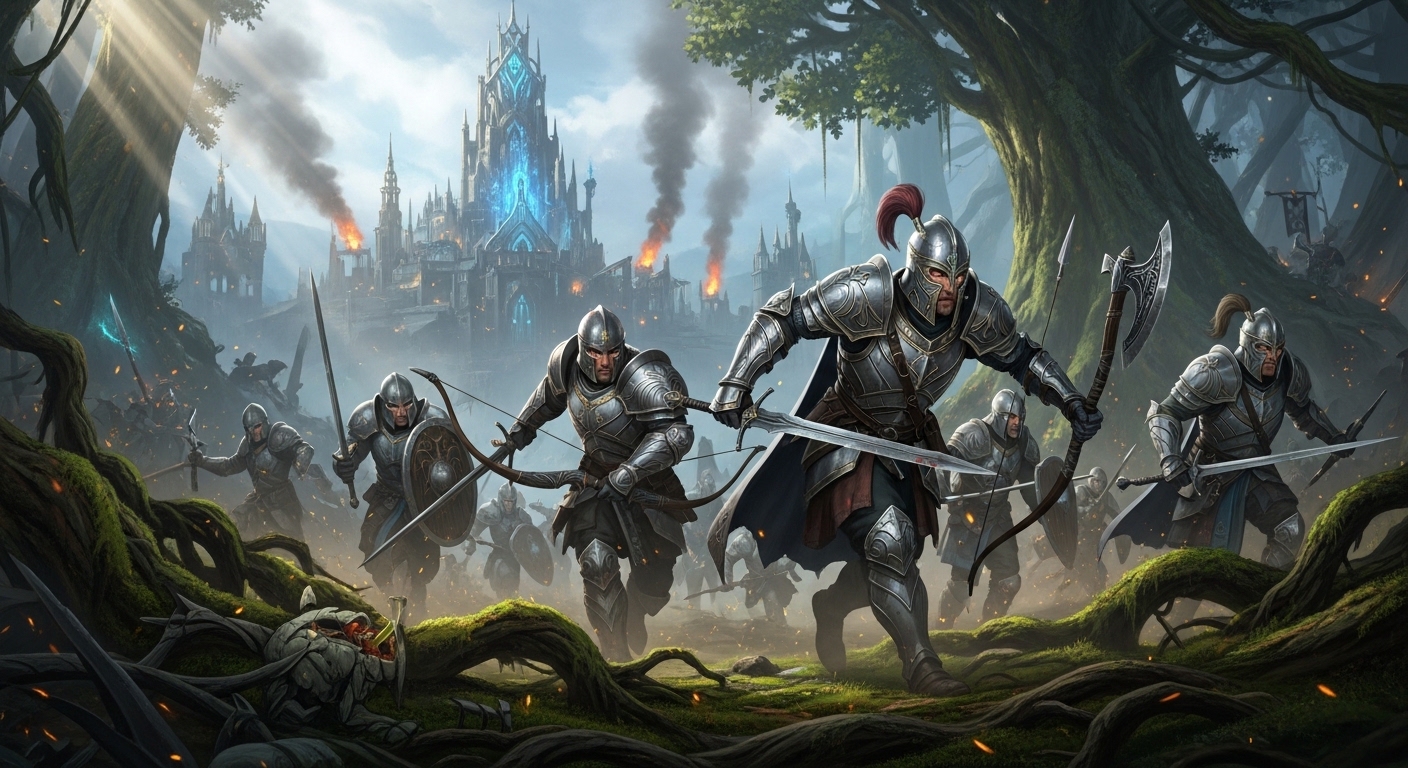
Introduction: Building Your Fantasy Empire
Elvenar, InnoGames’ beloved fantasy city-builder, continues to captivate strategy enthusiasts with its unique blend of city management, tactical combat, and long-term progression. Whether you’ve just chosen between the graceful Elves or industrious Humans, or you’re a veteran seeking to optimize your endgame strategy, this comprehensive guide will provide the tactical depth needed to thrive in the ever-evolving world of Elvenar
.
Success in Elvenar isn’t measured in days or weeks—it’s a marathon of strategic decisions spanning months and years. The game rewards patience, planning, and adaptability, with multiple paths to victory depending on your preferred playstyle. This guide synthesizes community-tested strategies, recent meta shifts, and fundamental principles to help you build a city that stands the test of time.
Early Game Foundation: Chapters 1-5
Your first critical decision—choosing between Elves and Humans—sets the aesthetic and strategic tone for your entire journey. While both races share identical core mechanics, their unique unit compositions and building aesthetics create distinct experiences. Elves favor defensive, nature-themed units with smaller building footprints, while Humans command offensive, medieval-styled forces with more rectangular structures
.
Resource Management Fundamentals
The holy trinity of Elvenar resources—Coins, Supplies, and Knowledge Points—requires careful balance. Coins flow from Residences, Supplies from Workshops, and Knowledge Points regenerate at one per hour (with a maximum storage of 10). Early players should prioritize upgrading Residences and Workshops to establish a stable economic base before expanding aggressively
.
A crucial early-game strategy involves leveraging the World Map for Knowledge Point generation. Rather than waiting for the hourly regeneration, scout and negotiate provinces actively. Each completed encounter rewards a Knowledge Point and relics, accelerating your research progression significantly. This “active scouting” approach can double or triple your KP income during periods of intense play
.
Space Optimization: The Golden Rules
Space is your most precious and non-renewable resource. Veteran players emphasize ten fundamental principles for city layout:
- Position your Main Hall in a corner to minimize road requirements
- Place culture buildings and the Builder’s Hut along the outer edges (they don’t need road access)
- Upgrade roads to the highest available tier for bonus culture
- Ensure roads serve multiple buildings—single-building roads waste space
- Keep your city shape compact and square
- Orient rectangular buildings with their shorter side touching roads
- Group similar buildings together for easier management
- Replace obsolete culture buildings with higher-efficiency models
- Utilize “wasted” road-end spaces for small culture ornaments
- Plan for building size increases at levels 5-6
Following these principles can free up 15-20% more space for production buildings, directly accelerating your progression.
Mid-Game Mastery: Chapters 6-15
As you advance beyond the introductory chapters, Ancient Wonders (AWs) become central to your strategy. These monumental structures provide permanent bonuses but require substantial investment in Knowledge Points and resources. The 2025 meta has shifted significantly regarding AW priorities due to cost rebalancing and new chapter releases
.
Ancient Wonder Priority Strategy
The community consensus identifies several “must-have” wonders regardless of playstyle:
Golden Abyss remains the universal recommendation for new players. Despite early-game inefficiency (it provides less population per square than standard Residences until approximately Chapter 5), its long-term value is undeniable. At maximum level, it provides an 18% population discount, freeing hundreds of thousands of population capacity for other buildings
.
Mountain Halls pairs perfectly with Golden Abyss, offering another 18% population discount plus significant goods production bonuses. Together, these wonders create the economic foundation for advanced gameplay
.
For combat-focused players, Martial Monastery (Humans) or Sanctuary (Elves) provides essential health buffs to all units, while Needles of the Tempest accelerates barracks training and enhances Light Ranged units. The Shrine of the Shrewdy Shrooms (or Dwarven Bulwark for Humans) increases training queue capacity, effectively adding virtual Armories without population cost
.
The Timewarp has emerged as a game-changing wonder for tournament participation, reducing the 16-hour cooldown between tournament rounds. Combined with a fed Polar Bear pet, this enables “instant tournament” completion—completing all rounds in a single session rather than spreading them across days
.
The “Max Before Adding” Philosophy
Experienced players strongly recommend fully leveling one or two wonders before constructing additional ones. This approach creates “power spikes” where wonders become highly efficient space-wise, rather than spreading resources thinly across multiple underleveled structures. A level 30 Golden Abyss provides exponentially more value than three level 10 wonders occupying the same space
.
Tournament Domination: Weekly Competitive Play
Tournaments represent Elvenar’s primary competitive element and the main source of Knowledge Points, relics, and premium rewards. Understanding tournament mechanics separates casual players from elite city-builders.
Tournament Structure and Strategy
Each weekly tournament features one of nine goods types (Steel, Planks, Crystal, Scrolls, Silk, Magic Dust, Elixir, Gems, or Marble). The tournament consists of six rounds across multiple provinces, with difficulty scaling based on your city advancement level—not your chapter progress
.
Critical insight: The first several provinces feature “easy” encounters where your squad size outnumbers the enemy. The difficulty spike begins around Province 8, with significant jumps at Province 10 and beyond. By Province 20, you’re fighting at a 1.5x numerical disadvantage
.
Optimal Tournament Approach
To maximize points while minimizing resource expenditure:
- Fight early provinces, cater later ones: The first 6-10 provinces are efficient to fight; beyond that, catering becomes more resource-effective
- Complete fewer provinces to higher stars: Six provinces to 6-star completion yields more points than 54 provinces to 1-star, with significantly easier encounters
- Use military boost buildings strategically: Unleashed Unit Upgrade, Magnificent Mage Multiplier, Enlightened Light Range, and Dwarven Armorer should be placed late in the week to span two tournament cycles
- Prepare troops in advance: Begin training tournament-specific units one week before the relevant tournament
Combat Tactics by Tournament Type
Each tournament favors specific unit compositions:
- Steel Tournament: Dominated by Mages; use Light Ranged (Archers/Rangers) with Golem support
- Planks Tournament: Heavy in Light Ranged; deploy Orc Strategists and Drones
- Crystal Tournament: Mage-heavy; leverage Dryads for 50% bonus damage against Heavy Melee
- Scrolls Tournament: Challenging mix requiring Banshees against Heavy Ranged with Golem backup
- Dust Tournament: Considered most difficult due to unpredictable enemy compositions
Advanced players utilize “niche” units like Vallorian Veterans, Gruff Orc Warriors, and Sinister Cerberus in specific matchups where their high stats overcome type disadvantages
.
Spire of Eternity: Endgame Challenge
The Spire of Eternity offers weekly high-difficulty encounters with premium rewards including diamonds, combat buildings, and exclusive artifacts. Success requires either substantial military strength or diplomatic resources.
Diplomacy vs. Combat
The Spire presents three paths: fighting, negotiating, or a hybrid approach. Negotiation costs scale with your city advancement level, making it increasingly expensive for advanced players. However, the “Spire Wizard” community tool helps calculate encounter odds, enabling informed decisions about which encounters to fight versus cater
.
Resource Management for Spire
Successful Spire runners maintain substantial reserves of:
- Orcs (for military encounters)
- Mana and Seeds (for higher-level negotiations)
- Time instants (for accelerating troop training)
- Pet food (for maintaining Phoenix and Bear buffs)
Late Game Optimization: Chapters 16-24
As you approach the current chapter cap (Chapter 24 as of early 2026), strategy shifts from expansion to refinement. Guest races settlements, introduced in Chapter 6, consume massive space but provide essential progression resources
.
The Guest Race Cycle
Each guest race (Dwarves, Fairies, Orcs, Wood Elves, Sorcerers, Halflings, Elementals, Amuni, Constructs, and others) introduces unique mechanics:
- Space Preparation: Clear sufficient area before unlocking guest race technologies
- Portal Placement: Position portals centrally to minimize road connections to settlement buildings
- Efficient Layouts: Use community-tested “settlement layouts” to maximize production per square
- Timed Production: Align long productions with your play schedule; 9-hour productions overnight, 1-hour during active play
Evolving Buildings and Artifacts
Events provide evolving buildings that improve through artifact collection. Strategic players plan artifact usage carefully—using Royal Restorations to upgrade building chapters only when necessary, saving artifacts for buildings that align with their strategy (military, goods, or hybrid)
.
Advanced Economic Strategies
The Trading Economy
Elvenar’s trading system enables specialization. Focus production on your boosted goods (indicated by relics surrounding your city) and trade for non-boosted materials. Place trades offering slight premiums (10-25%) to attract takers quickly, and check the trader regularly for favorable deals
.
Fellowship Dynamics
Joining an active fellowship accelerates progress through:
- Knowledge Point threads (mutual AW investments)
- Goods trading without cross-tier penalties
- Tournament coordination for collective rewards
- Neighborly Help motivation chains
Seek fellowships matching your activity level—casual players thrive in relaxed groups, while competitive players need high-activity fellowships pushing for 10+ tournament chests weekly.
Conclusion: The Long Game
Elvenar rewards strategic patience. The most successful players combine efficient city planning with consistent tournament participation, adapting their wonder priorities as their playstyle evolves. Whether you choose the military path of tournament dominance or the economic route of trading and negotiation, the fundamentals remain: optimize space, maximize efficiency, and plan for the long term.
As the game continues to evolve with new chapters and features, the community remains the best resource for emerging strategies. Engage with fellow players, experiment with different approaches, and remember—every “mistake” is just a learning opportunity in your Elvenar journey.
Leave a Reply