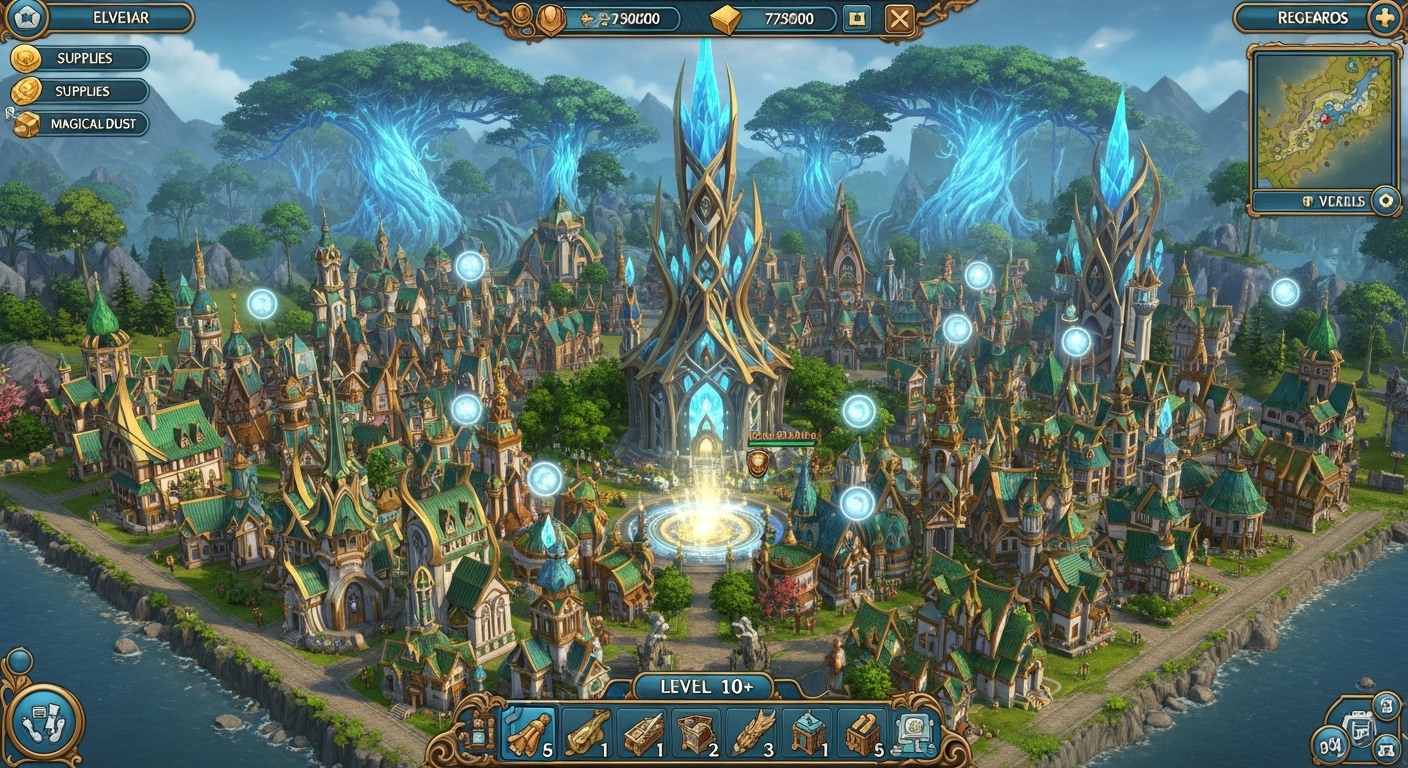
In the magical realm of Elvenar, where Elven forests shimmer with ancient magic and Human citadels rise with industrial might, every great city revolves around a single central structure: the Town Hall (officially called the Main Hall). This imposing building serves not merely as administrative headquarters but as the literal and figurative center of your entire civilization—storing your wealth, enabling your economy, connecting your infrastructure, and determining your capacity for growth. Understanding the Main Hall’s multifaceted functions proves essential for any aspiring ruler seeking to transform humble settlements into magnificent kingdoms
.
Foundational Functions: More Than Storage
The Main Hall arrives with your city’s founding, requiring no research or construction costs. Unlike other buildings, it cannot be sold, demolished, or rebuilt—it remains your permanent companion throughout your Elvenar journey, evolving through 46 distinct upgrade levels that transform its appearance from modest wooden structures to grand architectural marvels befitting advanced civilizations
.
While most players initially perceive the Main Hall primarily as storage infrastructure, its role extends far beyond simple warehousing. The building serves as the connection hub for your entire city—virtually all structures require road connections to the Main Hall to function. This radial dependency creates the distinctive city layouts characteristic of Elvenar, with roads spiderwebbing from the central hall to reach every workshop, residence, and manufactory
.
The Main Hall provides the exclusive storage mechanism for three critical resources: Coins, Supplies, and Goods. However, these storage systems operate under fundamentally different rules. Goods storage—encompassing Standard Goods (Marble, Steel, Planks, Crystal, Scrolls, Silk, Elixir, Magic Dust, Gems), Sentient Goods, and Ascended Goods—faces no capacity limitations. Players can accumulate unlimited quantities of manufactured goods, creating stockpiles that sustain extended tournament runs, Spire climbs, and trading operations
.
Conversely, Coins and Supplies face strict storage caps determined entirely by Main Hall level. Early-game players with Level 1 Main Halls might store merely thousands of these resources, while endgame veterans with fully upgraded halls manage tens of millions—some reporting capacities exceeding 46 million Coins and 4.6 million Supplies
. This capacity constraint creates one of Elvenar’s most persistent strategic challenges: managing production to avoid wasting resources when storage limits are reached.
The Upgrade Progression: Costs and Benefits
Main Hall upgrades follow a chapter-locked progression system, with specific upgrade ranges tied to technological research. Early chapters provide modest level increases, while later chapters unlock substantial leaps in capacity and functionality. For example, Chapter 3 (Humans) or Chapter 4 (Elves) provides the “Superior Main Hall” research enabling upgrades to levels 8-15, while Chapter 5’s Dwarven technology unlocks levels 16-19
.
Each upgrade delivers four distinct benefits:
First, and most obviously, storage capacity for Coins and Supplies increases substantially. A Level 6 Main Hall stores approximately 13,000 Coins and 6,500 Supplies, while Level 15 capacities reach hundreds of thousands, and endgame levels accommodate millions
.
Second, the Coins received from Neighborly Help scale directly with Main Hall level. When visitors click your Main Hall during Neighborly Help, they generate Coins for your collection upon next login—higher-level halls produce substantially greater quantities. This passive income stream proves particularly valuable for casual players who may not actively generate Coins through residence collection
.
Third, the rewards you receive when helping others similarly escalate. Each Neighborly Help action you perform yields Coins and Supplies based on your Main Hall level, creating virtuous cycles where upgraded halls accelerate resource acquisition that funds further upgrades
.
Fourth, Main Halls contribute Ranking Points—the metric determining player standings on world leaderboards. While less tangible than resource benefits, these points establish social prestige and competitive standing
.
Upgrade costs escalate dramatically with level. A typical mid-game upgrade (Level 16, first Dwarven tier) requires 154 available population, 310 available culture, and 1.87 million Coins
. These requirements force players to balance Main Hall advancement against other development priorities, particularly since upgrades consume builders for extended periods and demand substantial population that might otherwise staff manufactories or military buildings.
Strategic Storage Management
The Main Hall’s storage limitations create persistent optimization challenges. Players regularly encounter situations where production exceeds capacity—overnight workshop operations might generate half the total supply storage in a single production cycle, while residence collections overflow coin bins
. Several strategies address these constraints:
Active Collection Schedules: Dedicated players collect resources before capacity is reached, timing visits to maximize production without waste. This approach demands consistent engagement but preserves every resource generated.
Strategic Spending: Excess Coins can fund World Map exploration, expansion purchases, or trading; surplus Supplies support building upgrades, research, or tournament catering. Proactive spending prevents capacity waste while advancing other objectives
.
Wonder Investment: The Golden Abyss Ancient Wonder directly links to Main Hall level, generating Coins based on hall capacity. This synergy makes Main Hall upgrades more valuable for Golden Abyss owners, as each hall level indirectly increases Wonder production
.
Event Optimization: During Fellowship Adventures, players collect “coin bags” by performing Neighborly Help. Higher Main Hall levels reduce the number of help visits required per bag, making event participation more efficient
.
The Neighborly Help Nexus
The Main Hall functions as the primary target for Neighborly Help, Elvenar’s social mechanic where players visit each other’s cities to provide assistance. Three help options exist, but the Main Hall remains the most universally available—unlike Culture Buildings (which require eligible structures) or Builder’s Huts (which have boost limits), Main Halls can always receive help unless actively upgrading
.
When visitors click your Main Hall, they generate immediate rewards for themselves (Coins and Supplies based on their Main Hall level) and deferred rewards for you (Coins collectible upon your next login). This exchange creates mutual benefit: visitors gain instant resources, while hosts accumulate passive income. The “golden handshake” button—appearing when you return help to recent visitors—provides enhanced rewards including both Coins and Supplies, making reciprocal relationships particularly valuable
.
The Main Hall’s role in Neighborly Help extends to city naming conventions. Players often append codes like “CBM” (Culture-Builder’s Hut-Main Hall) or “MCB” (Main Hall-Culture-Builder’s Hut) to their city names, indicating preferred help priorities. While Culture Buildings provide the most impactful bonuses (doubling culture output for 8+ hours), Main Hall clicks remain reliable fallback options when culture buildings are unavailable or already assisted
.
Visual Evolution and Cultural Identity
The Main Hall’s appearance transforms dramatically through upgrade levels, reflecting your civilization’s advancement. Early levels feature modest wooden structures appropriate to fledgling settlements. Mid-game upgrades introduce stone fortifications and architectural sophistication. Endgame halls become magnificent palaces—Elven versions incorporating living wood, crystalline spires, and magical luminescence; Human variants displaying industrial grandeur, smokestacks, and mechanical marvels
.
This visual progression provides tangible feedback on development, with each upgrade celebration marking milestones in your city’s evolution. The Main Hall’s central placement and distinctive appearance make it the natural focal point of city design, with roads radiating outward and other structures positioned to maximize both functionality and aesthetic harmony.
Advanced Considerations: Timing and Optimization
Experienced players debate optimal Main Hall upgrade timing. Some advocate aggressive early upgrading to maximize storage and Neighborly Help benefits, accepting temporary population constraints that limit other construction. Others recommend patient, need-based upgrading, advancing halls only when storage limits actually impede progress—such as when research requires millions of Coins beyond current capacity
.
The “Coin Wall” phenomenon illustrates this strategic tension. Certain research technologies and expansion purchases require Coin quantities that challenge storage limits. Players with under-leveled Main Halls may find themselves unable to afford critical advancements despite having production capacity to generate required resources over time. Conversely, premature upgrades consume resources and builder time that might accelerate other development
.
Fellowship Perks indirectly influence Main Hall strategy. The “Advanced Help” Perk extends the duration of received help, meaning players can collect Neighborly Help rewards less frequently while maintaining equivalent benefits. This reduces pressure on Main Hall coin storage frequency, potentially enabling slower upgrade schedules without sacrificing income
.
Conclusion: The Center That Holds
The Main Hall represents Elvenar’s design philosophy in architectural form: interconnected systems where individual elements support collective prosperity. Its storage constraints teach resource management; its Neighborly Help integration rewards community participation; its upgrade progression provides long-term development goals; its visual evolution offers satisfying progression feedback.
For new players, the Main Hall simply holds resources. For veterans, it becomes a strategic optimization target—its level determining economic capacity, social utility, and competitive standing. Whether you prioritize rapid upgrades to maximize Golden Abyss production or maintain lean halls to focus resources elsewhere, the Main Hall remains the immovable center around which your entire Elvenar experience revolves.
In a game of magical forests and industrial fortresses, of tournament glory and fellowship cooperation, the humble Main Hall stands as the foundation upon which all else is built. Understanding its nuances separates adequate city management from masterful kingdom stewardship
.
Leave a Reply