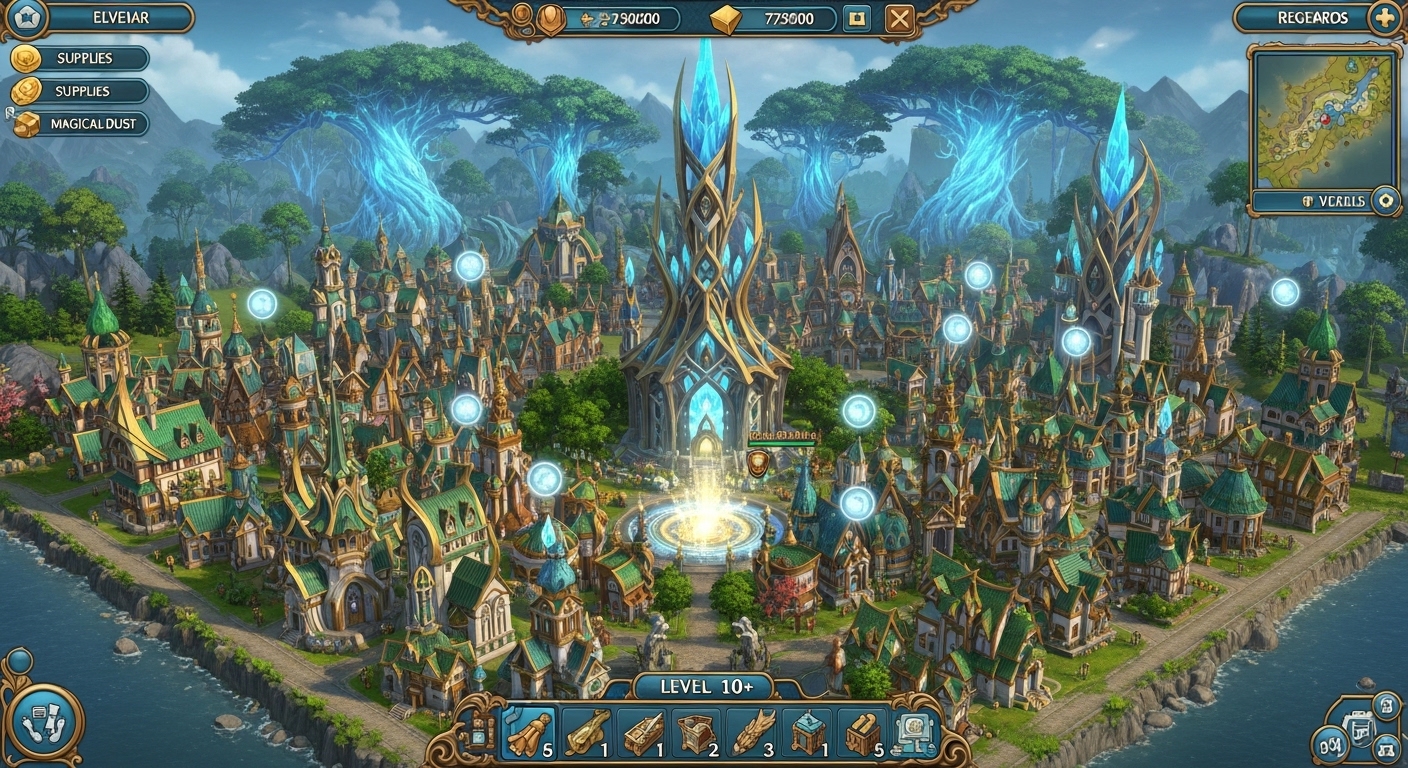
In the ever-expanding crafting ecosystem of Elvenar, Evolution Recipes represent some of the most sought-after and strategically significant options available in the Magic Academy. These specialized recipes allow players to acquire Artifacts—the magical keys that transform ordinary buildings into extraordinary, evolving powerhouses. Understanding how to obtain, craft, and deploy these evolution materials separates casual city builders from strategic masterminds who dominate tournaments and Spire ascents
.
The Foundation: Evolving Buildings and Artifacts
Evolving Buildings stand as Elvenar’s most dynamic structure type, capable of growing from humble Stage 1 foundations into magnificent Stage 10 marvels that provide escalating bonuses. Unlike standard buildings with fixed outputs, evolving structures increase their population, culture, and production values with each evolution stage. Some, like the Fire Phoenix, Storm Phoenix, and Aureate Phoenix, even function as pets that provide additional combat bonuses when fed
.
The evolution mechanism requires specific Artifacts—magical items unique to each building type. A Fire Phoenix demands Phoenix Artifacts, while a Mermaid’s Paradise requires Mermaid Artifacts. These artifacts serve as the fuel for progression, with each stage requiring an increasing number of artifacts to unlock
.
Historically, artifacts were event-exclusive rewards, obtainable only during specific seasonal events. Players who missed the Evolution of the Phoenix event, for example, had no path to acquire Fire Phoenix artifacts or evolve their buildings. This exclusivity created “fear of missing out” (FOMO) and frustrated players who joined after event conclusion or couldn’t complete event objectives
.
The Crafting Revolution: Artifacts in the Magic Academy
The introduction of Evolution Recipes fundamentally transformed artifact accessibility. Now, players can craft artifacts directly through the Magic Academy, creating alternative progression paths independent of event timing. This change democratized evolving building advancement while introducing new strategic considerations
.
Evolution Recipes follow standardized costs: typically 3 Blueprints plus Combining Catalysts and Spell Fragments. The exact resource requirements scale with your chapter progress, ensuring costs remain relevant to your economic capacity. A Chapter 5 player faces modest fragment demands, while a Chapter 20 player invests substantially more for the same artifact
.
The recipe pool includes artifacts for multiple evolving building sets: Phoenix artifacts (Fire, Storm, and Aureate Phoenixes), Stonehenge artifacts, Mermaid artifacts, Bear artifacts, and numerous others introduced through seasonal events. Each recipe appears randomly in the Magic Academy’s rotation, competing for limited crafting slots against combat boosts, enchantments, and other valuable options
.
The Recipe Pool Challenge: Scarcity in Abundance
While evolution recipes provide artifact access, their random rotation system creates significant frustration. The Magic Academy refreshes every six hours with randomly selected options from hundreds of potential recipes. With artifact recipes, combat boost buildings, pet food, enchantments, and countless other options competing for slots, desired evolution materials may not appear for weeks
.
Community reports document extreme variance—some players encounter multiple Phoenix artifact recipes weekly, while others wait seven weeks or longer for a single Fire Phoenix artifact offer. This randomness isn’t malfunction but intentional design, creating scarcity that encourages frequent engagement and, potentially, diamond expenditure for recipe refreshes
.
The recipe pool dilution worsens with each new evolving building introduction. When Bears debuted, their artifacts joined Phoenix, Stonehenge, and Mermaid recipes in the already-crowded pool. Unlike some craftable buildings that disappear from rotation once owned, artifact recipes persist indefinitely, meaning players with fully evolved Phoenixes still see Phoenix artifact recipes blocking more relevant options
.
Strategic Evolution Crafting
Effective evolution recipe management requires balancing immediate needs against long-term collection:
Prioritize Incomplete Sets: Focus crafting on evolving buildings you’ve started but haven’t completed. A Stage 7 Fire Phoenix deserves artifact investment more than starting a new Stonehenge at Stage 1. Partial evolution represents sunk costs that yield maximum returns when finished
.
Evaluate Building Utility: Not all evolving buildings merit equal investment. The Fire Phoenix provides universal combat damage bonuses applicable to all unit types, making it universally valuable. More specialized buildings like the Mermaid’s Paradise offer goods production that may overlap with your existing infrastructure. Assess your city’s specific needs before committing scarce catalysts
.
Maintain Catalyst Reserves: Evolution recipes require Combining Catalysts—the rarest crafting resource. Spire participation provides primary catalyst income, with weekly climbs generating 3-5 catalysts depending on progress depth. Hoarding catalysts for high-value evolution opportunities prevents wasteful expenditure on marginal recipes
.
Consider Event Timing: If the Autumn Zodiac event approaches with its powerful evolving building rewards, conserving catalysts for post-event artifact crafting may prove wiser than immediate Phoenix evolution. Event buildings typically provide 10-12 artifacts during the event itself, potentially completing lower-stage evolutions without crafting investment
.
The Tome of Evolution: Advanced Crafting Options
Beyond individual artifact recipes, Elvenar introduced sophisticated evolution mechanics through Tome of Evolution recipes. These advanced options allow players to exchange sets of evolution tokens for selection chests, providing flexibility in artifact acquisition
.
The Tome system enables conversion between artifact types—trading surplus Phoenix artifacts for scarce Bear artifacts, for example. This exchange mechanism helps players with mature, fully-evolved buildings redirect resources toward newer acquisitions. However, conversion recipes carry premium costs and require careful evaluation of exchange ratios
.
Recent updates introduced Artifact Powers, allowing old artifacts (including those won in the Spire) to convert into sorceries with multiple artifact options. This system enables players to transform unwanted artifacts into selection opportunities, though with power costs that limit frequency
.
Spire Integration: Alternative Artifact Sources
While crafting provides reliable artifact access, the Spire of Eternity offers direct artifact rewards that complement evolution recipes. Weekly Spire climbs can yield artifact chests containing 5-10 artifacts for specific evolving buildings, potentially bypassing crafting entirely for lucky climbers
.
The Spire’s random artifact distribution creates interesting strategic tension. You might receive 10 Stonehenge artifacts while desperately seeking Phoenix materials. This variance encourages maintaining diverse evolving building projects rather than hyper-focusing on single structures, as any artifact type may suddenly become available
.
High-level Spire participation (Gold or Silver finishes) dramatically increases artifact income, potentially providing 20-30 artifacts monthly across various building types. For dedicated players, Spire rewards may satisfy evolution needs without significant crafting investment, preserving catalysts for combat boosts and other priorities
.
Recipe Pool Manipulation Strategies
Desperate players employ various techniques to improve evolution recipe appearance odds:
Inventory Management: Crafting and retaining certain buildings removes them from future rotation. The craftable Chess Set, for example, stops appearing once crafted and stored in inventory. While the expanding recipe pool limits this strategy’s effectiveness, maintaining lean building inventories theoretically improves odds for desired options
.
Timing Adjustment: Using diamonds to immediately refresh recipes or temporarily disconnecting the Magic Academy from roads (pausing its function) shifts refresh cycles. These techniques help align recipe availability with your active hours rather than sleep periods, though they require resource investment or temporary production loss
.
Selective Crafting: Crafting marginal recipes simply to clear them from rotation represents expensive but effective pool management. Some players craft unwanted Festival Merchants or obsolete enchantments to eliminate these options, hoping to force evolution recipes into subsequent rotations. This strategy demands substantial catalyst reserves and carries no guarantee of success
.
Economic Considerations: Cost vs. Value
Evolution crafting requires significant resource investment that must yield proportional returns:
Direct Costs: A typical artifact recipe costs 3 Blueprints, 5 Combining Catalysts, and thousands of Spell Fragments. For players with fully upgraded Magic Academies (level 5), fragment costs remain manageable through regular disenchantment and Spire participation. Catalysts represent the true bottleneck, with each artifact potentially requiring a week of Spire climbing to replace
.
Opportunity Costs: Every catalyst spent on evolution recipes cannot fund combat boost buildings like Enlightened Light Range or Magnificent Mage Multiplier. During tournament weeks, these combat boosts may provide greater immediate value than gradual building evolution. Balancing long-term infrastructure against short-term performance defines elite crafting strategy
.
Evolution Stage Efficiency: Artifacts yield diminishing returns at higher stages. Evolving from Stage 1 to 2 requires minimal artifacts and provides substantial percentage improvements. Advancing from Stage 9 to 10 demands significantly more artifacts for marginal gains. Cost-conscious players often stop evolution at Stage 8-9, redirecting resources to new building starts rather than perfecting existing structures
.
Common Evolution Mistakes
New and experienced players alike sabotage their evolution potential through preventable errors:
Impulsive Crafting: Using catalysts on available artifacts simply because they appear, regardless of building utility or current stage. A Stage 9 Fire Phoenix deserves priority over starting a Stage 1 Mermaid’s Paradise, but random recipe appearance tempts poor prioritization
.
Neglecting Event Participation: Seasonal events provide the most efficient artifact acquisition. Players who skip events or fail to complete artifact milestones create unnecessary crafting burdens. Event participation should be the primary artifact source, with crafting serving as gap-filling rather than primary progression
.
Artifact Hoarding Without Evolution: Collecting artifacts without the corresponding building base wastes inventory space and crafting opportunities. Ensure you possess or can craft the evolving building foundation before committing catalysts to artifact acquisition
.
Ignoring Recipe Pool Pollution: Allowing inventory to fill with obsolete craftable buildings increases recipe pool clutter, theoretically reducing evolution recipe frequency. Regular inventory audits and strategic disenchantment maintain lean, efficient crafting environments
.
The Future of Evolution Crafting
Elvenar’s evolution system continues expanding with each seasonal event introducing new buildings and artifacts. Community feedback consistently requests deterministic recipe selection—directly purchasing desired artifacts rather than hoping for random rotation. Developers maintain that randomness preserves engagement and economic balance, though quality-of-life improvements like dedicated evolution recipe slots remain popular suggestions
.
Recent implementations of artifact conversion and Tome of Evolution mechanics suggest gradual movement toward flexibility. Players can increasingly redirect unwanted artifacts toward desired alternatives, reducing the pain of unfavorable random distribution. These systems, while imperfect, represent evolutionary steps toward player-friendly artifact management
.
Conclusion
Evolution Recipes in Elvenar’s Magic Academy transformed evolving buildings from event-exclusive luxuries into achievable long-term goals. Through strategic crafting, Spire participation, and resource management, players can construct magnificent Stage 10 structures regardless of event timing or historical participation.
Success requires patience—accepting that artifact recipes appear unpredictably, that catalysts accumulate gradually, and that evolution progresses incrementally. The most effective players balance immediate needs against future possibilities, craft selectively rather than impulsively, and maintain diverse evolving building portfolios that capitalize on whatever artifacts random fortune provides.
In Elvenar’s magical economy, evolution recipes represent the bridge between chance and choice, between missing out and catching up. Master this bridge, and your city will flourish with ever-growing, ever-powerful evolving wonders.