Category: Elvenar Tips and Tricks

  • The Complete Elvenar Events Strategy Guide: Maximizing Rewards and Efficiency

    The Complete Elvenar Events Strategy Guide: Maximizing Rewards and Efficiency

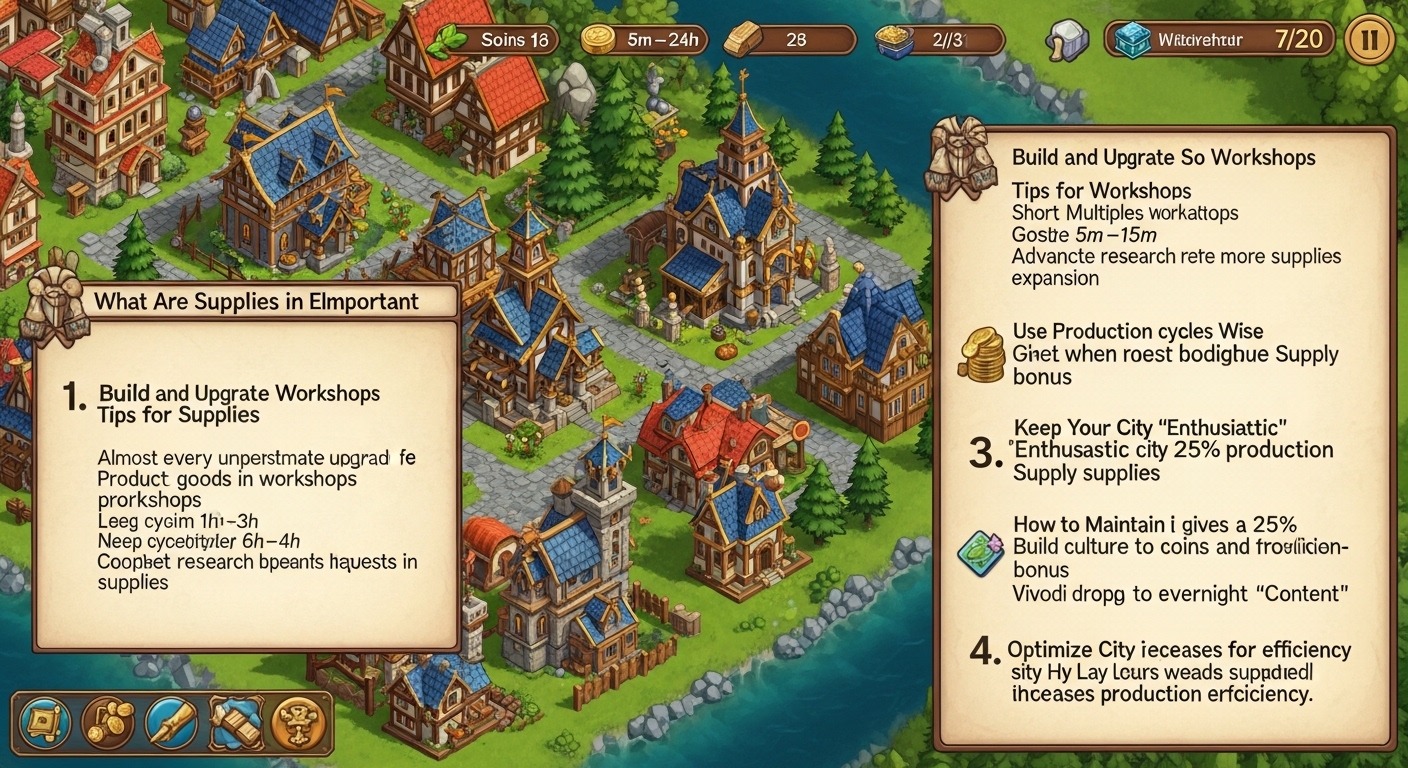
    In Elvenar, supplies are one of the most important resources for building, upgrading, and progressing through the game. While coins are used alongside supplies in many actions, it is often supplies that players run out of first. Without a steady supply production system, your city’s growth can slow down dramatically.

    This comprehensive guide will teach you everything you need to know about producing, managing, and maximizing supplies in Elvenar, whether you are a beginner or an advanced player.


    What Are Supplies in Elvenar?

    Supplies are a core resource used for:

    • Constructing and upgrading buildings
    • Producing goods in workshops
    • Completing certain quests
    • Supporting city development

    Unlike coins, which come mainly from residences, supplies are produced through workshops and manufacturing buildings. Managing supplies properly is essential for smooth progression.


    Why Supplies Are So Important

    Many players underestimate the importance of supplies early on, but they quickly become a bottleneck.

    Key Reasons:

    • Almost every building upgrade requires supplies
    • Advanced research consumes large amounts of supplies
    • Goods production depends heavily on supply availability

    Without enough supplies, your entire progression slows down—even if you have plenty of coins.


    1. Build and Upgrade Workshops

    Workshops are your main source of supplies.

    Tips for Workshops:

    • Build multiple workshops early in the game
    • Upgrade workshops regularly instead of building too many
    • Keep them active at all times

    Higher-level workshops produce significantly more supplies, making upgrades more efficient than expansion.


    2. Use Production Cycles Wisely

    Choosing the right production cycle is key to maximizing supply output.

    Production Strategy:

    • Short cycles (5m–15m): Best when you are actively playing
    • Medium cycles (1h–3h): Good for casual play
    • Long cycles (6h–24h): Ideal for overnight or offline time

    Matching production cycles with your schedule ensures that your workshops are never idle.


    3. Keep Your City “Enthusiastic”

    Culture directly affects supply production.

    Why It Matters:

    • An “Enthusiastic” city gives a 25% production bonus
    • Applies to both coins and supplies

    How to Maintain It:

    • Build culture buildings and decorations
    • Avoid dropping to “Content” or lower

    This bonus alone can significantly boost your supply output without extra effort.


    4. Optimize City Layout for Efficiency

    A well-organized city increases production efficiency.

    Layout Tips:

    • Place workshops close to roads
    • Avoid wasting space with unnecessary decorations
    • Use upgraded buildings instead of many small ones

    Efficient use of space allows you to fit more productive buildings in your city.


    5. Balance Between Supplies and Coins

    A common mistake is focusing too much on one resource.

    Balance Strategy:

    • Maintain a healthy ratio of residences and workshops
    • Adjust production based on your needs

    For example:

    • If you’re low on supplies → build/upgrade workshops
    • If you’re low on coins → upgrade residences

    Balance ensures smooth progression without delays.


    6. Use Event Buildings for Supply Boost

    Event buildings are one of the best ways to increase supply production.

    Benefits:

    • Higher production than regular buildings
    • Additional bonuses like culture or knowledge points
    • Save space while increasing efficiency

    Participating in events can give you powerful supply-producing structures that outperform standard workshops.


    7. Take Advantage of Ancient Wonders

    Ancient Wonders provide powerful bonuses that can improve your supply production.

    Key Benefits:

    • Boost resource production
    • Provide passive bonuses
    • Improve overall efficiency

    Investing in the right Ancient Wonders can make a huge difference in long-term supply farming.


    8. Complete Quests for Extra Supplies

    Quests are an easy way to gain additional supplies.

    Types of Quests:

    • Story quests
    • Daily quests
    • Event quests

    Completing these regularly gives you extra resources without additional effort.


    9. Use Boosts and Spells

    Spells and boosts can temporarily increase your supply production.

    Examples:

    • Production boosts
    • Event-based bonuses

    Use these strategically when you need a large amount of supplies quickly.


    10. Trade to Save Supplies

    Trading can reduce the need for excessive supply production.

    Smart Trading Tips:

    • Trade goods instead of producing everything
    • Use marketplace offers wisely
    • Avoid overpaying

    Trading efficiently helps you save supplies for more important tasks.


    11. Expand Your City Carefully

    Expansion gives you more space, but it should be done wisely.

    Tips:

    • Don’t expand too quickly without resources
    • Use new space for high-production buildings
    • Focus on efficiency, not just size

    A well-managed expansion supports better supply production.


    12. Avoid Idle Time

    Idle workshops mean lost supplies.

    How to Avoid It:

    • Log in regularly
    • Set long production cycles before logging off
    • Plan your production ahead

    Consistency is key to maintaining steady supply income.


    13. Advanced Supply Strategies

    Once you master the basics, you can improve further with advanced techniques.

    Advanced Tips:

    • Replace old buildings with high-efficiency event buildings
    • Use optimized city layouts from experienced players
    • Focus on upgrading instead of expanding

    Advanced players prioritize efficiency per tile, not just total production.


    14. Common Mistakes to Avoid

    Avoiding mistakes can significantly improve your supply production.

    Mistakes:

    • Ignoring culture bonus
    • Letting workshops stay idle
    • Expanding too fast
    • Not upgrading buildings
    • Overproducing unnecessary goods

    Fixing these mistakes can instantly improve your gameplay.


    15. Daily Routine for Maximum Supplies

    Here’s a simple daily routine to follow:

    1. Log in and collect all supplies
    2. Start new production cycles
    3. Complete quests
    4. Trade excess goods
    5. Check culture level
    6. Upgrade buildings if possible

    Following this routine ensures consistent growth.


    Conclusion

    Supplies are one of the most critical resources in Elvenar, and managing them efficiently is essential for long-term success. By building and upgrading workshops, maintaining an enthusiastic city, using event buildings, and avoiding idle time, you can significantly increase your supply production.

  • Elvenar Best Army Setup: The Ultimate Guide to Winning Battles

    Elvenar Best Army Setup: The Ultimate Guide to Winning Battles

    In Elvenar, having a strong and well-balanced army is essential for conquering provinces, completing tournaments, and progressing efficiently through the game. Many players struggle with battles not because they lack units, but because they don’t use the right army setup.

    This guide will help you understand the best army compositions, strategies, and unit combinations so you can dominate battles whether you play as Elves or Humans.


    Understanding Combat in Elvenar

    Before choosing the best army setup, you need to understand how combat works in Elvenar.

    • Battles are turn-based
    • Each unit has strengths and weaknesses
    • Terrain and positioning matter
    • Ranged and melee units behave differently

    Winning battles isn’t just about power—it’s about strategy and balance.


    Types of Units in Elvenar

    Both Elves and Humans have different units, but they generally fall into these categories:

    1. Light Melee Units

    • Fast and agile
    • Good for attacking ranged enemies
    • Weak against heavy units

    2. Heavy Melee Units

    • High defense and health
    • Slow movement
    • Best used as tanks

    3. Ranged Units

    • Attack from distance
    • Deal high damage
    • Vulnerable if enemies get close

    4. Magical Units (Elves) / Special Units (Humans)

    • Unique abilities
    • Can deal splash or special damage
    • Require strategic use

    Best Army Setup for Beginners

    If you’re new to Elvenar, start with a balanced army.

    Recommended Setup:

    • 2 Heavy Melee Units
    • 3 Ranged Units
    • 3 Light Melee Units

    Why this works:

    • Heavy units absorb damage
    • Ranged units deal damage safely
    • Light units eliminate enemy ranged units

    This setup is easy to manage and works well in early battles.


    Best Army Setup for Elves

    Elven units are known for their speed and magic abilities.

    Strong Elven Composition:

    • Treants (Heavy Tanks)
    • Archers (Ranged Damage)
    • Sorceresses (Magic Units)

    Example Setup:

    • 2 Treants
    • 3 Archers
    • 3 Sorceresses

    Strategy:

    • Use Treants to block enemies
    • Keep Archers behind for damage
    • Use Sorceresses for splash attacks

    Elves rely on precision and positioning, so always protect your ranged and magic units.


    Best Army Setup for Humans

    Human units are more defensive and durable.

    Strong Human Composition:

    • Swordsmen (Heavy Units)
    • Crossbowmen (Ranged Units)
    • Knights (Fast Attackers)

    Example Setup:

    • 3 Swordsmen
    • 3 Crossbowmen
    • 2 Knights

    Strategy:

    • Use Swordsmen as front line
    • Crossbowmen deal damage from behind
    • Knights quickly eliminate threats

    Humans excel in defensive battles and sustained fights.


    Advanced Army Setups

    As you progress, you’ll need specialized setups depending on the enemy.

    1. Anti-Ranged Setup

    Use this when enemies have many ranged units:

    • 4 Light Melee Units
    • 2 Heavy Units
    • 2 Ranged Units

    Light units rush and destroy enemy archers quickly.


    2. Defensive Setup

    Best for tough battles:

    • 4 Heavy Units
    • 2 Ranged Units
    • 2 Support Units

    This setup focuses on survival and gradual damage.


    3. Aggressive Setup

    For quick wins:

    • 5 Ranged Units
    • 3 Light Units

    High damage but risky—requires good positioning.


    Importance of Terrain

    Terrain plays a huge role in battle outcomes.

    Key Tips:

    • Place ranged units on high ground
    • Use obstacles to block enemies
    • Protect weak units behind tanks

    Good positioning can turn a weak army into a winning one.


    Manual vs Auto Battles

    Auto Battle:

    • Quick and convenient
    • Works for easy fights

    Manual Battle:

    • Better control
    • Higher win chances in tough fights

    Recommendation:

    Use manual battles for:

    • Boss fights
    • Difficult provinces
    • Tournament battles

    Unit Positioning Strategy

    Positioning is just as important as unit selection.

    Basic Formation:

    • Heavy units in front
    • Ranged units at the back
    • Fast units on the sides

    Tips:

    • Don’t expose ranged units early
    • Focus attacks on one enemy at a time
    • Use terrain for advantage

    Common Mistakes in Army Setup

    Avoid these common errors:

    • Using only one type of unit
    • Ignoring enemy composition
    • Poor positioning
    • Overusing auto battle
    • Not upgrading units

    Fixing these mistakes can instantly improve your win rate.


    Upgrading Your Army

    Strong units make a big difference.

    How to improve your army:

    • Upgrade military buildings
    • Unlock new unit types
    • Research combat technologies

    Higher-level units have better stats and abilities.


    Tournament Army Strategy

    Tournaments require efficient army use.

    Tips:

    • Use balanced setups
    • Avoid heavy losses
    • Adapt to each enemy
    • Save strong units for later rounds

    Winning tournaments gives great rewards, so plan carefully.


    Best Army Setup for Map Exploration

    When exploring provinces:

    • Use balanced armies
    • Adjust based on enemy type
    • Preserve units for multiple battles

    Don’t go all-out in one fight—think long-term.


    Combining Army with Strategy

    The best army setup depends on your strategy.

    Key Principles:

    • Adapt to enemies
    • Use terrain wisely
    • Protect valuable units
    • Focus on efficiency

    No single setup works everywhere—you must adjust.


    Pro Tips for Dominating Battles

    • Always scout enemy units
    • Use manual battles in tough situations
    • Keep your army balanced
    • Upgrade regularly
    • Learn enemy weaknesses

    These small improvements can make a huge difference.


    Conclusion

    The best army setup in Elvenar is not about using the strongest units—it’s about using the right combination of units for each battle. A balanced army with proper positioning and strategy will always outperform a random setup.

  • The Complete Elvenar Crafting Tutorial: Mastering the Magic Academy

    The Complete Elvenar Crafting Tutorial: Mastering the Magic Academy

    The Magic Academy stands as one of Elvenar’s most transformative buildings, converting unwanted inventory items into powerful resources, exclusive buildings, and game-changing enhancements. Mastering crafting mechanics separates casual players from strategic architects who maximize every resource. Whether you’re drowning in excess enchantments, desperate for specific buildings, or seeking to optimize your Vision Vapor generation, this comprehensive guide reveals every technique for transforming the Magic Academy into your city’s most productive asset.

    Understanding Crafting Fundamentals

    Crafting becomes available once you build and upgrade the Magic Academy, unlocking the dedicated Crafting tab alongside enchantment production

    . The system operates on three unique resources that function nowhere else in Elvenar: Combining Catalysts, Spell Fragments, and Vision Vapor

    .

    Combining Catalysts serve as the primary crafting fuel, required for most recipes in varying quantities based on item value

    . These are produced directly in the Magic Academy’s enchantment slots, making catalyst generation your foundational crafting activity.

    Spell Fragments function as secondary crafting currency, created by “disenchanting” unwanted buildings, instants, and enchantments from your inventory

    . Your fragment total displays in the Crafting tab, with a convenient “+” button activating the disenchantment interface

    .

    Vision Vapor represents your crafting reward—accumulated each time you craft an item, displayed underneath the Mystical Object chest

    . Reaching 100 Vision Vapor triggers reward selection from three options, creating a compounding returns system where crafting begets more crafting opportunities.

    The Recipe System and Slot Mechanics

    Every six hours, five new recipes appear in your Magic Academy, organized into specific categories since the July 2020 update

    :

    • Slot #1: Buildings only
    • Slot #2: Knowledge Points, Ancient Wonder KP, Royal Restorations, and Rune Shards
    • Slot #3: Coin instants, Supply instants, and Portal Profits
    • Slot #4: Time instants exclusively
    • Slot #5: Relics, Pet Food, and Artifacts

    This categorization means specific items always appear in designated slots, though a display bug occasionally shifts their visual order

    . Understanding these slots allows targeted crafting strategies—if you need Pet Food, you only need to monitor Slot #5, ignoring other categories.

    Strategy 1: Resource Generation and Management

    Sustainable crafting requires balancing three interdependent resources through deliberate production choices.

    Combining Catalyst Stockpiling: Experienced players maintain Combining Catalyst production 24/7 in the Magic Academy, building reserves for unexpected valuable recipes

    . One player reports cooking catalysts continuously until reaching comfortable stockpiles, then switching to other enchantments

    . The maximum catalyst cost for any single recipe varies, but maintaining 20-30 catalysts provides security for most opportunities.

    Spell Fragment Optimization: Disenchant excess inventory items strategically. Each disenchantment generates fragments proportional to item value, with Magic Academy level upgrades increasing fragment yields

    . During initial inventory cleanup, players often generate 40,000+ fragments

    , providing substantial crafting capital.

    Vision Vapor Cycling: Every craft adds Vision Vapor to your Mystical Object. At 100 points, you select one of three randomized rewards—often including more catalysts, fragments, or valuable instants

    . This creates positive feedback loops where crafting resources generate more crafting opportunities.

    Strategy 2: Disenchantment Excellence

    The disenchantment interface transforms inventory clutter into crafting currency. Access it through your inventory directly or via the Spell Fragments “+” button in the Crafting tab

    .

    High-Value Disenchantment Targets: Summoning Buildings and Purple/Gold Banner Instants provide exceptional fragment returns but require confirmation due to their rarity

    . Event buildings that no longer fit your chapter or strategy also disenchant efficiently.

    Strategic Preservation: Before disenchanting, verify whether items might become valuable later. One player describes keeping artifacts for buildings they no longer possess, creating “a dagger in my heart every time I see them”

    . Conversely, players who disenchanted all pet food early game later regretted the decision when powerful pet-dependent buildings became available.

    Fragment Emergency Protocols: If fragment reserves deplete, disenchant common enchantments like Power of Provision or Magical Manufacturing. With 200+ spells stockpiled from tournament participation, converting 100 enchantments generates substantial emergency fragments

    .

    Strategy 3: Recipe Prioritization and Selection

    With hundreds of potential recipes and only five slots every six hours, strategic selection becomes essential

    .

    Building Priority Hierarchy: Top-tier craftable buildings include Festival Merchants (culture plus divine seeds), Traveling Merchants II, and military boosters like Enlightened Light Range, Magnificent Mage Multiplier, and Unleashed Unit Upgrade

    . These structures often outperform chapter-equivalent buildings while providing hybrid benefits.

    Chess Set Strategy: The Magical Chess Set represents a unique crafting opportunity—each building is unique, meaning you can only possess one of each type in inventory or city

    . However, crafting these pieces removes them from the recipe pool, increasing frequency of other desirable buildings in Slot #1

    . Consider crafting Chess Set pieces even if you don’t immediately place them, purely to improve future recipe odds.

    Artifact Management: Evolving building artifacts appear in Slot #5, but with caveats. You cannot craft artifacts for buildings you already possess in inventory or city

    . If you want a second Fire Phoenix, you must first disenchant or sell your existing one

    . Artifact recipes remain in the pool indefinitely, though specific artifacts may rotate based on event schedules

    .

    Military Booster Focus: Since battle boosters migrated exclusively to crafting (no longer appearing in events), prioritize these recipes when visible

    . The +50% damage and health buildings provide tournament and Spire advantages that justify significant resource investment.

    Strategy 4: Time Management and Refresh Techniques

    Recipe cycles operate on fixed timers, but multiple methods exist for accelerating opportunities.

    Sip of Clarity Utilization: This consumable item allows free recipe refreshes without waiting for the 6-hour countdown

    . Use these strategically during events or when desperate for specific items. You can use multiple Sips sequentially, completely resetting your options until desirable recipes appear

    .

    Diamond Refresh Alternative: Without Sips of Clarity, spend premium currency to force recipe changes

    . This becomes expensive for regular use but justified for critical needs—like obtaining a Festival Merchant during a resource crunch or securing battle boosters before tournament deadlines.

    Optimal Check Timing: The 6-hour cycle means 4 recipe sets daily. Adjust your schedule to check the Magic Academy at consistent intervals—many players align checks with meal times or work breaks to maximize opportunity exposure

    . Missing cycles significantly reduces crafting potential over weeks.

    Time Instant Efficiency: When crafting time-sensitive items, deploy Time Instants to complete production before recipe expiration

    . Spending 4.5 hours of Time Instants to secure a 7-hour Time Instant recipe generates net positive time returns while clearing slots for new opportunities.

    Strategy 5: Advanced Crafting Economics

    Sophisticated players treat crafting as an economic system with inputs, outputs, and optimization opportunities.

    Moonstone Library Investment: The Moonstone Library set, craftable in the Magic Academy, requires substantial upfront Spell Fragments and Combining Catalysts

    . However, it generates daily crafting materials that repay investment within a month, thereafter providing pure profit

    . Consider this a mandatory mid-game crafting target.

    Festival Merchant Longevity: Festival Merchants provide exceptional value but require 72 Royal Restorations to maintain chapter relevance across six chapter transitions

    . Before crafting, evaluate whether you possess sufficient restoration resources, or whether waiting for later chapter crafting proves more efficient.

    Catalyst Production vs. Crafting Balance: Some players produce Combining Catalysts exclusively, pausing only when specific recipes demand attention

    . Others maintain continuous Magical Manufacturing production, relying on Spire rewards and event gains for catalysts

    . Your tournament participation level and Spire success determines optimal balance.

    Vision Vapor Maximization: During Fellowship Adventures, aggressive crafting generates Arcane Residue badges. Use Sips of Clarity and Time Instants to cycle recipes rapidly, accumulating Vision Vapor for Mystical Object rewards that often include more crafting resources

    .

    Strategy 6: Recipe Pool Manipulation

    Understanding how recipes enter and exit the pool enables long-term strategic planning.

    Recipe Accumulation Problem: As Elvenar adds new recipes without removing old ones, the total pool dilutes, reducing frequency of any specific item

    . This “ever increasing recipes” phenomenon makes desired buildings increasingly rare

    .

    Mitigation Tactics: Craft unique buildings (like Chess Set pieces) to remove them from your personal pool

    . While you cannot affect the global recipe pool, eliminating your eligible targets improves your personal odds. Some players craft undesirable buildings purely to clear pool space for preferred options.

    Seasonal and Temporary Recipes: Certain recipes activate only during specific seasons or events

    . Winter-only buildings and temporary event recipes create limited windows for acquisition. Monitor patch notes and community resources to identify these opportunities.

    Strategy 7: Integration with City Strategy

    Effective crafting supports broader city objectives rather than operating in isolation.

    Culture Emergency Response: When culture shortages block upgrades, craft pure culture buildings immediately

    . Three 2×2 culture flame buildings resolved one player’s post-Amuni expansion crisis

    .

    Military Infrastructure Shortcuts: Rather than building dedicated barracks or armories for temporary needs, craft 5-day military buildings during push periods

    . These provide immediate troop production without permanent space commitment.

    Resource Conversion: Craft Portal Profits when approaching guest race settlement completion, or Coin/Supply instants during heavy construction phases. This transforms crafting resources into immediate progression acceleration.

    Pet Food Security: For players with evolving buildings or bears requiring feeding, maintain pet food crafting priority whenever Slot #5 offers recipes

    . Running out of pet food cripples powerful building abilities that underpin city efficiency.

    Conclusion: Your Crafting Mastery Path

    Mastering Elvenar crafting transforms the Magic Academy from a peripheral building into your city’s strategic command center. Your path to crafting excellence involves:

    • Producing Combining Catalysts continuously to maintain resource security for unexpected opportunities
    • Disenchanting excess inventory strategically, preserving rare items while converting clutter into Spell Fragments
    • Understanding slot categories to monitor only relevant recipe types
    • Prioritizing high-value buildings like Festival Merchants, military boosters, and Chess Set pieces
    • Using Sips of Clarity and Time Instants to manipulate recipe availability and complete critical crafts
    • Investing in Moonstone Library for long-term crafting material generation
    • Managing artifact crafting limitations by understanding unique building restrictions
    • Balancing catalyst production against other enchantment needs based on your Spire and tournament participation
  • The Complete Elvenar Culture Buildings Guide: Mastering Happiness and City Efficiency

    The Complete Elvenar Culture Buildings Guide: Mastering Happiness and City Efficiency

    Culture represents the heartbeat of your Elvenar civilization, transforming sterile production centers into thriving communities while directly amplifying your economic output. Mastering culture building placement, selection, and optimization creates cascading benefits across every aspect of your city—from coin generation to research speed, from population happiness to competitive ranking. This comprehensive guide reveals every strategy for maximizing culture efficiency, from fundamental mechanics to advanced endgame techniques.

    Understanding Culture Fundamentals

    Culture serves dual essential functions in your city: it enables building upgrades and generates production bonuses. Every upgraded building consumes culture points, with higher tiers demanding exponentially more

    . Without adequate culture, your city stagnates regardless of other resource availability.

    The Culture Bonus system transforms excess culture into tangible economic benefits. When your available culture exceeds required amounts, remaining points generate production multipliers for coins and supplies

    . This bonus operates in distinct tiers: Level 1 boosts production to 125%, Level 2 reaches 150%, Level 3 hits 160%, and Level 4 achieves 170%

    . These aren’t gradual increases but threshold-based jumps—crossing each threshold instantly activates the corresponding bonus

    .

    Critically, the maximum sustainable bonus without external assistance is 170%. Reaching the theoretical 200% cap requires Neighborly Help—visits from fellowship members and neighbors who “polish” your cultural buildings, temporarily boosting their culture output

    . Additionally, Ensorcelled Endowment spells add 5% per enchanted building (maximum 5 buildings), but only function when those buildings receive Neighborly Help

    .

    The precise calculation for culture bonus thresholds follows a specific formula: for 125% bonus, you need available culture equal to 20% of (working population + required culture); for 150%, it’s 40%; for 160%, it’s 60%; and for 170%, it’s 80%

    . Understanding this formula allows precise planning of your cultural infrastructure needs.

    Strategy 1: The No-Road Revolution

    The single most important culture building mechanic separates novice from expert city planners: culture buildings require no road connection

    . Unlike residences, workshops, and manufactories that demand street access, cultural structures function completely disconnected from your road network.

    Border Optimization: Place all cultural buildings along your city perimeter, completely isolated from roads

    . This preserves central space for production buildings that actually require infrastructure, effectively expanding your functional city area by 15-20%. A 3×3 manufactory consumes 9 squares plus road access; a 3×3 culture building uses only 9 squares total .

    Filler Strategy: Small 1×1 and 1×2 culture buildings excel at filling “dead” spaces—road ends, gaps between larger structures, and edge irregularities

    . The 2×1 Nature’s Blessing provides 100 culture, outperforming two Luxury Street squares (60 culture) while occupying identical space

    . Systematically identify these micro-opportunities and populate them with diminutive cultural structures.

    Visual vs. Functional Trade-offs: While disconnected border placement may appear aesthetically awkward

    , the spatial efficiency gains are undeniable. Prioritize function over form during competitive growth phases; reorganize for visual harmony once your economy stabilizes.

    Strategy 2: Road Culture Maximization

    Since roads are mandatory infrastructure, extracting maximum culture value from them optimizes unavoidable space consumption. Advanced road types provide substantial culture points that compound across your entire network

    .

    Immediate Upgrade Policy: Upon researching improved street types, upgrade your entire road network immediately

    . Luxury Streets provide 30 culture per square—across 130 squares, this generates 3,900 culture, potentially 40% of your required total

    . Delaying upgrades wastes daily production potential that compounds over weeks.

    Road-Residence Interface: Buildings only require connection to a single road square

    . Orient rectangular structures with their shorter dimension against roads, minimizing road contact while maintaining functionality. A 3×3 residence touching the road on only one square preserves surrounding space for culture buildings or additional structures

    .

    Surplus Road Preservation: During city reorganization, relocate rather than sell excess road segments

    . Store unused luxury streets in peripheral spaces for future expansion rather than recovering minimal coin value. This preserves your investment in high-culture infrastructure.

    Strategy 3: Building Selection and Replacement by Chapter

    Cultural buildings cannot be upgraded but can be sold for partial resource recovery

    . This creates a dynamic replacement cycle as you advance through chapters, with each guest race introducing themed structures with unique aesthetics and values

    .

    Early Chapters (1-5): Begin with Luminous Signposts (Elves) or Glorious Statues (Humans), progressing through Purple Blossom Trees, Shrines of Enar, and Flying Boats

    . These foundation buildings provide essential culture for initial expansion but quickly become obsolete.

    Dwarven Chapter (6): Ancient Grounds, Traveller’s Rest, and Elder Dragon Oracle introduce dwarven aesthetics with improved efficiency

    . The Temple of the Holy Fire becomes available for significant culture contributions.

    Fairy Chapter (7): Baoboak Trees, Cocoon Lampions, and the Temple of Seeds offer fairy-themed alternatives

    . The Giant Snail Palace and Princess Anwen provide substantial end-of-chapter culture boosts.

    Orc Chapter (8): War Drums, Fancy Fossil Rock, and King Diabhal’s Throne shift to aggressive orcish aesthetics

    . These structures often provide superior culture-per-square ratios than earlier alternatives.

    Wood Elves (9): Weeping Willows (5×5, 4,480 culture plus mana production) become available, though their massive footprint creates spatial challenges

    . Gate of Manepica and Treants Grave offer alternatives without mana production requirements.

    Sorcerers & Dragons (10): Witch Market Stall, Chess Pieces, and Arcane Libraries provide magical theming

    . The Arcane Library particularly suits mana-independent culture needs.

    Efficiency Metrics: Evaluate buildings by culture-per-square ratios rather than absolute values. Calculate (Total Culture) ÷ (Width × Length) for direct comparison, replacing outdated structures as chapters unlock superior alternatives

    .

    Strategy 4: Hybrid Building Strategy

    Many players prefer “hybrid” culture buildings providing secondary benefits—population, goods, supplies, or military units

    . These dual-purpose structures maximize limited space, though pure culture buildings often achieve higher per-square culture density

    .

    Population-Culture Hybrids: Buildings like the Mysterious Cyclone (Elves) or Mage Tower (Humans) provide both culture and population, addressing two critical needs simultaneously. These prove particularly valuable during population-constrained expansion phases.

    Goods-Producing Culture: Festival Merchants (crafted in Magic Academy) provide culture plus divine seeds from Chapter 11 onward

    . However, upgrading through six chapters requires 72 Royal Restorations—evaluate long-term costs against immediate benefits

    .

    Military-Culture Structures: Certain event buildings provide culture alongside unit production, appealing to combat-focused players. These hybrids reduce dedicated military building requirements while maintaining happiness levels.

    Balance Consideration: While hybrids offer convenience, pure culture buildings typically achieve 20-40% higher culture-per-square efficiency

    . Dedicate space to pure culture for maximum bonus achievement, using hybrids only when specific secondary benefits address immediate deficits.

    Strategy 5: Ancient Wonder Integration

    Ancient Wonders provide culture solutions transcending standard building limitations, offering both direct bonuses and mechanic modifications.

    Direct Culture Wonders: The Martial Monastery (Elves) and Sanctuary (Humans) from Chapter 4 add substantial culture without increasing requirements

    . These wonders scale with upgrades, eventually providing thousands of culture points while occupying fixed 5×5 or 6×6 footprints. Their efficiency increases over time as standard building costs grow exponentially.

    Neighborly Help Extension: The Crystal Lighthouse (Elves) and Great Bell Spire (Humans) extend polished building duration by 12-16 hours at level 1, scaling to 40+ hours at advanced levels

    . This effectively doubles or triples Neighborly Help value, ensuring your 170% base bonus remains active longer. These wonders particularly benefit players with active fellowship participation.

    Watchtower Ruins: This wonder increases culture provided by polished buildings by 50-150% depending on level

    . Combined with Crystal Lighthouse/Great Bell Spire, this creates cascading multipliers where extended polish durations apply to enhanced culture values, dramatically reducing required building counts for bonus maintenance.

    Strategic Placement: Since Ancient Wonders require road connections and benefit from Neighborly Help, position them centrally near your Main Hall

    . Visitors’ screens load focused on the Main Hall, making nearby wonders more likely to receive polish than peripheral structures

    .

    Strategy 6: Event Building and Crafting Excellence

    Special events and Magic Academy crafting provide cultural buildings with exceptional efficiency and hybrid benefits unavailable through standard research.

    Event Building Efficiency: Event cultural buildings typically offer 2-3× the culture-per-square of chapter equivalents, often including population, goods, or mana production

    . Prioritize these during events, using Royal Restoration spells to maintain their relevance across chapter transitions.

    Evolution Building Potential: Evolving buildings from events can provide substantial culture when upgraded with artifacts. These structures often exceed standard building efficiency while offering additional benefits, making them priority targets during event participation

    .

    Spire of Eternity Rewards: Regular Spire participation yields Magic Residences and Workshops that indirectly support culture by freeing space otherwise dedicated to standard housing. This spatial liberation allows expanded cultural building placement without sacrificing population or production

    .

    Crafting Considerations: Before crafting any building, verify its production in later chapters

    . A Festival Merchant crafted in Chapter 5 requires 72 Royal Restorations to remain current through Chapter 11—potentially more expensive than waiting to craft it later

    .

    Strategy 7: Spatial Planning and City Layout

    Efficient culture integration requires holistic city planning that balances multiple competing demands.

    The Corner Anchor Strategy: Position your Main Hall in a city corner with minimal road connections, preserving central flexibility

    . As this building grows through upgrades, its increasingly awkward size can dominate layouts if centrally placed. By anchoring it peripherally, you maintain core space for cultural optimization.

    Zoning Principles: Dedicate city sectors to specific functions. Group culture buildings along borders and road ends, cluster production buildings near cultural zones for bonus maximization, and isolate military or guest race structures that don’t benefit from happiness bonuses. This zoning prevents inefficient intermixing and simplifies optimization.

    Expansion Timing: City expansions gained through research, map exploration, or premium purchase provide immediate culture growth opportunities. Prioritize filling new expansions with high-efficiency cultural structures before other building types, establishing bonus foundations that support subsequent development.

    Strategy 8: Neighborly Help Optimization

    Since 200% culture bonus requires external assistance, maximizing Neighborly Help efficiency becomes essential for competitive play.

    Visibility Engineering: Place your largest cultural buildings near the Main Hall where visitors first land

    . While some players meticulously search cities for polish targets, others click the nearest available structure. Strategic positioning ensures your highest-value buildings receive priority attention.

    Fellowship Coordination: Active fellowship membership guarantees consistent Neighborly Help through reciprocal visits. Establish daily visit routines, prioritizing members with Crystal Lighthouse/Great Bell Spire for extended bonus duration. This mutual support system maintains 200% bonuses with minimal individual space investment.

    Help-Responsive Design: Structure your city so that polished buildings provide maximum culture impact. A polished Watchtower Ruins-enhanced building generates 2-3× its base value—concentrate these high-multiplier structures where help is most likely.

    Strategy 9: Balanced Culture Economics

    While maximizing culture bonuses seems universally beneficial, sustainable city development requires balancing culture investment against other priorities.

    The 140-170% Sweet Spot: Experienced players target 140-170% base culture bonus, relying on Neighborly Help to reach the 200% cap

    . Attempting 200% independently requires excessive space investment in pure culture buildings that could otherwise support production or population. This trade-off prioritizes sustainable efficiency over maximum self-sufficiency.

    Population and Culture Interdependence: Cultural buildings require population support (workers), while residences need culture for upgrades. This symbiotic relationship demands simultaneous development—expanding culture without population growth stalls, while population without culture cannot upgrade

    . Maintain parallel advancement tracks to prevent bottlenecks.

    The Production Trade-off: Every square dedicated to culture is one removed from goods production, population housing, or military infrastructure. Over-investment in culture creates beautiful but economically hollow cities that cannot support their own advancement

    .

    Conclusion: Your Culture Mastery Path

    Mastering Elvenar culture buildings transforms city planning from reactive crisis management to proactive strategic optimization. Your path to cultural excellence involves:

    • Exploiting no-road mechanics by placing all cultural buildings on borders, freeing central space for production
    • Maximizing road culture through immediate upgrades to advanced street types
    • Selecting buildings by efficiency metrics, replacing outdated structures as chapters unlock superior alternatives
    • Investing in Ancient Wonders like Martial Monastery/Sanctuary for direct culture and Crystal Lighthouse/Great Bell Spire for help extension
    • Targeting 140-170% base bonus, using Neighborly Help to reach 200% rather than over-investing in independent capacity
    • Participating consistently in events for high-efficiency hybrid cultural buildings
    • Optimizing city layout for Neighborly Help visibility and cultural bonus coverage
    • Balancing culture investment against production, population, and military needs for sustainable growth
  • The Complete Elvenar Barracks Guide: Mastering Military Production and Troop Training

    The Complete Elvenar Barracks Guide: Mastering Military Production and Troop Training

    Military might in Elvenar flows from three distinct training facilities, each producing specialized units that dominate different battlefield scenarios. Understanding how to optimize your Barracks, Training Grounds, and Mercenary Camp transforms struggling armies into unstoppable forces capable of conquering tournaments, spires, and world map provinces. This comprehensive guide explores every aspect of military production to accelerate your city’s martial development.

    Understanding the Three Military Buildings

    Elvenar features a trio of training facilities that unlock progressively through research, each serving distinct strategic purposes

    .

    The Barracks represents your foundational military structure, available immediately after completing initial research. It produces “generalist” troops—the basic Light Melee, Light Ranged, Heavy Melee, and Mage units that form your army’s backbone

    . These units offer balanced performance across various situations without excelling in specific matchups.

    The Training Grounds unlocks in Chapter 2 alongside your first specialized unit, the Cerberus

    . This facility produces specialized troops including Cerberus, Dryad, Banshee, Orc Warrior, and Orc Strategist—units designed for specific tactical roles rather than general combat

    .

    The Mercenary Camp becomes available later, offering the game’s most powerful specialized units. For Elves, this means Rangers (superior Light Ranged), Blossom Mages (elite magical units), and Valorian Guards (enhanced Heavy Melee). Humans gain access to Frog Princes (devastating Heavy Ranged) and other premium troops

    .

    Each building operates independently with separate training queues, meaning you can simultaneously produce nine different unit types across three facilities. Neglecting any single building reduces your total army production by 33%, creating significant long-term disadvantages

    .

    Barracks Mechanics and Optimization

    Your Barracks serves as the primary training facility throughout early chapters, with upgrade paths extending through 42+ levels

    . Each upgrade reduces training time and potentially increases available training slots, allowing more simultaneous production queues.

    Training Slots represent your production capacity. The Barracks starts with limited slots and gains additional ones as you upgrade, eventually supporting up to 5 simultaneous training queues

    . These slots operate independently—when one finishes training, the next begins automatically, creating continuous production chains.

    Training Size determines how many units fit in each slot. The base training size of 6 means each slot accommodates units totaling weight 6—six Axe Barbarians (weight 1 each) or one Paladin (weight 6)

    . This weight system creates important production considerations: light units train in bulk while heavy units consume entire slots for single squads.

    Armories expand your training capacity beyond base limits. Each Armory increases the training size of slots across all military buildings, allowing more units per training cycle

    . Strategic Armory placement and upgrades dramatically accelerate army replenishment rates.

    From Chapter XXI – The Vallorian Legend onward, Barracks contribute to Prosperity generation—a special requirement for constructing certain chapter buildings

    . This adds economic value to military infrastructure, making Barracks upgrades valuable even for primarily peaceful players.

    Training Speed vs. Training Size: The Critical Balance

    Two distinct mechanics govern troop production efficiency, and understanding their interaction separates expert commanders from novices.

    Training Speed determines how quickly units complete training. Higher speed means faster replenishment and shorter queue times. The Needles of the Tempest Ancient Wonder specifically accelerates Barracks training by up to 40%, while Victory Springs (Training Grounds) and Flying Academy (Mercenary Camp) provide similar benefits for their respective facilities

    .

    Training Size determines how many units you receive per completed training slot. Larger training size means more troops per collection but longer individual training times. The Shrine of Shrewdy Shrooms and Dwarven Bulwark Ancient Wonders increase training size significantly

    .

    The optimal balance depends on your play schedule. Players checking frequently benefit from high speed and moderate size, enabling multiple daily collections. Players with limited access prefer massive training sizes that sustain overnight production without constant reloading

    .

    Expert players aim for 10-15 hour total queue times across all slots—long enough to sustain overnight production but short enough to prevent idle time during active play

    . Achieving this requires careful coordination between building upgrades, Ancient Wonder levels, and Armory counts.

    Unit Specialization and Strategic Deployment

    Each military building produces units optimized for specific tactical roles, and understanding these specializations enables battlefield dominance.

    Barracks Units serve as generalists. Human Priests (Mages) and Paladins (Heavy Melee) rank among the best barracks troops, with Priests considered the premier mage unit throughout the game

    . Elven Treants and Golems provide solid Heavy Melee options, though they generally underperform Human equivalents

    .

    Training Grounds Units fill tactical niches. Cerberus (Light Melee) excel against mages but suffer from low initiative. Orc Strategists (Heavy Ranged) outperform standard Mortars significantly, making them essential for Human players

    . Dryads and Banshees provide specialized magical support, though their fragility limits general utility

    .

    Mercenary Camp Units dominate competitive play. Rangers (Light Ranged) offer superior range, initiative, and counterattack capabilities compared to standard Archers

    . Blossom Mages (Elves) provide the best magical offense available, while Frog Princes (Humans) deliver devastating Heavy Ranged damage

    . Valorian Guards give Elves competitive Heavy Melee options despite general racial disadvantages in that category

    .

    The strategic implication is clear: Mercenary Camp units should comprise your primary fighting force whenever possible, with Barracks and Training Grounds troops filling gaps or providing specific counter-matchups

    .

    Race-Specific Considerations

    Human and Elven military structures produce different units with distinct tactical implications.

    Human Advantages: Human Barracks units generally outperform Elven equivalents, particularly Priests (superior mages) and Paladins (better Heavy Melee)

    . Human players can delay Mercenary Camp construction longer than Elves, as their Barracks troops remain competitive through mid-game

    .

    Elven Advantages: Elven Mercenary Camp access becomes critical earlier. Blossom Mages immediately outclass Sorceresses, and Rangers dominate Light Ranged combat

    . Elven players should prioritize Mercenary Camp construction as soon as available, even sacrificing Training Grounds temporarily if space-constrained

    .

    Both races benefit from maintaining all three military buildings eventually. The “build only Barracks” strategy severely limits tactical flexibility and total production capacity, hobbling tournament and spire performance

    .

    Ancient Wonders and Military Optimization

    Several Ancient Wonders dramatically impact military production and effectiveness:

    Needles of the Tempest: Essential for any fighting city, this wonder accelerates Barracks training while boosting Light Range unit damage

    . Prioritize early construction and steady upgrades.

    Flying Academy: The Mercenary Camp equivalent, reducing training time while enhancing Light Melee damage. Critical for Elven players relying on Blossom Mages and Rangers

    .

    Victory Springs: Training Grounds acceleration with Heavy Melee damage bonuses. Less universally essential but valuable for specific tournament types

    .

    Simia Sapiens: Considered the best overall military wonder, providing massive training speed increases across all facilities

    . Late-game acquisition but transformative impact.

    Shrine of Shrewdy Shrooms: Increases training size while producing Archer units. Synergizes with heavy Armory strategies

    .

    Dwarven Bulwark: Alternative training size booster using squad size rather than Armory levels. Often superior for players with limited Armory investments

    .

    Martial Monastery/Sanctuary: Increases troop health, reducing battlefield losses and effectively amplifying your total army size through better survival rates

    .

    Advanced Training Techniques

    Queue Management: Maintain continuous production by queuing multiple training slots before collection. When the first slot finishes, immediately add another to prevent idle time

    . Set phone timers for Barracks completion when running extended queues

    .

    Brown Bear Exploitation: The Brown Bear pet doubles troop collection when fed, effectively providing 5-10 bonus squads per activation

    . Coordinate feeding with time booster usage—activate the bear, collect massive troop reserves, then use time instants to replenish training queues before the buff expires

    .

    Time Booster Optimization: Save 5-hour and 2-hour time instants for intensive military pushes. Apply them to Mercenary Camp or Training Grounds specifically when you need specialized troops for upcoming tournaments

    .

    Temporary Armory Deployment: Place temporary Armories before heavy tournament weeks to boost Shrine of Shrewdy Shrooms effectiveness, then remove them afterward to reclaim space

    .

    Supply Management and Sustainability

    Training troops consumes enormous Supplies, creating economic constraints that limit military development. A city running three military buildings 24/7 requires 8+ fully upgraded Workshops or equivalent supply generation from Ancient Wonders and event buildings

    .

    Supply optimization strategies:

    • Prioritize Workshop upgrades alongside military buildings
    • Construct Endless Excavation and Tome of Secrets Ancient Wonders for passive supply generation
    • Utilize Prosperity Towers if available in your chapter
    • Balance troop production with economic capacity—running all three buildings continuously wastes resources if you cannot sustain the supply drain

    Common Military Mistakes

    Building Only Barracks: This cripples your tactical options and reduces total production by 66%. All three buildings are essential for competitive play

    .

    Ignoring Training Grounds: Modern updates made Training Grounds viable, especially for Orc Strategist and Cerberus production. Dismissing this building reflects outdated thinking

    .

    Neglecting Ancient Wonders: Military wonders provide multiplicative benefits that compound over time. Delaying Needles of the Tempest or Flying Academy construction creates permanent disadvantages.

    Over-Specializing: While Mercenary Camp troops are generally superior, situations exist where Barracks or Training Grounds units excel. Maintaining diverse reserves enables optimal tactical responses.

    Poor Queue Management: Allowing training slots to sit idle wastes potential production. Check military buildings at least twice daily to maintain continuous queues.

    Conclusion: The Path to Military Mastery

    Barracks mastery in Elvenar requires understanding that military power flows from three distinct sources, each requiring investment and optimization. Your Barracks provides foundational generalists, the Training Grounds offers tactical specialists, and the Mercenary Camp delivers elite units that dominate competitive content.

    Success demands balancing training speed and size through Ancient Wonder selection, maintaining continuous production queues, and managing the supply economy that sustains your war machine. Race-specific considerations guide build priorities—Humans enjoy superior Barracks troops while Elves depend earlier on Mercenary Camp access.

  • Elvenar Resource Farming Guide: Maximizing Your Economic Output

    Elvenar Resource Farming Guide: Maximizing Your Economic Output

    Understanding Elvenar’s Resource Ecosystem

    Elvenar operates on a complex resource management system where efficiency and strategic planning determine your success. The game features multiple resource types that interconnect in intricate ways, requiring players to master farming techniques for sustainable growth. Unlike many strategy games, Elvenar emphasizes steady accumulation over rapid bursts, making consistent farming strategies essential for long-term prosperity

    .

    The fundamental resources—Coins, Supplies, and Goods—form the backbone of your economy. Understanding how to farm these efficiently separates thriving cities from struggling ones. This guide explores advanced farming techniques that maximize output while minimizing space and time investment.

    Coins: The Foundation of Your Economy

    Primary Coin Generation Methods

    Coins represent the most basic yet crucial resource in Elvenar. They fund construction, research, and trading activities. Understanding coin farming requires recognizing that Coins are “a fixed-duration, auto-generating, hard-capped central Resource” that cannot be sped up by any method, though production can be enhanced

    .

    Residence Optimization: Residences are your primary coin source, but placement and upgrades significantly impact output. Strategic positioning next to Cultural Buildings can improve productivity through the culture bonus system

    . However, the most efficient approach focuses on maximizing culture bonus rather than individual building adjacency.

    The Golden Abyss (Late Game): For established players, the Golden Abyss Ancient Wonder becomes a significant coin source, though it’s not recommended for early game due to opportunity costs

    .

    Advanced Coin Farming: The Neighborly Help Strategy

    The most sustainable coin farming method involves Neighborly Help (NH). Polishing cultural buildings in other players’ cities earns you coins while encouraging reciprocal help on your own buildings

    . This creates a virtuous cycle where active community participation directly translates to increased resource generation.

    Implementation:

    • Visit 30+ neighbors daily
    • Focus polishing on large cultural buildings (3×3 or larger)
    • Maintain reciprocal relationships with active players
    • Join an active Fellowship for guaranteed trading partners

    Supplies: Production Optimization

    Workshop Efficiency

    Workshops produce Supplies—the second fundamental resource required for building upgrades, troop training, and crafting. Production efficiency depends on selecting appropriate time cycles based on your play schedule

    .

    Production Cycle Strategy:

    • 5-minute cycles: Maximum efficiency when actively playing (requires constant attention)
    • 1-hour cycles: Balanced efficiency for regular check-ins
    • 9-hour cycles: Optimal for overnight production
    • 1-day cycles: Maximum yield per click for busy schedules

    Key Insight: The hobby room and advertisement features are “much more useful to a low chapter city than to a high chapter city”

    . New players should leverage these features constantly for supply production boosts.

    The “Extra Workshops” Technique

    Experienced players maintain additional low-level workshops specifically for event quests and Fellowship Adventures

    :

    Setup:

    • Maintain 4-6 “baby” workshops at level 1 for quick 2-minute productions
    • Keep 2 “big” workshops for regular supply generation
    • Use Power of Provision (PoP) spells on big workshops for rapid tool recovery

    This approach allows completing event quests requiring multiple 9-hour productions without disrupting regular supply generation

    .

    Goods Production: The Boosted Strategy

    Understanding Production Boosts

    Elvenar features nine Standard Goods across three tiers:

    • Basic Goods: Marble, Steel, Planks
    • Refined Goods: Crystal, Silk, Scrolls
    • Precious Goods: Gems, Magic Dust, Elixir

    Each player receives three “boosted” goods (one per tier) that produce at 100% efficiency. Non-boosted goods produce at only 25% efficiency—a devastating 75% reduction

    .

    Critical Rule: Build manufactories ONLY for your boosted goods. Producing non-boosted goods is “a total waste of resources” that locks up population needed for other purposes

    .

    The Relic Collection System

    Production boosts scale with relic collection from the World Map:Table

    Relics CollectedBoost Percentage
    30 relics171% boost
    100+ relics300%+ boost
    500 relics700% maximum

    The difference between boosted and non-boosted becomes dramatic as you accumulate relics. At just 171% boost, you produce 3x more goods for the same cost as non-boosted

    . At maximum 700% boost, the advantage becomes overwhelming.

    Farming Strategy:

    • Prioritize provinces containing your boosted goods relics
    • Complete encounters to collect relics
    • Participate in Tournaments for additional relic rewards

    Manufacturing Space Optimization

    Rather than counting buildings, experienced players measure production by total square tiles

    :

    Recommended Targets:

    • Early Game: 20 squares of factory space per boosted good
    • Mid Game: Minimum 40 squares per boosted good
    • Late Game: Adjust based on trading relationships and needs

    As chapters progress, buildings grow larger, allowing fewer structures to occupy the same space while producing more goods

    .

    The “Small Factory” Quest Strategy

    For event efficiency, maintain small-level manufactories (level 1-4) specifically for quest completion

    :

    Benefits:

    • Smaller footprint (2×1 for basic goods)
    • Faster upgrade times for “upgrade building” quests
    • Ability to run multiple simultaneous productions
    • Easy to rebuild after selling for space

    Implementation:

    • Keep 6-8 small basic goods manufactories
    • Maintain 4-6 small workshops
    • Use for 9-hour production quests while main factories handle regular production

    Advanced Goods: Sentient and Ascended

    Sentient Goods (Chapter 12+)

    Upon reaching Chapter 12 (The Elementals), you unlock Sentient Goods production. These replace 1-day and 2-day productions in level 24+ manufactories

    .

    Critical Mechanics:

    • Decay System: Sentient Goods lose 10% overnight, transforming back into Standard Goods
    • New Boosts: Your boosted Sentient Good = your boosted Standard Good + 1 (e.g., if Steel is boosted, Platinum becomes your Sentient boost)
    • Production Requirements: Divine Seeds + corresponding Standard Goods

    Farming Strategy:

    • Plan ahead by upgrading manufactories to level 24 before reaching Chapter 12
    • Maintain balanced Sentient Goods production to minimize decay losses
    • Trade excess Basic Sentient Goods for Refined and Precious variants

    Ascended Goods (Chapter 18+)

    Chapter 18 (Team Spirit) introduces Ascended Goods with similar decay mechanics but requiring Unurium instead of Divine Seeds

    .

    Preparation:

    • Upgrade Basic Manufactories to level 32
    • Stockpile Unurium through regular gameplay
    • Understand that Ascended Goods boost = Standard boost + 2

    Trading as Resource Farming

    The Trading Economy

    Since you can only efficiently produce three goods, trading becomes essential for the other six. The Trader interface allows exchanging surplus for needed materials

    .

    Trading Ratios:

    • Same-tier goods: 1:1 (fair trade)
    • Cross-tier trades: 4:1 or 16:1 ratios

    Fellowship Advantages:

    • Guaranteed trading partners
    • Internal trades at favorable rates
    • No penalty for trades within fellowship

    Market Manipulation Strategy

    Advanced players use trading to their advantage:

    Technique:

    • Offer boosted goods at slightly favorable rates (e.g., 100 planks for 95 steel)
    • Ensure trades are snapped up quickly
    • Build reputation as reliable trader
    • Accumulate non-boosted goods without production inefficiency

    Important: Avoid 0-star or 1-star trades visible to neighbors, as these create negative reputation. Use fellowship-only trades for unfavorable exchanges

    .

    Event Building Farming

    Seasonal events offer “hybrid” buildings that provide multiple resource types in single structures. These are space-efficient miracles that outperform standard buildings

    .

    Prioritization:

    • Population + Culture + Goods buildings
    • Culture-only buildings with high efficiency (Lava Codex is “Gold Standard” at 2×2)
    • Buildings matching your current chapter needs

    Strategy: Seasons benefit new cities significantly more than established ones. “A lot of Seasons can be CH5 min, even for that true newb”

    . Delay placing Season buildings until you reach minimum chapter requirements to maximize value.

    Enchantment and Spell Farming

    Magic Academy Production

    The Magic Academy allows crafting enchantments that boost resource production:

    Key Enchantments:

    • Power of Provision (PoP): Boosts Workshop production
    • Magical Manufacturing: Boosts Manufactory production
    • Ensorcelled Endowment (EE): Doubles culture building output (requires 125%+ base culture)

    Farming Technique:

    • Craft enchantments using collected resources
    • Apply PoP to workshops before long productions
    • Use Magical Manufacturing on manufactories during heavy production periods
    • Maintain 125%+ base culture to enable EE effectiveness

    Time Management: The Real Resource

    Elvenar’s most limited resource is time. Efficient farming requires optimizing your play schedule:

    Active Play Sessions:

    • Short, frequent logins (3-4 times daily)
    • Collect and restart 1-hour productions
    • Help neighbors for reciprocal benefits
    • Check Trader for favorable deals

    Passive Play:

    • Set 9-hour productions before sleep
    • Use 1-day productions when away extended periods
    • Accept that progress continues even when offline

    Common Farming Mistakes to Avoid

    1. Building Non-Boosted Manufactories

    This is the most expensive beginner mistake. “You will never be able to collect anything substantial to make them worthwhile even leveled up all the way”

    .

    2. Ignoring Culture Bonus

    Farming at 100% efficiency when you could achieve 170% wastes 70% potential output. Prioritize culture buildings

    .

    3. Neglecting Relic Collection

    Without relics, your boosted goods produce at base levels. Prioritize World Map expansion for relic provinces.

    4. Over-Extending Space

    Don’t place all available expansions immediately. “Keep cities small” for efficient tournament and spire performance

    .

    5. Wasting Time Instants

    Use time boosters strategically for critical productions rather than routine farming.

    Long-Term Farming Sustainability

    Elvenar rewards patient, consistent resource management over rapid expansion. The “marathon, not a sprint” approach applies to farming:

    Sustainable Practices:

    • Balance short-term needs with long-term goals
    • Invest in Ancient Wonders that enhance production (Enar’s Embassy for mana, Prosperity Towers for supplies)
    • Maintain fellowship relationships for trading advantages
    • Adapt strategies as new chapters unlock

  • The Ultimate Elvenar Buildings Layout Guide: Designing Your Dream City

    The Ultimate Elvenar Buildings Layout Guide: Designing Your Dream City

    Introduction: The Art of Space Optimization

    In Elvenar, every grid square is precious real estate. Whether you’re a new player with a tiny settlement or a veteran managing a sprawling metropolis, efficient city layout determines your economic success, military strength, and overall progression speed. This comprehensive guide reveals proven strategies for organizing your buildings, minimizing wasted space, and creating a city that’s both beautiful and ruthlessly efficient

    .


    Core Principles of Efficient Layout

    The Ten Golden Rules of Space Optimization

    Veteran players have distilled city design into essential principles that maximize productivity while minimizing waste

    :

    1. Corner Your Main Hall Place your Main Hall in a corner with no more than 2 roads leading from it. This bulky, awkwardly-sized building dictates your entire layout if centered—corners minimize road waste and free prime space for production buildings. The top corner works best, building streets downward and sideways from there

    .

    2. Group Buildings by Type Keep all buildings of the same type together in lines or blocks. This makes collection easier, production management simpler, and helps visitors identify your boosted goods for trading

    .

    3. Roads Serve Two Buildings Minimum Every road block should touch at least two buildings. Roads serving only one building waste space that could host productive structures

    .

    4. Narrow Edge to Road For rectangular buildings, place the short side facing the road. A 3×2 building should show its 2-square side to the road, not the 3-square side. This simple rotation can save 20+ road blocks—enough for an extra building

    .

    5. No Edge Roads Never place roads at your city’s edge—they only serve one building. Start roads one square inward, using that edge space for 1×1 culture ornaments or buildings that don’t need road access

    .

    6. Upgrade Roads for Free Culture Convert all roads to the highest unlocked version—each upgrade provides 10-30 culture per block, equivalent to free culture buildings without wasting space. Build new road types directly over old ones without deletion

    .

    7. Culture Buildings in the Center Counter-intuitively, place culture buildings in the city center, not edges. This allows maximum-length straight roads at the perimeter where they’re most efficient. Since culture buildings don’t need road access, central placement optimizes space perfectly

    .

    8. Builder’s Hut at the Edge Place your Builder’s Hut with culture buildings at the edge. It doesn’t need road access, so keep paths far away

    .

    9. Perfect Square Expansion Expand your city in perfect squares (5×5, 6×6, 7×7). This maintains optimal building-to-road ratios and simplifies future expansion planning

    .

    10. Big Buildings at Road Ends Position your largest buildings at road ends—they only need one road square, saving connections for smaller structures

    .


    The Double Spiral Design: Maximum Efficiency

    For players seeking ultimate optimization, the Double Spiral Design represents the pinnacle of space efficiency

    :

    Basic Guidelines

    • Zero crossroads: Keep roads straight until hitting corners
    • Long, straight roads: Maximize building connections per road block
    • Both road sides used: Buildings on each side of every road
    • Central culture cluster: All non-road buildings in the middle
    • Main Hall on edge/corner: Minimize its awkward footprint impact

    Why It Works

    Traditional layouts scatter culture buildings around edges, forcing roads to snake inefficiently. The Spiral Design inverts this: roads run straight along the perimeter, serving maximum buildings, while culture buildings fill the center where roads aren’t needed

    .

    Space Savings: One player converted 91 road tiles into empty building space using this method—enough for multiple manufactories or residences

    .

    Practical Example

    Early-game Spiral cities feature one road spiraling inward, with buildings arranged by size along its length. Late-game versions use two parallel spirals (the “Double Spiral”) with the Main Hall between them, each road serving different building types

    .


    Building-Specific Placement Strategies

    Residences: Your Population Foundation

    Place residences in rows with short sides to roads. Group them together for easy collection and culture bonus maximization. Position near your best culture buildings to boost Coin production

    .

    Upgrade Strategy: Upgrade existing residences rather than building new ones. Upgrades maximize population density while conserving space—critical as your city grows

    .

    Workshops: Production Powerhouses

    Workshops should form production districts with easy access. Place them near each other for batch production management. In late game, 8 workshops set to 1-hour cycles optimize quest completion

    .

    Shape Considerations: Workshops change dimensions as you upgrade (3×6 to 4×5 in later chapters). Plan expansion space for these transitions

    .

    Manufactories: Specialized Zones

    Group manufactories by tier (Basic, Crafted, Magical) in dedicated zones. Keep your boosted goods manufactories closest to roads for frequent access, as these run most often

    .

    Efficiency Math: Two 2×2 manufactories (8 squares) often outperform one 3×3 manufactory (9 squares) while offering more flexibility

    .

    Military Buildings: Strategic Corners

    Place Barracks and Training Grounds at city corners or edges. These large buildings only need one road square when positioned at road ends, saving connections for smaller structures

    .

    Armory Placement: Position armories near military buildings but not at the expense of prime central space. 2-4 armories suffice for most players—excess wastes population better spent on production

    .

    Guest Race Settlements: Temporary Optimization

    Guest Races (Dwarves, Fairies, Orcs, etc.) require dedicated settlement space. Plan spare expansions for these—they grow substantially and disappear after chapter completion

    .

    Teleport Strategy: Use Teleport Spells from the Spire to temporarily store regular buildings, freeing space for guest race structures without permanent loss

    .


    Transitional Layouts: Managing Change

    The Transition Concept

    Buildings change shapes and sizes as you upgrade. Rather than rebuilding constantly, use transitional layouts—temporary arrangements that minimize disruption while moving toward optimal end-state designs

    .

    Implementation Strategy

    1. Identify shape changes: Note which buildings will change dimensions in upcoming chapters
    2. Reserve final positions: Keep space open for upgraded building footprints
    3. Temporary placement: Move changing buildings to flexible locations during transitions
    4. Gradual migration: Shift buildings to final positions as upgrades complete

    Example: When workshops change from 3×6 to 4×5, temporarily place them in flexible zones while reserving their final spots. Once upgraded, move them to permanent positions

    .


    Advanced Space-Saving Techniques

    The Magic Academy Trick

    Position your Magic Academy to use only 1 road tile by placing it at a road end or corner. This bulky 4×4 building often wastes road connections—strategic placement saves 3-4 road blocks

    .

    Barracks Efficiency

    The Barracks can operate with just 2 road tiles when placed strategically at road junctions or corners. Given its large footprint (5×3), minimizing road waste is crucial

    .

    Road-Culture Exchange

    Place 1×1 culture ornaments at road ends that reach the city edge. The buildings on either side only need one road square, and you gain “free” culture from otherwise “wasted” end space

    .

    Event Building Integration

    Event buildings provide culture, population, and special bonuses. Place road-requiring event buildings with regular production buildings, and non-road event buildings with your central culture cluster

    .


    Common Layout Mistakes to Avoid

    The Crossroads Problem

    Every crossroad (4-way intersection) wastes space. Use T-junctions or straight lines instead. If you must turn, use corners rather than four-way splits

    .

    The Centered Main Hall Trap

    New players often center their Main Hall, forcing roads to radiate outward like spokes. This creates massive road waste. Corner placement reduces road connections from 4+ to 1-2

    .

    Scattered Culture Buildings

    Spreading culture buildings around edges forces roads to snake inefficiently. Central clustering allows straight perimeter roads

    .

    Ignoring Road Upgrades

    Every road upgrade provides free culture. A city with Chapter 15 roads gains thousands of culture points versus Chapter 1 footpaths—equivalent to multiple culture buildings without using building space

    .


    Quality of Life Enhancements

    Collection Efficiency

    Group buildings by collection frequency. Place frequently-collected buildings (residences, boosted manufactories) closest to your Main Hall for quick access. Rarely-collected buildings (armories, some event buildings) can sit farther away

    .

    Visitor-Friendly Design

    Place your best culture buildings near the Main Hall where visitors naturally look when helping. This ensures you receive neighborly help on your most valuable structures

    .

    Flexibility Zones

    Always maintain 2-3 spare expansions for restructuring. Use these as staging areas when reorganizing—move buildings to temporary space while rebuilding permanent zones, then return them optimized

    .


    Late-Game Optimization

    The Endgame Transition

    As you approach maximum expansion (457-460 provinces), shift from growth to refinement:

    • Replace basic buildings with Magical variants (Magic Workshops, Magic Residences) for superior production per square
    • Maximize Ancient Wonders that provide population or production bonuses, freeing building space
    • Eliminate redundant structures—2 maxed Prosperity Towers workshops can replace 9 normal workshops

    Tournament and Spire Preparation

    Organize your city for efficient tournament play. Keep military buildings accessible for quick training cycles. Position your Timewarp wonder (if built) for easy access to tournament cooldown management

    .


    Conclusion: Your City, Your Strategy

    The perfect Elvenar layout balances efficiency with playability. While the Double Spiral Design offers maximum space utilization, it requires frequent restructuring as buildings change. More organic layouts sacrifice some efficiency for flexibility.

    Remember: roads are necessary evils, not assets. Minimize them ruthlessly, upgrade them constantly, and position them strategically. Every road block saved is a building block gained—multiplied across hundreds of expansions, these savings transform your city’s potential.

  • Evolution Recipes in Elvenar: Crafting Your Path to Powerful Evolving Buildings

    Evolution Recipes in Elvenar: Crafting Your Path to Powerful Evolving Buildings

    In the ever-expanding crafting ecosystem of Elvenar, Evolution Recipes represent some of the most sought-after and strategically significant options available in the Magic Academy. These specialized recipes allow players to acquire Artifacts—the magical keys that transform ordinary buildings into extraordinary, evolving powerhouses. Understanding how to obtain, craft, and deploy these evolution materials separates casual city builders from strategic masterminds who dominate tournaments and Spire ascents

    .

    The Foundation: Evolving Buildings and Artifacts

    Evolving Buildings stand as Elvenar’s most dynamic structure type, capable of growing from humble Stage 1 foundations into magnificent Stage 10 marvels that provide escalating bonuses. Unlike standard buildings with fixed outputs, evolving structures increase their population, culture, and production values with each evolution stage. Some, like the Fire Phoenix, Storm Phoenix, and Aureate Phoenix, even function as pets that provide additional combat bonuses when fed

    .

    The evolution mechanism requires specific Artifacts—magical items unique to each building type. A Fire Phoenix demands Phoenix Artifacts, while a Mermaid’s Paradise requires Mermaid Artifacts. These artifacts serve as the fuel for progression, with each stage requiring an increasing number of artifacts to unlock

    .

    Historically, artifacts were event-exclusive rewards, obtainable only during specific seasonal events. Players who missed the Evolution of the Phoenix event, for example, had no path to acquire Fire Phoenix artifacts or evolve their buildings. This exclusivity created “fear of missing out” (FOMO) and frustrated players who joined after event conclusion or couldn’t complete event objectives

    .

    The Crafting Revolution: Artifacts in the Magic Academy

    The introduction of Evolution Recipes fundamentally transformed artifact accessibility. Now, players can craft artifacts directly through the Magic Academy, creating alternative progression paths independent of event timing. This change democratized evolving building advancement while introducing new strategic considerations

    .

    Evolution Recipes follow standardized costs: typically 3 Blueprints plus Combining Catalysts and Spell Fragments. The exact resource requirements scale with your chapter progress, ensuring costs remain relevant to your economic capacity. A Chapter 5 player faces modest fragment demands, while a Chapter 20 player invests substantially more for the same artifact

    .

    The recipe pool includes artifacts for multiple evolving building sets: Phoenix artifacts (Fire, Storm, and Aureate Phoenixes), Stonehenge artifacts, Mermaid artifacts, Bear artifacts, and numerous others introduced through seasonal events. Each recipe appears randomly in the Magic Academy’s rotation, competing for limited crafting slots against combat boosts, enchantments, and other valuable options

    .

    The Recipe Pool Challenge: Scarcity in Abundance

    While evolution recipes provide artifact access, their random rotation system creates significant frustration. The Magic Academy refreshes every six hours with randomly selected options from hundreds of potential recipes. With artifact recipes, combat boost buildings, pet food, enchantments, and countless other options competing for slots, desired evolution materials may not appear for weeks

    .

    Community reports document extreme variance—some players encounter multiple Phoenix artifact recipes weekly, while others wait seven weeks or longer for a single Fire Phoenix artifact offer. This randomness isn’t malfunction but intentional design, creating scarcity that encourages frequent engagement and, potentially, diamond expenditure for recipe refreshes

    .

    The recipe pool dilution worsens with each new evolving building introduction. When Bears debuted, their artifacts joined Phoenix, Stonehenge, and Mermaid recipes in the already-crowded pool. Unlike some craftable buildings that disappear from rotation once owned, artifact recipes persist indefinitely, meaning players with fully evolved Phoenixes still see Phoenix artifact recipes blocking more relevant options

    .

    Strategic Evolution Crafting

    Effective evolution recipe management requires balancing immediate needs against long-term collection:

    Prioritize Incomplete Sets: Focus crafting on evolving buildings you’ve started but haven’t completed. A Stage 7 Fire Phoenix deserves artifact investment more than starting a new Stonehenge at Stage 1. Partial evolution represents sunk costs that yield maximum returns when finished

    .

    Evaluate Building Utility: Not all evolving buildings merit equal investment. The Fire Phoenix provides universal combat damage bonuses applicable to all unit types, making it universally valuable. More specialized buildings like the Mermaid’s Paradise offer goods production that may overlap with your existing infrastructure. Assess your city’s specific needs before committing scarce catalysts

    .

    Maintain Catalyst Reserves: Evolution recipes require Combining Catalysts—the rarest crafting resource. Spire participation provides primary catalyst income, with weekly climbs generating 3-5 catalysts depending on progress depth. Hoarding catalysts for high-value evolution opportunities prevents wasteful expenditure on marginal recipes

    .

    Consider Event Timing: If the Autumn Zodiac event approaches with its powerful evolving building rewards, conserving catalysts for post-event artifact crafting may prove wiser than immediate Phoenix evolution. Event buildings typically provide 10-12 artifacts during the event itself, potentially completing lower-stage evolutions without crafting investment

    .

    The Tome of Evolution: Advanced Crafting Options

    Beyond individual artifact recipes, Elvenar introduced sophisticated evolution mechanics through Tome of Evolution recipes. These advanced options allow players to exchange sets of evolution tokens for selection chests, providing flexibility in artifact acquisition

    .

    The Tome system enables conversion between artifact types—trading surplus Phoenix artifacts for scarce Bear artifacts, for example. This exchange mechanism helps players with mature, fully-evolved buildings redirect resources toward newer acquisitions. However, conversion recipes carry premium costs and require careful evaluation of exchange ratios

    .

    Recent updates introduced Artifact Powers, allowing old artifacts (including those won in the Spire) to convert into sorceries with multiple artifact options. This system enables players to transform unwanted artifacts into selection opportunities, though with power costs that limit frequency

    .

    Spire Integration: Alternative Artifact Sources

    While crafting provides reliable artifact access, the Spire of Eternity offers direct artifact rewards that complement evolution recipes. Weekly Spire climbs can yield artifact chests containing 5-10 artifacts for specific evolving buildings, potentially bypassing crafting entirely for lucky climbers

    .

    The Spire’s random artifact distribution creates interesting strategic tension. You might receive 10 Stonehenge artifacts while desperately seeking Phoenix materials. This variance encourages maintaining diverse evolving building projects rather than hyper-focusing on single structures, as any artifact type may suddenly become available

    .

    High-level Spire participation (Gold or Silver finishes) dramatically increases artifact income, potentially providing 20-30 artifacts monthly across various building types. For dedicated players, Spire rewards may satisfy evolution needs without significant crafting investment, preserving catalysts for combat boosts and other priorities

    .

    Recipe Pool Manipulation Strategies

    Desperate players employ various techniques to improve evolution recipe appearance odds:

    Inventory Management: Crafting and retaining certain buildings removes them from future rotation. The craftable Chess Set, for example, stops appearing once crafted and stored in inventory. While the expanding recipe pool limits this strategy’s effectiveness, maintaining lean building inventories theoretically improves odds for desired options

    .

    Timing Adjustment: Using diamonds to immediately refresh recipes or temporarily disconnecting the Magic Academy from roads (pausing its function) shifts refresh cycles. These techniques help align recipe availability with your active hours rather than sleep periods, though they require resource investment or temporary production loss

    .

    Selective Crafting: Crafting marginal recipes simply to clear them from rotation represents expensive but effective pool management. Some players craft unwanted Festival Merchants or obsolete enchantments to eliminate these options, hoping to force evolution recipes into subsequent rotations. This strategy demands substantial catalyst reserves and carries no guarantee of success

    .

    Economic Considerations: Cost vs. Value

    Evolution crafting requires significant resource investment that must yield proportional returns:

    Direct Costs: A typical artifact recipe costs 3 Blueprints, 5 Combining Catalysts, and thousands of Spell Fragments. For players with fully upgraded Magic Academies (level 5), fragment costs remain manageable through regular disenchantment and Spire participation. Catalysts represent the true bottleneck, with each artifact potentially requiring a week of Spire climbing to replace

    .

    Opportunity Costs: Every catalyst spent on evolution recipes cannot fund combat boost buildings like Enlightened Light Range or Magnificent Mage Multiplier. During tournament weeks, these combat boosts may provide greater immediate value than gradual building evolution. Balancing long-term infrastructure against short-term performance defines elite crafting strategy

    .

    Evolution Stage Efficiency: Artifacts yield diminishing returns at higher stages. Evolving from Stage 1 to 2 requires minimal artifacts and provides substantial percentage improvements. Advancing from Stage 9 to 10 demands significantly more artifacts for marginal gains. Cost-conscious players often stop evolution at Stage 8-9, redirecting resources to new building starts rather than perfecting existing structures

    .

    Common Evolution Mistakes

    New and experienced players alike sabotage their evolution potential through preventable errors:

    Impulsive Crafting: Using catalysts on available artifacts simply because they appear, regardless of building utility or current stage. A Stage 9 Fire Phoenix deserves priority over starting a Stage 1 Mermaid’s Paradise, but random recipe appearance tempts poor prioritization

    .

    Neglecting Event Participation: Seasonal events provide the most efficient artifact acquisition. Players who skip events or fail to complete artifact milestones create unnecessary crafting burdens. Event participation should be the primary artifact source, with crafting serving as gap-filling rather than primary progression

    .

    Artifact Hoarding Without Evolution: Collecting artifacts without the corresponding building base wastes inventory space and crafting opportunities. Ensure you possess or can craft the evolving building foundation before committing catalysts to artifact acquisition

    .

    Ignoring Recipe Pool Pollution: Allowing inventory to fill with obsolete craftable buildings increases recipe pool clutter, theoretically reducing evolution recipe frequency. Regular inventory audits and strategic disenchantment maintain lean, efficient crafting environments

    .

    The Future of Evolution Crafting

    Elvenar’s evolution system continues expanding with each seasonal event introducing new buildings and artifacts. Community feedback consistently requests deterministic recipe selection—directly purchasing desired artifacts rather than hoping for random rotation. Developers maintain that randomness preserves engagement and economic balance, though quality-of-life improvements like dedicated evolution recipe slots remain popular suggestions

    .

    Recent implementations of artifact conversion and Tome of Evolution mechanics suggest gradual movement toward flexibility. Players can increasingly redirect unwanted artifacts toward desired alternatives, reducing the pain of unfavorable random distribution. These systems, while imperfect, represent evolutionary steps toward player-friendly artifact management

    .

    Conclusion

    Evolution Recipes in Elvenar’s Magic Academy transformed evolving buildings from event-exclusive luxuries into achievable long-term goals. Through strategic crafting, Spire participation, and resource management, players can construct magnificent Stage 10 structures regardless of event timing or historical participation.

    Success requires patience—accepting that artifact recipes appear unpredictably, that catalysts accumulate gradually, and that evolution progresses incrementally. The most effective players balance immediate needs against future possibilities, craft selectively rather than impulsively, and maintain diverse evolving building portfolios that capitalize on whatever artifacts random fortune provides.

    In Elvenar’s magical economy, evolution recipes represent the bridge between chance and choice, between missing out and catching up. Master this bridge, and your city will flourish with ever-growing, ever-powerful evolving wonders.

  • Mastering Turn-Based Combat in Elvenar: A Complete Strategic Guide

    While Elvenar is primarily celebrated for its enchanting city-building mechanics, the game’s turn-based combat system adds a compelling layer of strategic depth that separates casual players from true masters. Understanding the intricacies of battle mechanics, unit counters, and tactical positioning can transform frustrating defeats into decisive victories across the world map, tournaments, and the challenging Spire of Eternity

    .

    The Foundation: Understanding Combat Classes

    Elvenar’s combat system revolves around five distinct unit classes, each with specific strengths, weaknesses, and tactical roles. These classes form a complex rock-paper-scissors relationship that determines battlefield dominance

    :

    Light Melee units like Sword Dancers, Axe Barbarians, Cerberus, and Drone Riders excel at closing distances quickly and eliminating vulnerable ranged units. Their high movement speed allows them to reach enemy archers and mages before taking devastating damage, though they remain vulnerable to Heavy Melee and Heavy Ranged attacks

    .

    Light Ranged units including Archers, Crossbowmen, Rangers, and Dryads provide consistent damage from a distance. They dominate Heavy Melee opponents but must carefully position themselves to avoid Light Melee charges and Heavy Ranged bombardment

    .

    Heavy Melee units such as Treants, Paladins, and Orc Warriors serve as durable frontline fighters. They crush Light Melee opponents and withstand significant punishment, though their slow movement makes them susceptible to kiting tactics from ranged units

    .

    Heavy Ranged units including Golems, Mortars, and Orc Strategists deliver devastating area damage from afar. They decimate Light Ranged and Light Melee formations but struggle against Heavy Melee charges and Mage attacks

    .

    Mage units like Sorceresses, Priests, Blossom Mages, and Banshees provide magical support with special abilities. They counter Heavy Melee and Heavy Ranged effectively while offering unique buffs and debuffs that can turn the tide of battle

    .

    The Combat Triangle and Counter System

    Success in Elvenar combat requires mastering the counter relationships between unit types. Unlike simple rock-paper-scissors systems, Elvenar features nuanced interactions where multiple unit types can counter each target, but effectiveness varies based on specific circumstances

    .

    Heavy Melee units receive bonuses against Light Melee and Heavy Ranged, making them versatile frontline choices. However, they fall quickly to Mage attacks and struggle to catch mobile Light Ranged units. Light Ranged units dominate Heavy Melee but must fear Light Melee charges and Heavy Ranged bombardment equally

    .

    Mage units present interesting tactical considerations. While they counter Heavy Melee and Heavy Ranged effectively, they remain vulnerable to Light Ranged attacks. This creates dynamic battlefield scenarios where protecting your Mage units becomes crucial while simultaneously targeting enemy Mages with your own Light Ranged forces

    .

    Manual Combat vs. Auto-Combat

    Elvenar offers two combat modes: manual control and auto-fighting. While auto-combat provides convenience for routine encounters, experienced players consistently recommend manual control for challenging battles

    .

    Manual combat allows precise positioning, target prioritization, and tactical retreats that automated systems cannot replicate. The ability to kite enemies—attacking and then moving out of retaliation range—represents one of the most powerful manual techniques. Skilled players use this tactic to eliminate dangerous enemy units while preserving their own forces

    .

    Auto-fighting becomes viable once players significantly outpower their opponents or face familiar enemy compositions. However, during critical tournament pushes or difficult Spire encounters, manual control often determines the difference between victory and costly defeat

    .

    Province-Specific Strategies

    Different world map provinces feature distinct enemy compositions requiring tailored approaches. Understanding these patterns allows players to prepare appropriate unit combinations before engaging

    .

    Marble Provinces typically feature Heavy Melee, Heavy Ranged, and Light Ranged enemies. Early game strategies emphasize Light Ranged units despite their vulnerability to Cannoneers, using superior movement and range to eliminate enemy ranged threats quickly. Mid-game strategies shift toward Mage units as primary damage dealers, using Light Ranged units to draw enemy fire and protect valuable magical assets

    .

    Steel Provinces present Heavy Melee, Light Melee, and Mage enemy combinations. Light Ranged units dominate these encounters due to their bonuses against Heavy Melee and Mage opponents. However, Thief units require immediate attention as they possess devastating attack bonuses despite lacking defensive capabilities

    .

    Plank Provinces challenge players with Heavy Melee, Light Melee, and Light Ranged compositions. Heavy Ranged units become essential here, though they require protection from Ancient Orcs and Bandits. Successful strategies balance Heavy Ranged damage output with sufficient support units to handle mixed enemy forces

    .

    Crystal Provinces feature Heavy Ranged, Light Melee, and Mage enemies. Heavy Melee units shine in these encounters, benefiting from defensive bonuses against Hellhounds while crushing Light Melee opponents. The key challenge involves protecting these slow units from Enchantress attacks while closing distance to ranged threats

    .

    Scroll Provinces present perhaps the most complex encounters with Light Ranged, Heavy Ranged, and Mage combinations. Light Melee units become surprisingly effective here, particularly Cerberus against Abbots. However, Orc Deserters pose significant threats to Light Melee formations, requiring careful target prioritization and support unit selection

    .

    Unit Progression and Promotions

    As players advance through Elvenar’s 22 chapters, units undergo three progression levels: basic, advanced, and expert. Each promotion significantly enhances unit statistics and occasionally unlocks new abilities. These promotions fundamentally alter combat effectiveness and strategic options

    .

    Elven players face particular challenges during the mid-game period, roughly between chapters 3 and 5, where combat difficulty spikes significantly. Late Chapter 4 brings Cerberus promotions that help address these challenges, while early Chapter 5 introduces promoted Golems that dramatically improve Heavy Ranged capabilities. The Sorceress promotion later in Chapter 5 provides additional support, though many players consider Sorceresses the weakest point in the Elven military until unlocking the superior Blossom Mage in the Fairies chapter

    .

    Human players encounter similar progression challenges, with their weak point traditionally being Heavy Ranged units until appropriate promotions unlock. Understanding these progression bottlenecks helps players prepare alternative strategies and avoid overextending during difficult periods

    .

    Advanced Tactical Concepts

    Beyond basic unit counters, master players employ sophisticated tactics that maximize combat efficiency:

    Meat Shielding involves using inexpensive or abundant units to absorb enemy attacks while valuable damage dealers eliminate threats. This technique proves particularly effective when protecting Mage units or Heavy Ranged assets from aggressive Light Melee opponents

    .

    Initiative Management determines attack order based on unit types and positions. Understanding which units act first allows players to eliminate threats before they attack or position defensively to absorb initial enemy strikes. High-initiative units like Light Ranged often draw enemy fire, making them excellent candidates for meat shield roles despite their offensive capabilities

    .

    Terrain Utilization affects movement ranges and line-of-sight. Obstacles can block ranged attacks or force enemies into unfavorable positions. Skilled players use terrain to protect vulnerable units or create chokepoints where their Heavy Melee can dominate

    .

    Squad Composition balances unit types to handle diverse enemy forces. Pure compositions excel against specific enemies but fail against mixed forces. Successful armies typically feature primary damage dealers supported by counter-units that protect against the primary threat to those damage dealers

    .

    Tournament and Spire Combat

    Tournament combat introduces additional complexity through escalating difficulty tiers and specialized enemy formations. Early tournament rounds may succumb to auto-combat, but later rounds demand precise manual control and optimized unit compositions. Tournament preparation requires maintaining diverse unit stocks and understanding weekly rotation patterns that change available enemy types

    .

    The Spire of Eternity represents Elvenar’s ultimate combat challenge, featuring extremely difficult encounters that test every aspect of player preparation. Spire combat often requires specific unit combinations, perfect positioning, and sometimes multiple attempts to overcome particularly challenging configurations. Success in high-level Spire encounters separates casual fighters from elite commanders

    .

    Training and Resource Management

    Sustainable combat requires efficient military infrastructure. Barracks, Training Grounds, and Mercenary Camps provide different unit types, and balancing these facilities determines available tactical options. Early game limitations force difficult choices between training queues, while late-game players enjoy greater flexibility

    .

    Unit production costs vary significantly, creating economic considerations beyond pure tactical effectiveness. Sometimes substituting slightly less effective but more readily available units proves superior to waiting for optimal unit production. This economic dimension adds strategic depth to military planning

    .

    Race-Specific Considerations

    While Elvenar’s combat system maintains rough balance between races, Elven and Human units feature distinct characteristics that influence tactical approaches. Elven units often emphasize mobility and magical abilities, while Human units typically showcase durability and raw damage output. These differences manifest subtly in unit statistics and special abilities rather than fundamental combat roles

    .

    Understanding your chosen race’s strengths helps optimize unit selection and development priorities. Elven players might prioritize Cerberus and Blossom Mages, while Human players focus on Paladins and specialized Heavy Ranged options. Neither race holds absolute combat superiority, but their differences reward specialized strategic approaches

    .

    Conclusion

    Elvenar’s turn-based combat system rewards patience, preparation, and tactical sophistication. While the game accommodates casual players through auto-combat options, mastering manual combat techniques unlocks significant advantages in challenging content. Understanding unit counters, province-specific strategies, and advanced tactics like kiting and meat shielding transforms combat from a resource drain into a strategic asset.

    The journey from struggling with mid-game difficulty spikes to confidently conquering tournament challenges and Spire encounters represents one of Elvenar’s most satisfying progression arcs. Whether you command Elven magic or Human steel, victory belongs to those who study their enemies, prepare appropriate forces, and execute precise battlefield tactics.