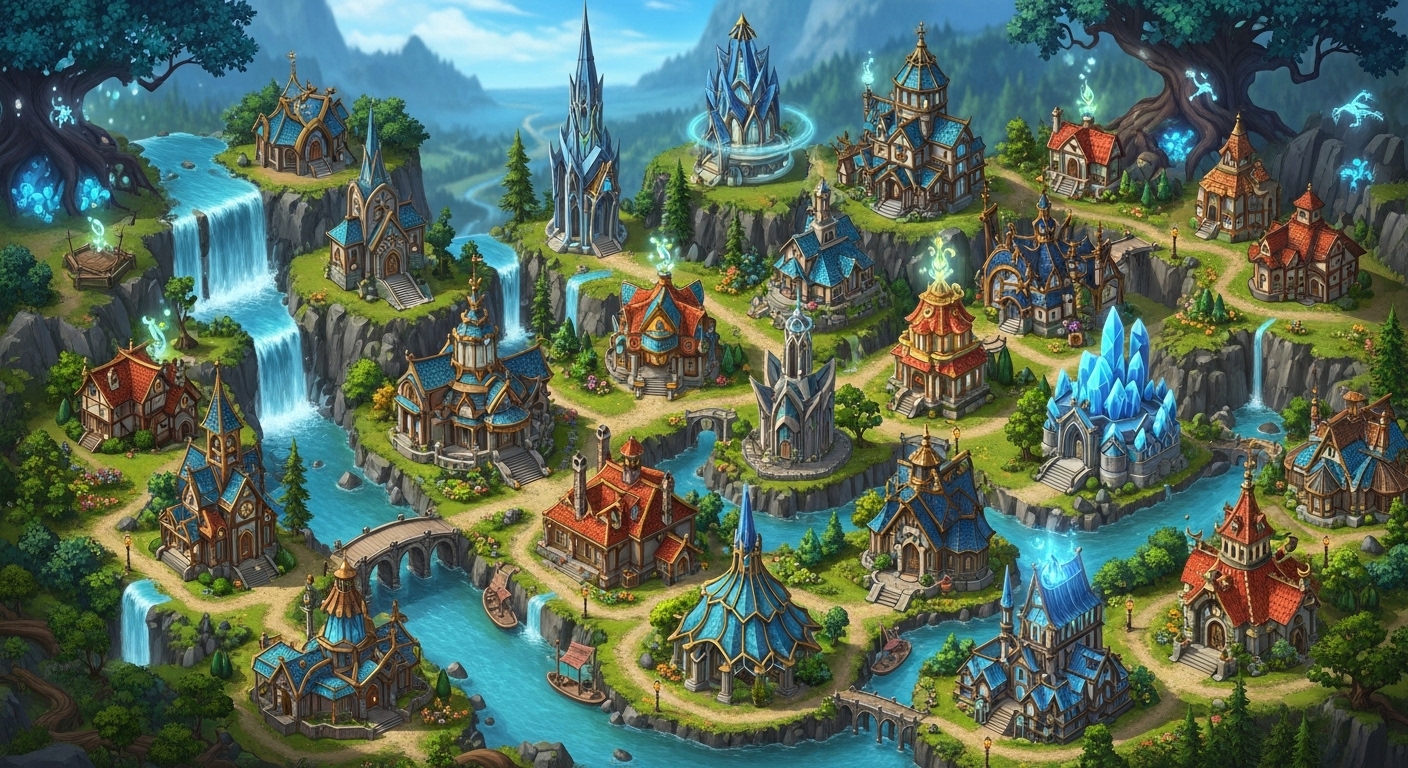
In the mystical world of Elvenar, the Crafting System stands as one of the most powerful yet frequently misunderstood mechanics available to city rulers. Centered within the Magic Academy, this system transforms accumulated resources into valuable buildings, powerful enchantments, and crucial combat boosts. Understanding crafting fundamentals separates efficient players from those who struggle with resource scarcity throughout their journey
.
The Magic Academy: Your Crafting Hub
The Magic Academy serves as the cornerstone of Elvenar’s crafting ecosystem. This specialized building unlocks relatively early in your city’s development and provides three essential functions: researching ancient technologies, crafting valuable items, and disenchanting unwanted materials. The Academy operates on a cyclical schedule, refreshing its available crafting recipes every six hours, creating a rhythm that rewards consistent engagement
.
Upgrading your Magic Academy proves crucial for crafting efficiency. Each level increases the Spell Fragments gained from disenchanting items, with level 5 providing optimal returns regardless of your current chapter progress. A player in Chapter 3 with a level 5 Academy receives identical disenchantment values to someone in Chapter 21, making early Academy investment strategically sound
.
Crafting Resources: Spell Fragments and Combining Catalysts
Two primary resources fuel the crafting engine: Spell Fragments (SF) and Combining Catalysts (CC). These materials work in tandem—virtually every crafting recipe requires specific quantities of both
.
Spell Fragments represent the more abundant resource, obtainable through multiple channels. The Spire of Eternity serves as the primary source, with weekly climbs generating thousands of fragments depending on your progress depth. Disenchanting unwanted buildings, instants, and enchantments from your inventory provides additional fragments, with values scaling based on item rarity and Magic Academy level. A single disenchantment can yield anywhere from hundreds to tens of thousands of fragments
.
Combining Catalysts prove more elusive. These rare materials primarily come from Spire rewards, crafting recipe outputs, and special building productions like the Moonstone Library set, which provides one catalyst daily once fully assembled. The scarcity of catalysts often becomes the bottleneck limiting crafting frequency, making their conservation and strategic deployment essential
.
The Crafting Recipe Ecosystem
Elvenar’s crafting system features dozens of recipes across multiple categories, with availability rotating randomly every six hours. The recipe pool has expanded dramatically over time, now including hundreds of potential options that compete for limited crafting slots
.
Combat Boost Buildings rank among the most coveted recipes. These temporary structures provide percentage-based enhancements to specific unit types—Enlightened Light Range boosts Light Ranged units, Magnificent Mage Multiplier empowers Mages, and Unstoppable Orc Warriors strengthens Heavy Melee forces. These buildings typically last 5-7 days and can stack with other bonuses, creating devastating combat combinations when deployed strategically
.
Event Buildings and Artifacts allow players to acquire or upgrade special structures from past events. Crafting artifacts enables evolving building progression without waiting for event reruns, while complete buildings provide immediate utility. The Chess Set, Gingerbread House, and Mermaid Paradise represent examples of craftable building sets that provide ongoing resource generation
.
Enchantment Recipes create temporary city-wide buffs. Power of Provision accelerates supply production, Magical Manufacturing boosts goods output, and Ensorcelled Endowment enhances coin generation. These enchantments prove invaluable during heavy building phases or when preparing for demanding tournament pushes
.
Resource Conversion Recipes offer economic flexibility. Players can transform excess materials into scarce alternatives—converting surplus coins into supplies, basic goods into sentient goods, or spell fragments directly into combining catalysts. These recipes help balance asymmetric resource accumulation
.
Strategic Crafting Priorities
Effective crafting requires establishing clear priorities based on your current city needs and future goals:
Early Game (Chapters 1-6): Focus on Pet Food for evolving buildings and Portal Profits for guest race advancement. The Moonstone Library set should be your top crafting priority—despite requiring substantial initial investment (over 20,000 spell fragments), it generates 525 fragments and 1 combining catalyst daily once complete, paying for itself in approximately 40 days
.
Mid Game (Chapters 7-12): Transition toward Combat Boost Buildings as tournament participation becomes economically crucial. Enlightened Light Range and Unstoppable Orc Warriors particularly shine due to the “ranged dominance” meta in Elvenar combat. Maintain Moonstone Library production while stockpiling catalysts for high-value opportunities
.
Late Game (Chapters 13+): Prioritize Artifact Crafting for evolving building upgrades and Royal Restoration recipes for building rejuvenation. Combat boost buildings remain relevant, though their relative value decreases as permanent Ancient Wonder bonuses accumulate. Resource conversion recipes help manage the massive goods requirements of advanced chapters
.
The Recipe Rotation Challenge
A persistent community concern involves recipe availability. With hundreds of recipes competing for limited slots, desired options may not appear for weeks. Players report waiting seven weeks or longer for specific combat boost recipes, creating frustration when tournament participation demands immediate enhancement
.
Several strategies mitigate this randomness:
Frequent Checking: The six-hour rotation cycle means four potential opportunities daily. Consistent monitoring maximizes chances of catching desired recipes, though this demands significant time investment.
Recipe Pool Manipulation: Crafting and retaining certain buildings (like the Chess Set) removes them from future rotation, theoretically increasing odds for preferred alternatives. However, with expanding recipe pools, this strategy’s effectiveness remains debatable
.
Diamond Acceleration: Spending premium currency to immediately refresh recipes provides direct access to desired options. This expensive approach suits wealthy players or critical tournament pushes but proves unsustainable for regular use.
Timing Adjustment: Occasionally using diamonds to shift refresh timing ensures cycles occur during your active hours rather than sleep periods, preventing missed opportunities
.
Advanced Crafting Techniques
Master crafters employ sophisticated strategies to optimize their Magic Academy usage:
Disenchantment Optimization: Regular inventory audits identify disenchantment candidates. Portal Profits from evolving buildings like Fire Phoenix (5% every 48 hours = 210 fragments daily when disenchanted) and Trading Outpost provide steady fragment income. Event buildings that no longer serve your city layout convert into substantial resource injections—some players maintain over one million spell fragments through disciplined disenchantment
.
Recipe Profit Analysis: Certain recipes generate net positive returns. The Rainbow Flower Cage costs 300 spell fragments to craft but sells for one combining catalyst after placement—potentially profitable if catalyst value exceeds fragment cost. Similarly, the 6 Catalysts → 2,500 Fragments recipe enables resource conversion when catalysts accumulate excessively
.
Inventory Management: Maintaining diverse building stocks allows instant quest completion and strategic flexibility. Pocket combat boost buildings, resource instants, and miscellaneous structures prepare you for unexpected daily quest demands or sudden tournament pushes
.
Spire Integration: Weekly Spire participation provides the foundation for sustainable crafting. Gold Spire completion generates thousands of fragments and multiple catalysts, enabling consistent crafting without resource anxiety. Players struggling with fragment scarcity should prioritize Spire advancement over other weekly activities
.
Economic Considerations
Crafting represents a significant economic sink requiring careful resource allocation. The Moonstone Library set exemplifies this—while ultimately profitable, its 20,000+ fragment construction cost demands months of saving for new players. This creates tension between immediate needs (combat boosts, enchantments) and long-term investments (passive generation buildings)
.
Opportunity Cost Awareness: Every fragment spent on combat boosts cannot fund Moonstone Library progress. Every catalyst used for minor enchantments delays artifact crafting. Successful players establish clear hierarchies—emergency combat boosts take precedence during tournament weeks, while passive generation dominates peaceful periods.
Scaling Efficiency: As your city grows, fragment generation accelerates through multiple Spire clears, evolving building disenchantment, and Moonstone Library maturation. Early crafting scarcity transforms into late-game abundance, enabling frequent high-value crafting without resource anxiety. Patience during lean early periods yields exponential later returns
.
Common Crafting Mistakes
New players frequently sabotage their crafting potential through preventable errors:
Neglecting Magic Academy Upgrades: Failing to prioritize Academy level 5 dramatically reduces fragment generation from all sources. The upgrade cost pays for itself through improved disenchantment values within weeks.
Impulsive Crafting: Using catalysts on marginal recipes (low-tier enchantments, temporary resource boosts) creates scarcity when high-value options finally appear. Disciplined catalyst conservation enables immediate response to exceptional opportunities.
Ignoring Disenchantment: Hoarding obsolete buildings and unused instants wastes potential fragments. Regular inventory purges maintain liquidity for crafting demands.
Recipe Pool Pollution: Crafting suboptimal buildings “just because they’re available” clutters inventory and potentially blocks better future options. Selective crafting maintains lean, purposeful stocks
.
The Future of Crafting
Elvenar’s crafting system continues evolving. Recent updates introduced artifact crafting for evolving building advancement and expanded building sets with complex recipes. Community feedback suggests desire for deterministic recipe selection rather than random rotation, though developers maintain that randomness preserves game balance and engagement
.
The fundamental crafting loop—accumulate resources through Spire and disenchantment, convert through Magic Academy, enhance city capabilities—remains Elvenar’s most reliable progression path. Mastering this system ensures consistent advancement regardless of spending level, making the Magic Academy truly magical for dedicated players.