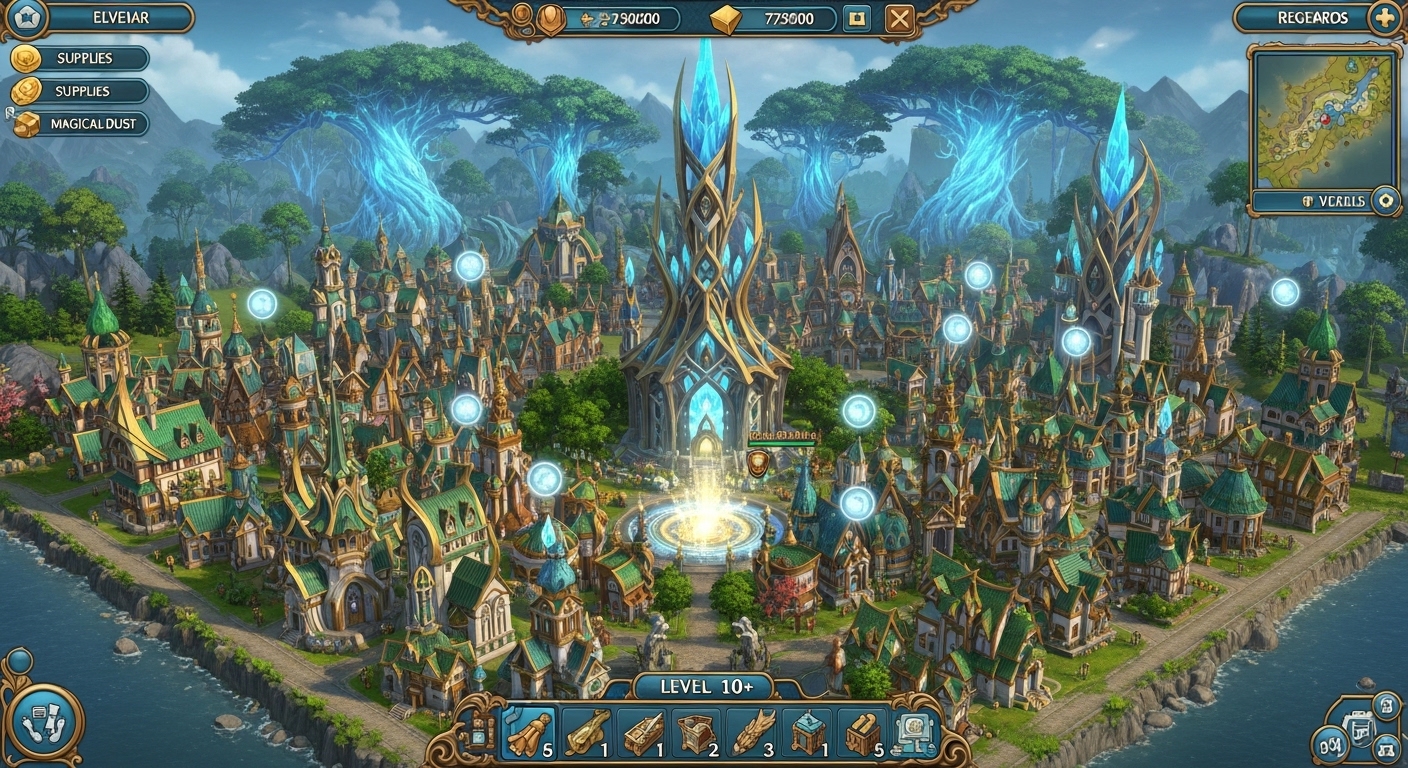
Introduction to Dual Pathways of Conquest
Elvenar presents players with a fundamental strategic choice that shapes their entire gameplay experience: the decision between catering (negotiation) and fighting (combat) as primary methods of province expansion and encounter resolution
. This browser-based fantasy city-building MMO, developed by InnoGames and released in 2015, distinguishes itself from other strategy games through this meaningful choice between peaceful diplomacy and military conquest
. Unlike games that force players down a single predetermined path, Elvenar allows individuals to develop their civilization according to their personal preferences, playstyle, and strategic priorities.
The catering versus fighting dynamic permeates every aspect of Elvenar’s world map gameplay, from the initial province scouts to late-game tournament participation and event quest completion . Each approach offers distinct advantages and disadvantages, requiring different city infrastructure, resource management strategies, and long-term planning. Understanding these differences and knowing when to employ each method—or how to balance both—is essential for any player seeking to maximize their civilization’s growth and prosperity.
This comprehensive analysis explores the intricacies of both catering and fighting in Elvenar, examining their mechanical foundations, strategic implications, economic considerations, and the hybrid approaches that often yield optimal results. Whether you prefer the merchant’s path of peaceful trade or the warlord’s way of military dominance, this guide provides the knowledge necessary to make informed decisions about your civilization’s expansion strategy.
Understanding Catering: The Diplomatic Path
The Mechanics of Negotiation
Catering in Elvenar refers to the negotiation system that allows players to resolve province encounters through resource exchange rather than military engagement
. When a player chooses to cater an encounter, they enter a diplomatic interface where they must offer specific combinations of manufactured goods to satisfy the encounter’s requirements. Success grants control of the encounter point without risking military losses or requiring troop training.
The negotiation system operates on a goods-based economy where each encounter demands specific quantities of manufactured resources
. Early game negotiations might require basic goods like Marble, Steel, and Planks in modest amounts—perhaps a few hundred units per encounter. As players advance through chapters and their squad size increases, catering costs escalate dramatically, with late-game negotiations potentially demanding thousands or even tens of thousands of units across multiple good types
.
A distinctive feature of Elvenar’s negotiation system is the mystery good mechanic, where certain required goods are initially hidden behind question marks
. Players must deduce these hidden requirements through logical reasoning, encounter context clues, or iterative attempts where failed negotiations provide feedback about which offered goods were correct. This puzzle element adds strategic depth to catering, transforming simple resource exchange into an engaging deduction challenge.
Each successful negotiation consumes the offered goods from the player’s inventory and grants immediate control of the encounter point
. Unlike combat, which might result in troop losses requiring replacement time and resources, catering provides instant resolution—assuming the player possesses sufficient goods stockpiles. This immediacy makes catering particularly valuable for time-sensitive objectives or when rapid province conquest is prioritized over resource efficiency.
Infrastructure Requirements for Catering
Building a catering-capable city requires substantial investment in manufacturing infrastructure and resource management systems
. Unlike combat-focused cities that prioritize barracks and military buildings, catering-oriented civilizations emphasize goods production above all else.
Manufacturing Facilities: A catering-capable city maintains high-level manufactories for all good types, not merely those receiving production boosts from collected relics
. While boosted goods production provides economic advantages, relying entirely on trade for non-boosted goods creates vulnerability when negotiation demands require specific resources. Diversified production ensures self-sufficiency for any encounter requirement.
Workshop Efficiency: Since workshops produce the supplies necessary for all manufacturing activities, catering cities prioritize workshop upgrades and efficient production scheduling. Running optimal production cycles—often longer-duration runs that maximize output per supply invested—generates the goods volume necessary for extensive negotiation
.
Storage Capacity: The Main Hall serves as the primary storage facility for both coins and goods, and its upgrade level determines maximum stockpile capacity
. Catering cities require higher-level Main Halls to accommodate the substantial goods reserves needed for advanced negotiations. Hitting storage caps wastes production potential and limits negotiation readiness.
Trade Network Integration: Active fellowship participation and trade network engagement multiply catering capability
. Even with diversified production, maintaining stockpiles of all goods for high-volume catering requires trade relationships that convert surplus boosted goods into needed non-boosted materials. A strong trade network effectively extends your production capacity beyond city limits.
Economic Considerations of Catering
The economic profile of catering differs fundamentally from combat in both resource types consumed and long-term sustainability
. Understanding these economic characteristics helps players assess whether catering aligns with their strategic goals.
Immediate Resource Consumption: Catering consumes manufactured goods immediately and permanently. Unlike combat losses, which can be replaced through training given sufficient time and resources, catered goods are gone forever. This consumption pattern means heavy catering depletes resources that could otherwise fund research, building upgrades, or fellowship trades.
Predictable Costs: Catering costs are known quantities before commitment. Players can see exactly which goods and quantities are required (or deduce hidden requirements through attempts), allowing precise cost-benefit analysis
. This predictability contrasts with combat, where random elements and tactical execution introduce outcome uncertainty.
Scaling Expenses: Catering costs increase exponentially with chapter progression and squad size growth
. Early game catering is economically trivial, while late-game catering can strain even robust economies. This scaling means that catering strategies viable in early chapters may become unsustainable without corresponding economic development.
Opportunity Cost Implications: Every good spent on catering represents a good not spent on research, construction, or trade. Heavy catering can stall technological advancement or infrastructure development by diverting resources from these permanent improvements
. The opportunity cost of catering must be weighed against its immediate benefits.
Understanding Fighting: The Military Path
The Combat System Foundation
Fighting in Elvenar involves turn-based tactical combat where players control military units against NPC forces on hexagonal battlefields
. The combat system employs rock-paper-scissors mechanics where different unit types excel against specific opponents, creating strategic depth through army composition, positioning, and tactical execution
.
The five primary unit categories—Light Melee, Heavy Melee, Light Ranged, Heavy Ranged, and Mage units—form the foundation of combat strategy
. Each category possesses specific strengths and weaknesses: Light Melee excels against Heavy Ranged but struggles against Heavy Melee; Light Ranged devastates Heavy Melee but falls to Heavy Ranged; and so forth through the complex web of relationships that govern battlefield effectiveness.
Combat encounters begin with army deployment, where players arrange their forces within designated starting zones
. Initiative order, determined by unit speed statistics, dictates action sequence throughout combat rounds. High-initiative units act early, potentially eliminating threats before they can respond or seizing advantageous positions that shape subsequent turns.
Battlefield terrain significantly impacts combat outcomes, with forests, hills, and structures providing defensive bonuses, chokepoints controlling movement, and elevation affecting range and damage
. Mastering terrain usage allows inferior forces to defeat superior numbers through positional advantage and tactical sophistication.
Military Infrastructure Investment
Building a combat-capable city requires dedicated infrastructure that competes with economic and cultural development for limited space and resources
. The extent of military investment determines combat effectiveness and shapes overall city strategy.
Barracks Development: The Barracks trains core military units and serves as the foundation of army production. Upgrading barracks unlocks advanced unit tiers with improved statistics and abilities. The Needles of the Tempest Ancient Wonder accelerates training, reducing recovery time between battles
.
Mercenary Camp Access: Beyond standard barracks units, Mercenary Camps provide specialized forces that fill tactical niches or complement standard army compositions. These facilities expand strategic options and allow adaptation to specific encounter types.
Squad Size Research: Military technology research increases squad size—the number of soldiers represented by each unit token
. Larger squads dramatically enhance combat effectiveness, making military research essential for fighting-focused players. This research investment represents a significant Knowledge Point commitment that could otherwise advance economic or cultural technologies.
Training Grounds and Doctrines: Advanced military buildings unlock unit enhancements or special capabilities that modify combat approaches. These investments allow specialization in specific tactics—speed-focused light melee armies, defensive heavy formations, or ranged bombardment strategies.
Ancient Wonder Priorities: Military-focused Ancient Wonders like the Martial Monastery (increasing unit health) and Needles of the Tempest (accelerating training) provide permanent combat enhancements
. Selecting these wonders over economic or cultural alternatives commits the city to military development paths.
Combat Economics and Sustainability
The economic profile of combat differs significantly from catering, involving different resource types, recovery dynamics, and risk patterns
.
Troop Replacement Costs: Combat losses require replacement through training, consuming time and resources. The cost per unit varies by type and tier, with advanced units demanding substantial investment. Unlike catering’s immediate consumption, combat losses create ongoing replacement obligations that can strain training capacity during intensive warfare periods.
Risk and Uncertainty: Combat outcomes involve tactical execution, random elements, and opponent variability that create outcome uncertainty
. Even favorable matchups can result in unexpected losses through poor positioning, initiative disadvantages, or chance. This uncertainty contrasts with catering’s predictable resource costs.
No Permanent Resource Loss: Victory without losses preserves all resources, making efficient combat economically superior to catering. Perfect combat execution achieves objectives without consuming manufactured goods, preserving these resources for research, construction, or trade
. However, achieving consistent perfect execution requires substantial skill and appropriate army composition.
Scaling and Tournament Impact: Combat difficulty scales with squad size and conquered provinces, similar to catering costs
. However, excessive province conquest increases tournament difficulty, potentially making tournament participation harder regardless of whether those provinces were conquered through combat or catering. This scaling affects both strategies equally in tournament contexts.
Comparative Analysis: When to Choose Each Approach
Situational Decision Factors
The optimal choice between catering and fighting depends on multiple situational factors that vary by encounter, resource availability, and strategic priorities
.
Resource Availability: When specific negotiation goods are abundant and not needed for other priorities, catering offers efficient resolution. Conversely, when goods are scarce or essential for research and development, fighting preserves these resources despite its risks and time requirements
.
Time Sensitivity: Catering provides immediate resolution assuming goods availability, while combat requires army deployment, battle execution, and potential recovery time. For time-sensitive objectives—tournament deadlines, event quest completions, or rapid expansion goals—catering’s speed may justify its resource costs
.
Army Strength: Players with powerful armies, advanced unit technologies, and substantial squad sizes often find combat more efficient than catering. A single victorious battle might cost less than the massive goods expenditure required for negotiation, particularly for hard encounters. Weak armies may find catering the only viable option for difficult provinces
.
Encounter Difficulty Assessment: Individual encounters vary in catering costs and combat difficulty. Some encounters are “easy” for one approach and “hard” for the other. Scouting information about enemy compositions and catering requirements allows informed decisions about optimal resolution methods for each encounter
.
Long-Term Strategic Position: Players prioritizing rapid technological advancement might prefer fighting to preserve goods for research. Those focusing on immediate territory expansion might accept catering costs for speed. Tournament-oriented players must balance both approaches based on weekly tournament types and their current military readiness.
Early Game vs. Late Game Considerations
The viability and optimal balance of catering versus fighting evolves significantly throughout Elvenar’s chapter progression
.
Early Game (Chapters 1-5): In early chapters, catering is extremely cheap and combat capabilities are limited by small squad sizes and basic unit types. Most players find catering the default choice for early expansion, as the goods costs are negligible and combat risks outweigh benefits. Military infrastructure investment is minimal, with resources directed toward economic development instead
.
Mid Game (Chapters 6-12): As squad sizes grow and advanced units unlock, combat becomes increasingly viable. Catering costs escalate but remain manageable for most encounters. This phase often sees players developing hybrid approaches, using combat for favorable matchups and catering for difficult encounters or when army recovery is impractical. Military infrastructure becomes a meaningful investment priority
.
Late Game (Chapters 13+): Late-game catering costs become substantial, often requiring thousands of goods per encounter. Meanwhile, advanced military units, substantial squad sizes, and Ancient Wonder enhancements make combat highly efficient for prepared players. Many late-game players shift toward fighting as their primary approach, reserving catering for specific situations where combat is disadvantageous or impossible
.
Fellowship and Social Considerations
Fellowship dynamics significantly influence catering versus fighting decisions through trade networks, collective strategies, and social expectations
.
Trade Network Support: Active fellowships with robust trade networks enhance catering viability by providing access to diverse goods. Players in strong fellowships can maintain catering strategies even with limited personal production by trading surplus for needed negotiation materials. Isolated players or those in inactive fellowships may find fighting more sustainable due to self-sufficiency requirements
.
Fellowship Goods Strategies: Some fellowships coordinate goods production, with members specializing in specific types and trading for others. This coordination allows collective catering capability that exceeds individual capacity. Fighting-oriented fellowships might prioritize military coordination and tournament performance over goods trading.
Collective Tournament Approaches: Tournament participation often requires fellowship coordination, and collective strategies might emphasize fighting or catering based on group capabilities. Fellowships with many combat-focused members might prioritize military tournament approaches, while goods-oriented fellowships might leverage catering for consistent participation.
Hybrid Strategies: The Optimal Balance
The Case for Strategic Flexibility
Pure dedication to either catering or fighting rarely represents optimal play in Elvenar. Instead, most successful players develop hybrid capabilities that allow method selection based on specific situation assessment
.
Capability Maintenance: Maintaining both goods production infrastructure and military capability provides optionality. Even fighting-focused players benefit from goods stockpiles for emergencies, tournament variations, or unexpected negotiation requirements. Similarly, catering-oriented players benefit from basic combat capability for easy encounters where fighting would be more efficient than goods expenditure
.
Encounter-Specific Optimization: Hybrid approaches allow encounter-by-encounter optimization. Easy combat matchups are fought; expensive or risky encounters are catered. This selective approach maximizes resource efficiency and minimizes unnecessary losses or expenditures.
Adaptation to Game Changes: Elvenar receives regular updates, event modifications, and balance adjustments that might shift optimal strategies. Players capable of both approaches adapt more easily to meta changes than those committed exclusively to one path.
Resource Allocation for Dual Development
Developing both catering and fighting capabilities requires thoughtful resource allocation that balances competing priorities without crippling either approach.
Infrastructure Balance: Cities need sufficient manufacturing for meaningful catering and adequate military buildings for combat capability. This often means accepting that neither system will be maximally optimized compared to specialized cities, but gaining strategic flexibility in exchange.
Research Prioritization: The technology tree requires choices between economic, military, and cultural advancements. Hybrid players often prioritize squad size research (enhancing combat) and goods production technologies (supporting catering) while accepting slower progress in other areas.
Ancient Wonder Selection: Wonder choices significantly impact hybrid capability. Some wonders support both approaches—economic wonders that boost goods production also support catering, while certain military wonders have secondary benefits. Selecting wonders with dual utility or maintaining a mix of economic and military wonders enables balanced development
.
Situational Decision Frameworks
Experienced players develop mental frameworks for rapid catering versus fighting decisions that optimize their hybrid capabilities.
Cost Threshold Analysis: Establish personal thresholds for acceptable catering costs based on current goods stockpiles and production rates. Encounters below this threshold are catered; those above are evaluated for combat viability. These thresholds adjust as chapter progression changes economic scales.
Combat Probability Assessment: Develop ability to quickly assess combat difficulty based on enemy composition, terrain, and personal army capabilities. High-probability victories are fought; uncertain or risky encounters are catered or deferred.
Time Value Evaluation: Consider current time availability and urgency. Quick catering resolves encounters immediately; combat requires engagement time and potential recovery periods. When time is scarce, catering efficiency improves relative to fighting.
Common Mistakes and Optimization Strategies
Catering-Specific Errors
Players prioritizing catering often fall into predictable traps that undermine their effectiveness
.
Over-Catering: Defaulting to catering for every encounter regardless of cost creates unsustainable resource drain. Some encounters are objectively better suited for combat due to their catering costs relative to combat difficulty. Selective catering preserves resources for situations where it provides genuine advantage.
Insufficient Goods Diversification: Relying entirely on boosted goods and trade creates vulnerability when negotiation demands require specific non-boosted materials in large quantities. Maintaining at least minimal production of all goods ensures self-sufficiency for unexpected requirements.
Neglecting Military Development: Completely ignoring combat capability creates dependency on catering for all expansion, including encounters where fighting would be trivially easy. Basic military development handles simple encounters efficiently, preserving goods for challenging situations.
Poor Fellowship Integration: Solo catering without trade network support requires massive personal production infrastructure that could otherwise fund city development. Active fellowship participation multiplies catering capability through trade access.
Fighting-Specific Errors
Combat-focused players similarly encounter common pitfalls that limit their effectiveness
.
Under-Investing in Goods Production: Neglecting goods production entirely creates dependency on combat for all expansion. When facing unfavorable matchups, army depletion, or time constraints, inability to cater creates bottlenecks and stalled progression.
Ignoring Squad Size Research: Failing to prioritize squad size research creates persistent combat disadvantages that compound over time. Even with tactical skill, small squads struggle against appropriately-sized enemy forces in advanced provinces.
Over-Aggressive Expansion: Conquering provinces too rapidly through combat increases tournament difficulty and creates army recovery cycles that strain training infrastructure. Measured expansion balances territorial gains with sustainable military operations and tournament performance preservation
.
Tactical Inflexibility: Committing to specific army compositions or tactics without adaptation to encounter specifics leads to unnecessary losses. Combat effectiveness requires flexibility and willingness to adjust approaches based on enemy composition and battlefield conditions.
Economic Management Mistakes
Both approaches suffer from poor economic management that undermines strategic goals.
Opportunity Cost Blindness: Failing to consider what resources could alternatively fund—research, upgrades, trade—leads to inefficient allocation. Every catered good or training resource represents foregone alternatives that might provide greater long-term benefit.
Storage Limitations: Inadequate Main Hall levels create production caps that waste manufacturing potential. When goods production hits storage limits, continuing production wastes resources; when catering demands exceed capacity, opportunities are missed.
Short-Term Optimization: Prioritizing immediate encounter resolution over long-term development creates cycles of reactive play rather than strategic growth. Sometimes accepting temporary slower progress enables superior long-term capability.
Conclusion
The catering versus fighting dynamic in Elvenar represents one of the game’s most compelling strategic dimensions, offering players genuine choice in how they build and expand their civilizations
. Neither approach holds universal superiority; instead, optimal strategy depends on individual preferences, city development priorities, fellowship dynamics, and specific situational factors.
Catering offers predictability, immediacy, and accessibility, particularly for early-game players or those preferring economic development over military management
. Its resource costs create economic trade-offs that must be balanced against other development priorities, and its viability scales with goods production infrastructure and trade network strength
.
Fighting provides potential efficiency, resource preservation, and tactical engagement for those who enjoy turn-based strategy combat
. Its effectiveness scales with military infrastructure investment, squad size development, and player tactical skill. Combat risks and uncertainties create different challenges than catering’s predictable costs, and its sustainability depends on training capacity and recovery management.
For most players, the optimal path lies not in exclusive commitment to either approach but in developing hybrid capabilities that provide strategic flexibility
. The ability to choose catering or fighting based on encounter specifics, resource availability, time constraints, and personal preference creates the most robust and adaptable civilization. This flexibility allows response to Elvenar’s diverse challenges—from routine province conquest to time-sensitive tournaments to unexpected event requirements—with appropriate and efficient methods.