Introduction
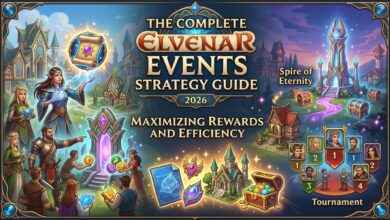
Events represent the lifeblood of accelerated progression in Elvenar, offering exclusive evolving buildings, powerful artifacts, and rare resources unavailable through standard gameplay. Unlike the steady grind of daily city management, events provide concentrated opportunities to dramatically enhance your settlement’s capabilities—but only for players who understand how to optimize their participation. Whether you’re a newcomer struggling to complete your first event or a veteran seeking to maximize artifact collection, this guide covers everything from basic quest management to advanced chest selection strategies that separate casual participants from elite reward collectors.
Understanding Event Structure
The Three Pillar System
Modern Elvenar events operate on three interconnected systems that provide currency for progression
:
Sequential Quests: A fixed series of 70+ quests that advance the event narrative and provide substantial currency rewards. These must be completed in order and typically include tasks like “Produce X goods,” “Collect Y supplies,” or “Win Z tournament encounters”
.
Daily Quests: New quests appearing every 24 hours throughout the event duration, offering additional currency and often featuring more flexible completion options than sequential quests
.
Event Currency Drops: Periodic appearances of event-specific currency (Dwarven Chips, magical ingredients, etc.) around your city that must be manually collected
.
Understanding how these systems interact is essential for maximizing rewards. Sequential quests provide the bulk of early currency, daily quests offer sustained income, and currency drops provide the incremental gains necessary for top-tier rewards.
Currency Collection Optimization
The 4-Hour Collection Cycle
Event currency drops appear at approximately 45-minute intervals with a maximum of 6 visible on your map simultaneously
. This creates a mathematical ceiling: logging in every 4 hours allows collection of 24 currency units per day (6 drops × 4 collections), totaling 504 currency over a 21-day event
.
Strategic scheduling:
- Morning collection (upon waking)
- Midday collection (lunch break)
- Evening collection (after work)
- Night collection (before bed)
Missing collections directly reduces your final currency total and reward potential. For players seeking maximum evolution artifacts, consistent 4-hour logging is non-negotiable
.
The Ashen Phoenix Advantage
The Ashen Phoenix evolving building, available from the Magic Academy, provides +1 event currency to every quest reward when placed in your city
. Over 70+ sequential quests and 21 daily quests, this bonus accumulates to 90+ additional currency—potentially the difference between 8 and 9 artifacts. Players serious about event participation should prioritize crafting this building even at level 0.
Quest Management Strategies
Preparation is Paramount
Successful event completion begins before the event starts. Experienced players maintain “event preparation infrastructure”
:
Reserve Space for Temporary Buildings: Keep 2-3 level 1 workshops and manufactories available for quest completion. These “event shanties” allow quest fulfillment without disrupting your main production chains
.
Scout But Don’t Complete: Leave 2-3 provinces scouted but uncompleted in each ring for emergency “Gain Relics” or “Solve Encounters” quests
. These provide quick completion options when other quest requirements prove difficult.
Stockpile Resources: Maintain reserves of coins, supplies, and goods above normal levels. Events frequently require sudden large expenditures, and running short can stall progression for hours or days.
The Quest List Advantage
Event quests follow predictable patterns, and accessing the full quest list before starting provides massive strategic advantages
. Resources like ElvenGems, iDavis, and community spreadsheets provide complete quest sequences, allowing you to:
- Work Ahead: Prepare production queues for upcoming “Collect X” quests
- Avoid Traps: Prevent premature collection that blocks subsequent quests (e.g., collecting all supplies when the next quest requires supply collection)
- Optimize Timing: Delay certain actions until they appear as quest requirements
Critical example: If quest 15 requires “Collect 4 Wooden Chests” and quest 16 requires “Collect 3 Wooden Chests,” collecting all 7 at once completes both efficiently. Collecting 4 for quest 15, then collecting 3 randomly before reaching quest 16, wastes potential progress
.
And/Or Quest Optimization
Many event quests offer “and/or” completion options—fulfill either condition or a combination
. These provide flexibility when you’re resource-constrained:
- Tournament vs. Province Encounters: Tournament encounters often provide multiple relics, making them efficient for “Gain Relics” quests. However, if tournament tents are exhausted, province encounters or crafting become alternatives .
- Fighting vs. Negotiating: Choose based on your current troop status and goods reserves. Early chapters often favor fighting; later chapters may require negotiation.
Chest Selection Strategy
Efficiency Mathematics
Event progression typically involves selecting from multiple chests/hoops/options, each costing different currency amounts and providing varying progress toward grand prizes
. The fundamental calculation is currency cost per progress point:
- Chest A: 45 currency for 2 progress = 22.5 currency per point
- Chest B: 56 currency for 2 progress = 28 currency per point
- Chest C: 94 currency for 3 progress = 31.3 currency per point
While Chest C might offer attractive secondary rewards (daily prizes, instant troops, etc.), Chest A provides the most efficient progress toward evolution artifacts. Players prioritizing maximum artifacts should almost always select the most efficient progress option
.
The MinMax Game Calculator
For players seeking mathematical optimization, external tools like the MinMax Game event calculator allow custom strategy modeling
. These tools account for your specific reward priorities—whether you value daily prizes, grand prizes, or specific building types—and generate optimal chest selection strategies accordingly.
Evolution Building Strategy
The 9-Artifact Goal
Maximum evolution buildings require 9 artifacts to reach full potential
. Achieving this requires:
- Completing all sequential quests
- Completing all daily quests
- Collecting approximately 80% of available currency drops
- Strategic chest selection favoring progress efficiency
Falling short of 9 artifacts means either accepting a suboptimal building or using Royal Restoration spells to compensate—resources better spent elsewhere.
Building Selection Priorities
Not all evolution buildings are created equal. When events offer multiple building choices (like the Tournament of Magic’s three-discipline system)
, evaluate based on:
Your City’s Needs: Population-starved cities should prioritize population buildings; culture-poor cities need culture generators; military-focused players want troop producers.
Chapter Scaling: Buildings that improve with chapter advancement provide long-term value; static buildings become obsolete quickly
.
Set Bonuses: Some event buildings form sets with powerful synergy effects. Completing partial sets from previous events may dictate current selection priorities.
Advanced Event Strategies
The Trading Post Investment
For players seeking maximum efficiency, purchasing the Trading Post building (available in some events) provides bonus currency on day one of future events
. This represents a long-term investment: spending currency now for increased production in subsequent events. The break-even calculation depends on your expected event participation over the next 6-12 months.
Pet Food and Military Building Timing
For fighters, event timing creates opportunities to stretch premium consumables across multiple tournaments. Military boost buildings last 5 days; placing them strategically allows coverage of two consecutive tournaments
. Combine with Polar Bear (cooldown reduction) and Timewarp (tournament acceleration) for maximum efficiency
.
Crafting Integration
The Magic Academy’s crafting system intersects with events in several ways:
- Spell Fragments: Disenchanting unwanted event buildings provides fragments for crafting Combining Catalysts
- Event Currency: Some crafting recipes offer event currency as rewards
- Pre-Event Preparation: Crafting Moonstone Library sets before events provides steady spell fragment income for quest completion
Common Event Mistakes
- Rushing Through Quests: Completing all sequential quests in the first two days leaves you dependent solely on daily quests and currency drops for the remaining weeks. Pace yourself to maintain steady progression .
- Disenchanting Prematurely: While disenchanting unwanted buildings provides spell fragments, early-game players often regret losing buildings that would have helped city development. Only disenchant when you’re certain you won’t use the building .
- Ignoring Email Verification: Confirming your email at event start provides free currency. Many players miss this easy bonus .
- Neglecting Daily Quest Timing: Daily quests appear on a 24-hour timer from event start, not from your last completion. Delaying day-one completion pushes your entire schedule back .
- Cross-Tier Trading for Quests: When quests require non-boosted goods, resist the temptation to use the Wholesaler’s 50% penalty trades. Instead, post fair trades with your fellowship or discovered neighbors .
Conclusion
Mastering Elvenar events requires understanding the interplay between quest completion, currency collection, and reward optimization. The player who plans ahead using quest lists, maintains consistent 4-hour collection schedules, selects chests based on efficiency mathematics, and prepares infrastructure before events begin will consistently secure maximum evolution artifacts and build a city of legendary power.